
For English death duty research, use the probate court, year and IR 27 folio to identify the IR 26 register; early country courts need a separate route.
Start With the Court, Probate Year, and Folio
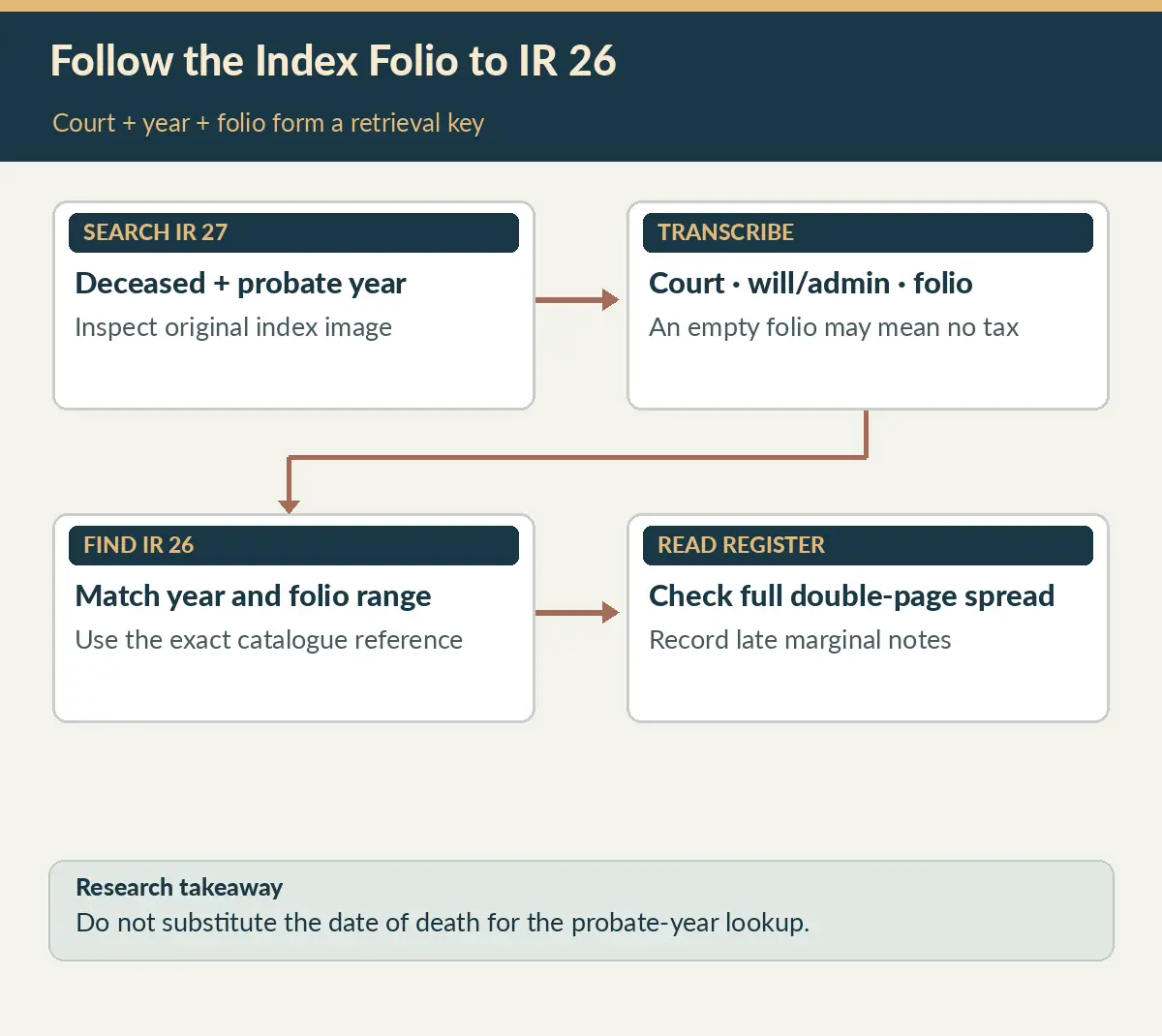
To find a death duty entry, begin with the deceased person’s name and a plausible probate year, inspect the index in Inland Revenue series IR 27, and capture the court, will-versus-administration type, and folio or entry number.
Use those three keys to identify the appropriate IR 26 register in The National Archives’ death duty guide. A surname alone cannot direct you to an exact register page. Death, probate, taxation, and any later annotations may occur in different years. Do not replace an uncertain court reference with a convenient similarly named testator.
Know What the 1796–1903 Series Actually Records
The Inland Revenue kept the registers for assessing legacy, succession, and estate duties, not for preserving a comprehensive family census. Tax calculations drew information from wills and administrations forwarded by probate courts. IR 26 comprises the registers; IR 27 comprises the accompanying indexes.
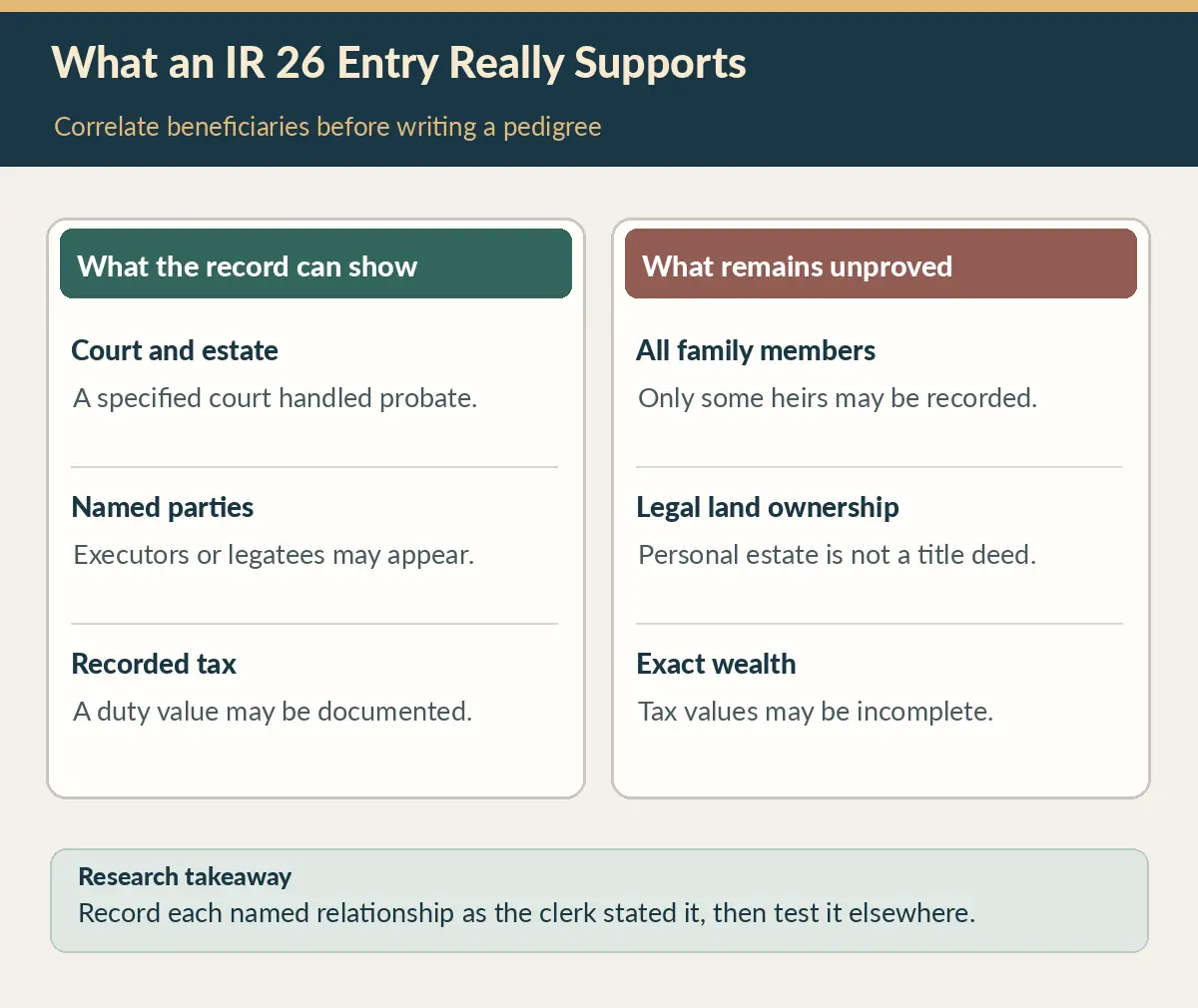
Before 1858, probate jurisdiction was divided among ecclesiastical courts, including the Prerogative Court of Canterbury (PCC) and numerous country courts. That distinction affects how early entries are located. The register may mention legatees, trustees, executors, a deceased person’s occupation, estate amounts, and later changes, but the precise fields depend on the record and period.
Search the Early Country-Court Exception Separately
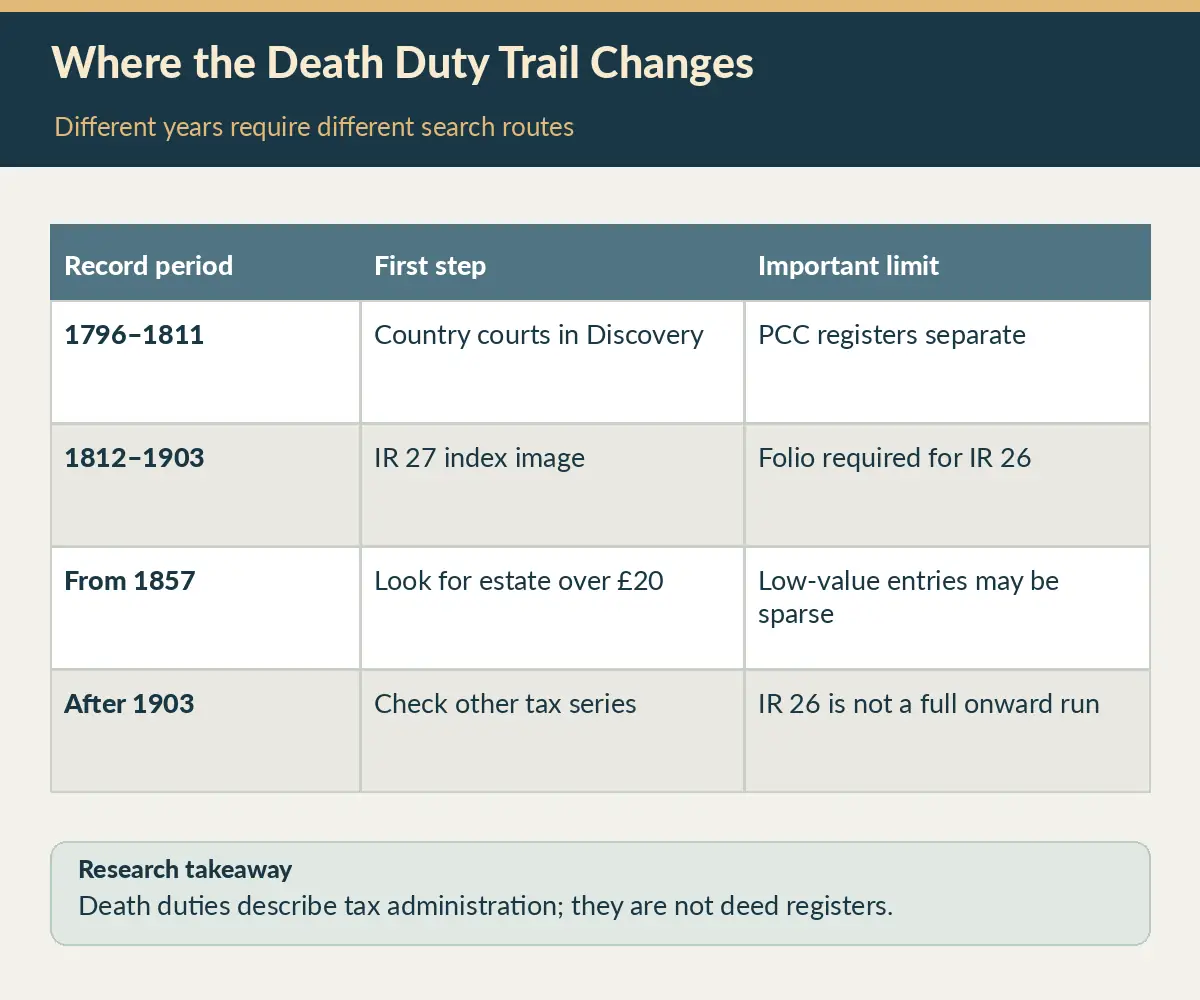
For 1796–1811 country-court death duties, TNA offers a direct catalogue search for surviving digitized registers. Its early country-court guide explains why this route excludes the PCC books and why some local registers no longer survive.
Try the deceased’s name with its likely spelling variations, but also search the appropriate probate date window. Probate might follow the death by several years. Record which courts and counties were checked rather than treating a negative result in a single database as proof no estate existed. The early digital material is only a part of IR 26.
Read IR 27 as a Finding Aid, Not as the Estate
For later registers, TNA points to digitized IR 27 index images on Findmypast, which may require payment or institutional access. Inspect the index image, not only a searchable transcription; the original layout indicates whether the entry represents a will or administration, its court and the register folio.
From 1796 through 1811 the index generally gives an entry number, while later indexes refer to a folio. The index is a signpost to a different record. A missing folio can mean no duty was payable and there may be no corresponding register entry. Never fabricate a folio to force a match.
Locate the Register Volume and Actual Page
Search IR 26 in the TNA catalogue by will or administration and the probate year, then sort or browse references until the stated folio range includes the index number. The relevant IR 26 file may not itself be immediately viewable online: TNA describes reading many registers in its reading room, and certain FamilySearch images have location-dependent access.
A page citation needs the full IR 26 reference, folio and relevant side of the double-page spread, not simply a website search URL. Note that marginal annotations can have been added years after the initial probate entry.
Distinguish Personal Estate, Duty, and Legal Title
For much of this period, the tax record concerns bequests and assessable personal estate, not an exhaustive inventory of freehold property. A figure entered in a register may not represent the family’s net wealth, especially where debts, valuation bands or exceptions apply.
TNA explains that from 1857 estates above £20 were entered but duties often were not collected on those under £1,500, leaving little information in some entries. An executor does not automatically own the house, and a named beneficiary is not automatically the deceased’s child. Use wills, land deeds, probate files, and civil or parish records for each separate claim.
Compare Similar Names Across Two Probate Courts
Suppose two hypothetical men named Thomas Green died in neighboring English counties. One IR 27 entry identifies a country court, another the PCC, both within two years of the death you are researching. Keep two candidate rows instead of choosing the closest date.
Record each index image, court, year, estate description and folio; examine both matching IR 26 references if available. Then compare occupations, executors and independent residence evidence. A matching family forename alone is weak: the same name may occur in many estates. A conflict should remain written in the research log until evidence distinguishes the two.
How We Research Death Duty Cross-References
Our method records the exact repository series and the index-to-register transfer before evaluating relationships. We transcribe the IR 27 heading, folio and court as seen, find the IR 26 document through the catalogue, and independently evaluate who supplied each detail. We separately label a register statement, our inference, and a still-unverified question.
We also check whether a reference points to later accounting material in IR 19 or another succession entry rather than inventing missing pages. The affiliate disclosure explains the site’s editorial transparency; archive searches are not presented as guaranteed free images.
Document a Negative Search Without Overclaiming
If a candidate is absent, record the index database, spelling variants, probate jurisdictions, covered years, and whether the specific early country-court register survives. A missing index hit can reflect an alternate surname, a late probate, a tax exemption or an estate outside this system.
A damaged folio reference is a reason to search neighboring register descriptions, not evidence that the person had no property. If an index exists but a register cannot be consulted, preserve that distinction. Give the next researcher a practical next action: obtain the corresponding will, locate the probate court’s records, or request access to the IR 26 volume.
More Records and Archives Guides
Write a Citation That Can Be Reproduced
Cite the deceased as entered, the probate court and year, IR 27 index details, and the IR 26 volume and folio if examined. State whether you personally consulted the image, saw only a transcription, or relied on a catalogue description. Add the repository and date of access; do not turn an incomplete retrieval into an invented original examination.
Keep the key result narrow: for example, “this register names a legatee” rather than “this register proves that the legatee inherited the family house.” The best next step is independent confirmation of the particular family relationship, asset, or address being investigated.
No. IR 27 is an index; IR 26 holds the registers to which its references lead.
The records are organized around probate or administration, which could follow a death by years.
No. Survival varies, and the digitized 1796–1811 country-court set excludes PCC volumes.
No. It can reflect no duty payable and does not exclude a probate record.
Only if the original entry states that relationship, and even then compare independent records.