
IR 6 preserves Legacy Duty Office incoming letters and copies of outgoing correspondence for 1812–1836. A cross-reference in an IR 26 death-duty register can point into this correspondence, using an entry of the form “Lr 234/16.” That notation identifies a line of administrative inquiry; it does not mean the person named in a letter inherited money or that a disputed payment occurred. Follow the number, year and original correspondence before making a family claim.
Start in the Duty Register, Not With an Assumed Heir
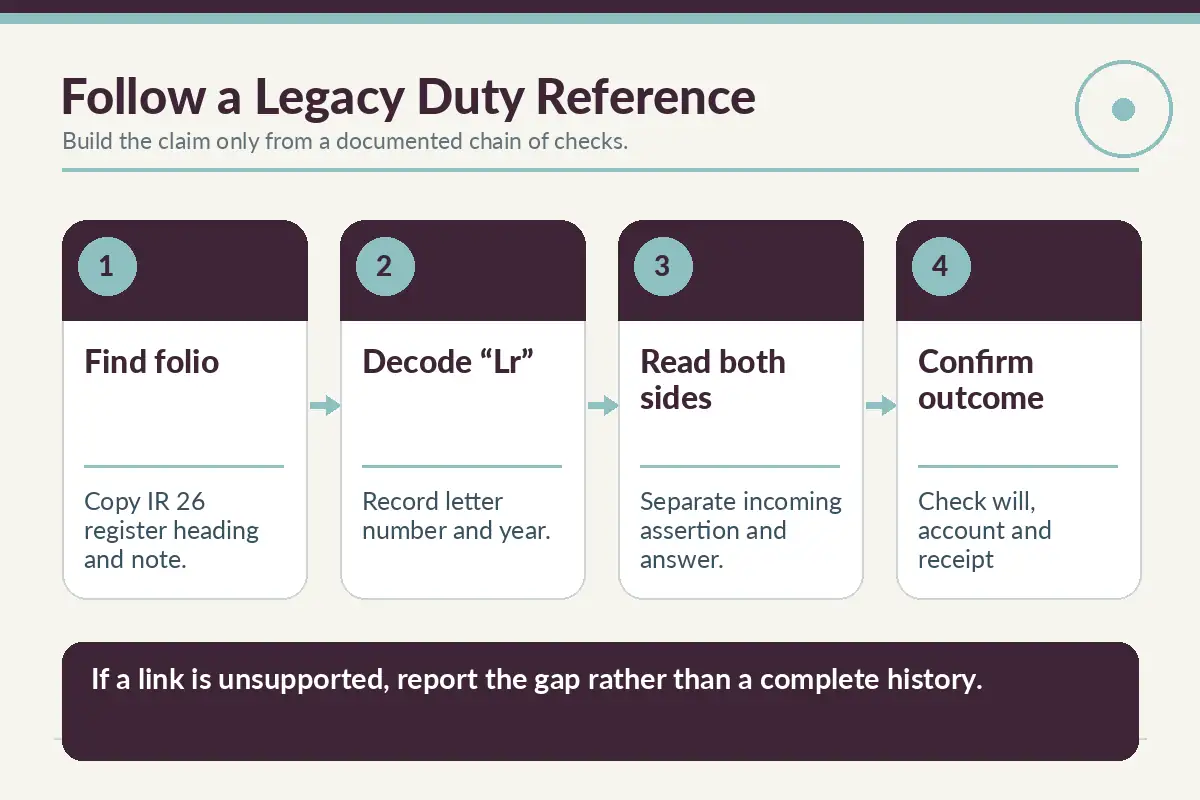
If a family narrative says that an ancestor received a legacy, first separate three events: the death of the person whose estate was administered, the terms of a will or grant of administration, and the actual distribution of the property. A death duty register is a taxation record connected with probate. It can name legatees and executors, but may also record conditional interests and later annotations. One name in a tax register is not sufficient evidence that money reached that person’s hands.
The National Archives identifies IR 26 as the main duty registers and IR 27 as their indexes for the relevant historical system. Search the correct court, date and folio before looking for correspondence. The official guide explains that some register references point beyond the ordinary entry to letters, accounts or other duty material. Record each reference as written. Do not treat a printed index, a register note and the later letter as interchangeable documents.
A useful opening worksheet includes the deceased’s name, probate jurisdiction, will or administration date, estate reference, the register folio and the name or question that prompted the inquiry. Mark family relationships as the register states them, rather than inserting relationships from an online tree. A presumed nephew, for example, could be a trustee, a legatee or an unrelated person with the same surname until a document identifies the role.

Decode the Lr Number and the Letter Year
The official death-duties guide gives an example: “Lr 234/16,” where 234 is a letter number and 16 means the year 1816. This points to in-letters to the Legacy Duty Office and copies of letters sent out, found in IR 6. The stated surviving period is 1812–1836. A user should not read the notation as a money amount, a register page or the year in which the will was necessarily signed.
Use the year and letter-number range in the IR 6 catalogue to locate the relevant piece. Its storage and ordering arrangements are not the same as a digitized newspaper index: The National Archives warns that IR 6 documents are stored offsite and require advance production. Check current instructions rather than promising instant image access. When the letter is obtained, note whether it was received by the office, copied as an outgoing reply, or attached to another inquiry.
Keep dates in separate fields for document creation, receipt, copying and any event described retrospectively. A letter written several months after a death may quote an earlier will or report a later tax assessment. If a query remains unresolved in the surviving correspondence, say so. The presence of an official exchange proves that an issue was raised and handled administratively to the extent recorded, not that either party’s preferred version was accepted as final.

Keep Statements, Rulings, and Payments Apart
A solicitor’s or executor’s incoming letter may assert kinship, the amount of a bequest or a claim to an exemption. That is evidence for what the sender argued, not automatically evidence that the claim was accepted. An outgoing office reply may request documents, explain a rule or propose an assessment. Look for its actual terms and any subsequent response before describing a resolved dispute. Administrative language can be compressed, so quote only essential phrases and retain the complete citation.
The tax context matters. The official guide distinguishes legacy, succession and estate duties and explains how the relationship of a recipient to the deceased could affect the rate payable. A family relationship in a duty register may be a category used for a tax calculation, not a stand-alone birth or baptism record. Treat even a stated son or daughter as a valuable clue whose parentage should be corroborated in civil or parish records where available.
A recorded assessed amount, a note about duty paid and a beneficiary’s actual receipt are separate claims. To confirm payment, look for an explicit receipt, an account or an independently preserved estate paper. To confirm a bequest’s terms, compare the original will or administration documentation. A document can be correct about taxation while being incomplete about how trust conditions, delays or litigation affected a particular descendant.
Explain Gaps in Survival and Correspondence
The IR 6 surviving letter sequence ends in 1836 according to the National Archives guide. Do not search it as a complete set of later Victorian estate correspondence. When an IR 26 register contains an annotation later than that span, identify the relevant alternate series instead of extending IR 6 dates. A failed name search may also result from the filing scheme being year-and-letter driven rather than fully indexed by recipient name.
Make negative evidence narrow and reproducible: record the date span, piece descriptions and ranges consulted; the letter number sought; and whether the piece was actually inspected. If it was unavailable or offsite, say “not yet examined,” not “missing.” A lack of a surviving later letter does not prove that no dispute took place. Separate preservation loss from a genuine documentary contradiction between two extant records.
A defensible summary is: “The IR 26 register cites an IR 6 Legacy Duty Office letter dated within 1812–1836. That correspondence documents an inquiry about an alleged entitlement, but independent proof of kinship and final payment has not yet been found.” This provides a useful route for descendants, probate researchers and local historians without converting an administrative question into a completed inheritance story.
More Records and Archives Guides
How We Research Legacy Duty Correspondence
We rely on The National Archives death-duties guide for the exact IR 26 → IR 6 notation, date limits, letter-number interpretation and offsite access note. The Discovery guide explains piece-level search logic and the taxation officers guide offers institutional context.
Our illustrated letter and seals are historical-inspired teaching images, not facsimiles of a named estate case. We keep the allegation, answer and proven payment as different categories. See the affiliate disclosure for the site’s relationship policy.
The National Archives identifies surviving Legacy Duty Office letters and outgoing copies in IR 6 from 1812 to 1836.
The official guide uses 234 as the letter number and 16 as the year 1816; it is a finding reference, not proof of payment.
Start with the relevant IR 26 duty register and its cross-reference, which may have been found through an IR 27 index.
No. Determine whether the name appears in an allegation, administrative answer, assessment or actual receipt; seek independent estate evidence.
Do not assume so. The National Archives notes that the series is held offsite and needs advance production; verify current access options.