
AIR 1 is an unusually varied group of papers about First World War military aviation. It includes Royal Flying Corps (RFC) squadron, wing, brigade, and headquarters material as well as papers of officers and related flying organizations. It is not a complete set of individual flying logbooks. Search by a unit and date first, then ask whether a named person can independently be placed there. The RFC existed from 1912 until its incorporation into the Royal Air Force on April 1, 1918; its naval wing became the Royal Naval Air Service in July 1914.
Identify the flying service and the right date
That chronology matters because similar words such as “flying service” can refer to different administrative bodies. The National Archives RAF operations guide describes AIR 1 as an extensive and mixed collection, including material outside strictly operational reports. A catalogue hit for an officer’s name may be a memorandum, a roster, or correspondence rather than evidence of a sortie. Put the date, service, unit, and kind of paper at the top of the research worksheet before making any claims.
Search AIR 1 by squadron, wing, and headquarters
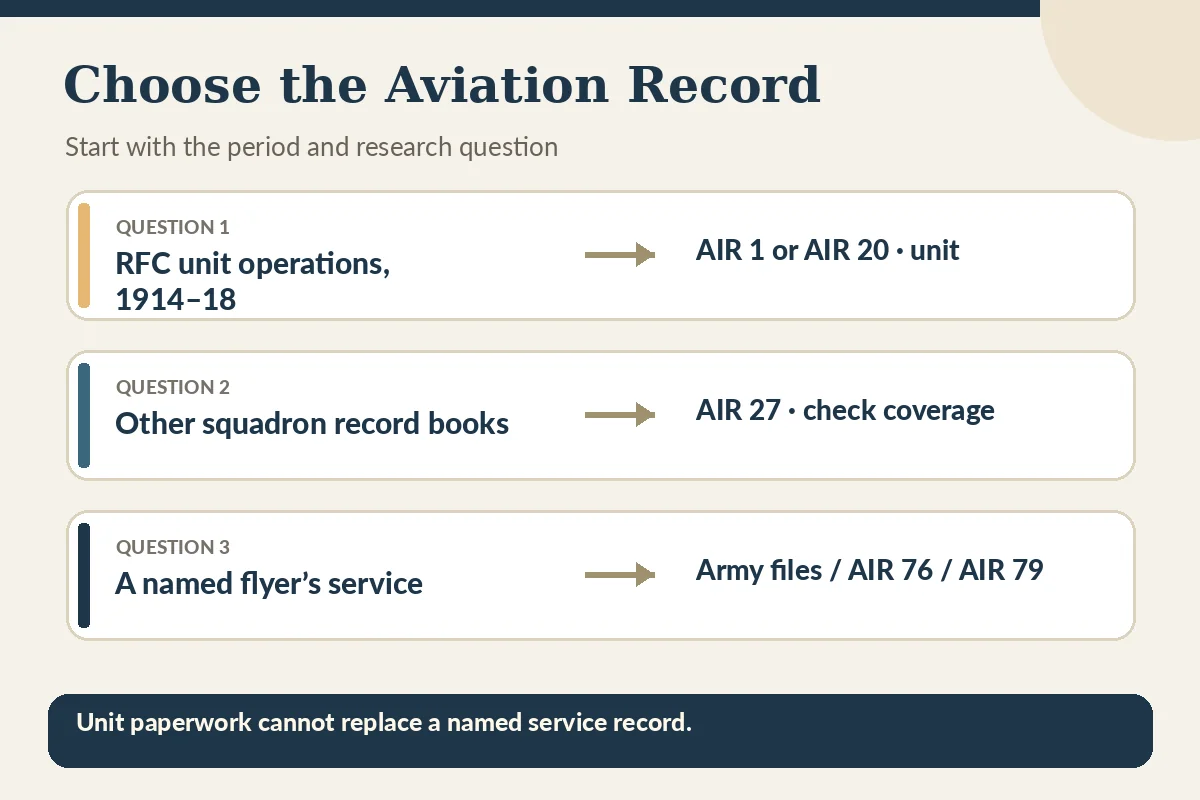
Try the squadron number with “R.F.C.” or the full phrase “Royal Flying Corps,” and repeat the search using wing or brigade numbers where the command structure is known. Also test an airfield, theatre, and officer name as alternative keys, restricting dates to the episode in question. The army operations guide directs researchers to AIR 1 and AIR 20 for RFC unit war diaries. Other aviation operational material can survive in AIR 27, so a missing hit in AIR 1 does not prove that the squadron never flew.
Record a catalogue piece’s exact title and date span. A large file might cover a brigade headquarters rather than one squadron, or contain correspondence assembled after a flight. If a description names a location, check when the relevant squadron was there; station assignments can change during the period covered by a file. Never turn a general theatre label into proof of a specific aerodrome. Search variants and spelling abbreviations, but do not manufacture a precise operational diary where the archive only describes miscellaneous papers.
Read the report as an administrative document
Operational paperwork may describe reconnaissance, escort duties, weather, aircraft availability, casualties, formation changes, and orders. These statements can be direct evidence that an activity was reported or that an order was issued. They do not automatically identify every pilot, observer, mechanic, or aircrew member who took part. Even a named officer on a distribution list may have received a document without flying the mission described in it. Treat after-action reports, routine orders, and plans as different classes of record.
Write a sortie ledger with the report date, event date, unit, aircraft reference if stated, named crew if stated, source piece, and a confidence note. An aircraft number appearing in a report may require comparison with aircraft record cards or squadron records elsewhere. A phrase such as “our machines returned” is not evidence about one ancestor. If precise movement matters, compare the AIR 1 description with the pages themselves, note whether the file contains originals or copies, and identify any appended reports whose survival is incomplete.

Separate a squadron’s location from someone’s service
A service record, not a squadron location map, should anchor a person to a period of service. The National Archives’ RFC airmen guide explains that some men’s service is found in Army series WO 363 or WO 364, while those who served in the RAF after April 1918 may appear in AIR 79; officers have separate routes that include AIR 76. Not all records survived and search access varies. Match service number, rank, unit, and dates rather than relying on a shared surname.
Suppose a squadron report records a reconnaissance flight on June 10 while a family letter says an ancestor served with that squadron “that summer.” The report establishes an operational event and the letter suggests a connection, but neither places that particular person in the aircraft. Find a dated posting, casualty record, roster, or named sortie entry. Then state the narrowest proved conclusion. A photograph of a biplane at the same airfield is contextual evidence, not an identification of everyone who flew from there.
Keep administrative gaps and chronology visible
AIR 1 may have material assembled across different administrative levels and dates; there is no guarantee of one diary for every squadron, campaign, and day. Some early RAF files cover a transition from Army organization, while others mention associated Australian or South African formations. Avoid assuming that a unit number uniquely identifies the same formation across all years or that one report tells the complete story of an operation. Where a report cites an order, attached map, or signal that is missing, cite the reference and mark the attachment as not seen.
Build a timeline in parallel: unit formation and transfers, recorded airfield, dates of the documents, and separately documented personal postings. If a squadron became part of the RAF, do not silently apply the later name to earlier events. An exact date and attribution make a modest sentence about unit activity more useful than an unsupported story about an ancestor’s combat mission. A negative search is limited to the catalogue and terms checked, not the whole surviving archive.
Consider a squadron that was ordered to conduct patrols on a certain morning while a roster places an airman with the unit that month. The order confirms a plan and the roster establishes a posting, but neither shows that the man personally flew that patrol. A dated crew list or report naming him would strengthen the case. This example illustrates why operational events and personal service must remain separate entries in the research timeline.

More Records and Archives Guides
How We Research Early Aviation Records
We verify the air arm and date before consulting AIR 1. We search both unit and command-level descriptions, record document dates distinct from event dates, and cite the specific record rather than a blanket series reference. To assess an individual’s claimed service, we look for named evidence in the appropriate Army or RAF service records. If a flight cannot be attributed to a person, we describe the squadron’s activity without inventing that connection.
Our diagrams use different paths for the early RFC, transitional RAF, and separate personnel files; the paths are alternatives, not a guaranteed chronology for every aviator. We note inaccessible or missing attachments rather than drawing conclusions from absence. For how we handle links and disclosures, see GenHis affiliate disclosure.
No. It contains a broad mix of squadron, command, officer, and administrative papers; individual flight logs are not guaranteed.
On April 1, 1918, the RFC and RNAS merged into the newly established Royal Air Force.
Only when the report specifically identifies them and the identification is sound; otherwise seek individual service evidence.
Search alternative unit wording and related AIR 20 or AIR 27 material, noting scope and surviving coverage.
Depending on dates and rank, check surviving Army records and RAF service series such as AIR 79 or AIR 76.