
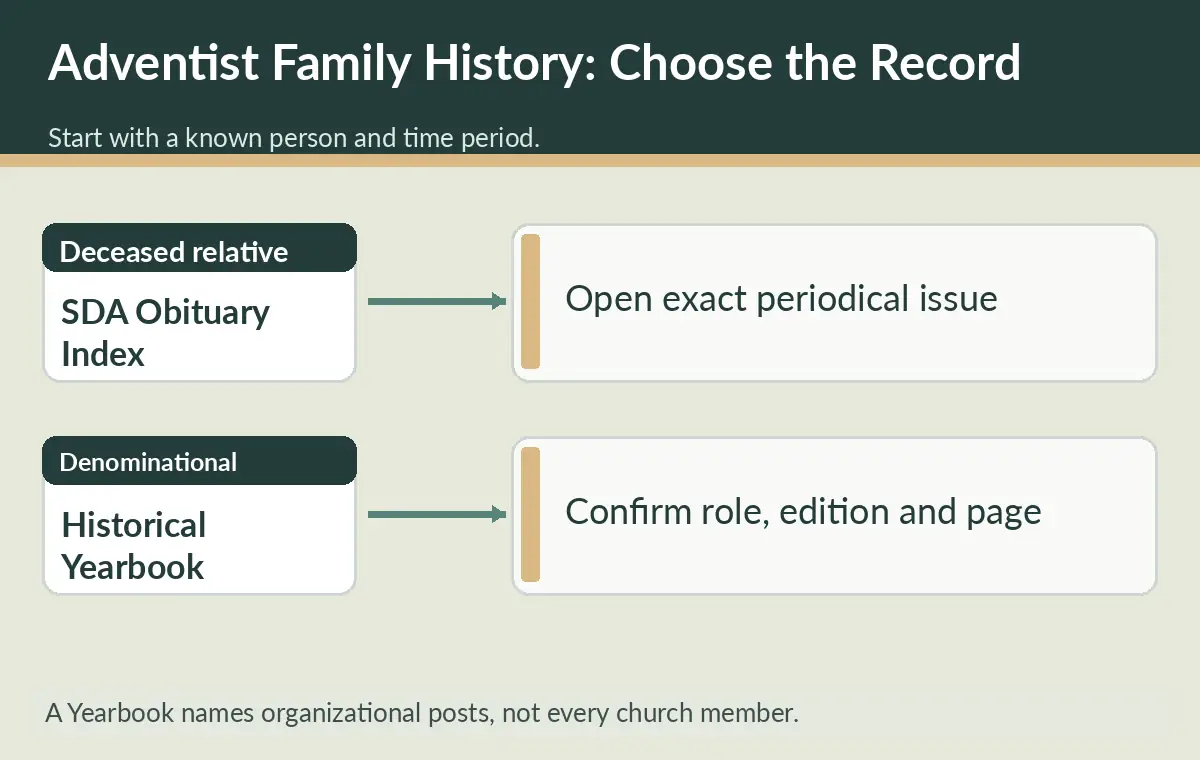
Researching a deceased Seventh-day Adventist relative begins with the right kind of denominational record. The official General Conference Archives family-history FAQ suggests the Seventh-day Adventist Obituary Index, followed by the original periodical issue; for people employed by the denomination, it recommends historical Adventist Yearbooks. Those are different documentary trails. An obituary can report family details, a yearbook may document an institutional role, and a local church record may document an event—none proves a full lineage by itself. Begin with a known person and approximate date, record the source of each result, then test parent and spouse claims in independent civil or church records.
Search the denominational obituary index first
Use the link from the Adventist Archives genealogy instructions to the Seventh-day Adventist Obituary Index. Search confirmed surname variants and given names rather than filling every search field with assumptions. If you obtain a hit, copy the periodical title, publication date, issue identifier, and page details provided. An index entry can point to an obituary without supplying the original wording. Avoid claiming it proves a marriage or parentage unless you have read what the obituary actually says and assessed the likely reporter’s knowledge.
An obituary notice may appear long after death and may omit estranged or deceased relatives. Distinguish its death date, publication date and any memorial-service date. If two obituary entries share a name, compare residence, stated age, ministry or school connection, and family members. Consider whether one relates to a person who moved to a different country. A matching surname and Adventist association are not enough to merge identities. Keep the citation to the obituary index separately from the citation to the periodical image you later inspect.
Locate the periodical issue and read its surroundings
The General Conference Archives hosts digitized periodicals at its periodical collection. Its search guidance says to select a named periodical and filter by the year when the issue is known. Open the specific issue rather than trusting a result snippet alone. A notice can continue on another page, include an editor’s correction, or use an abbreviated name. Copy literal birthplaces and stated relatives into a claim table, but label the information as obituary reporting rather than as original civil registration.
If an issue is missing from the portal, the archives’ missing-periodical FAQ lists several possible causes: an undigitized periodical, an unavailable physical issue or an upload omission. That is an access and coverage uncertainty, not proof a person never appeared. Look for the Adventist Digital Library or ask the archives about the particular publication and date. Preserve the scope of the search, including which issues you actually inspected, so a later discovery can revise the conclusion without reconstructing the whole search.
Use historic Yearbooks for organizational roles
The archives say historical Seventh-day Adventist Yearbooks are useful for people employed by denominational bodies. A Yearbook listing may give an institution, post or location for a particular edition; it should not be mistaken for a membership roll of all Adventists living in the area. Start with years supported by correspondence, a memorial notice or employment records and compare successive editions. Some people moved between institutions and missions, and a title may change without indicating a family move. Record the edition year and exact page each time.
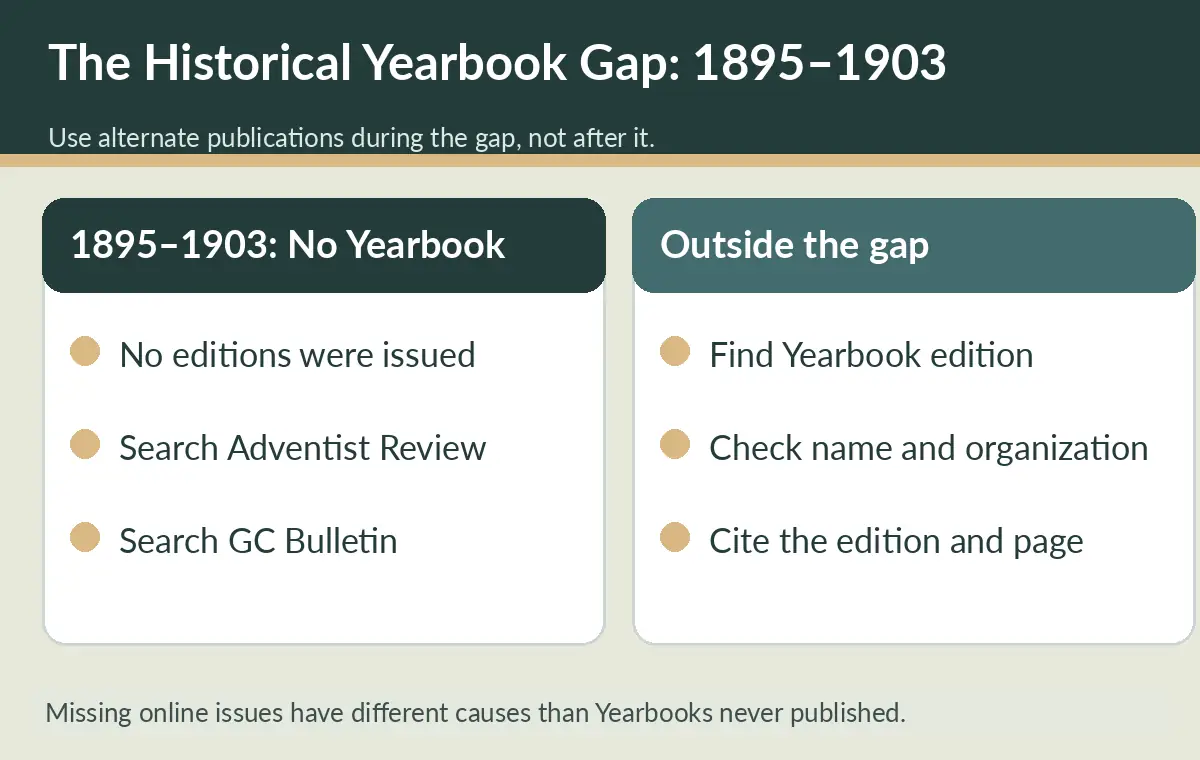
The General Conference explains that no Yearbook was published in the years 1895–1903. Do not create false negative evidence by treating the gap as lost digitized pages. The archives recommends looking for comparable organizational details in the Review and General Conference Bulletin for those years. A name in a Yearbook may help place a minister or teacher in a service context, but does not on its own prove ordination, every appointment, a household residence or a child’s birth. These require other sources appropriate to the claim.
Identify the correct institutional and local custodian
General Conference digitized publications are an excellent starting point, but not every congregation’s baptism or membership book is held there. The Center for Adventist Research at Andrews University describes extensive books, church periodicals, directories, record books and historical holdings. Check a repository catalog before contacting staff, and give the exact church, conference, person and date range. Ask whether the collection is open, restricted or not deposited; do not demand information about living congregants or private membership changes.
Religious-affiliation clues in a newspaper or family memoir should be tested against a named congregation or contemporaneous publication. A church may have merged, moved or changed regional conference affiliation. A modern website for that congregation is not necessarily the historical custodian of century-old records. Follow the ownership trail through local church, conference, institutional archives and relevant university collections as the available finding aids indicate. Record the location and access status of each candidate source before using its absence to support any family-history hypothesis.
Compare denominational reporting with government records
Imagine an obituary calls a deceased missionary ‘a native of Michigan’ and lists a spouse and two children. That phrase may identify a long-term association, birthplace or family origin depending on wording; it is not automatically a precise place of birth. Compare the reported death date with a historical civil death certificate where legally available, and compare the marriage relationship with a marriage record or contemporary household return. Note whether children are described as surviving, stepchildren or relatives by marriage. Preserve the obituary’s exact terms when the relationship is uncertain.
An official periodical may still reproduce a correspondent’s erroneous age, misspelled name or retrospective story. Grade each assertion separately: the person’s publication appearance is directly documented, while the claimed parentage may be secondary reporting. If another individual of the same name worked at an Adventist college, create separate candidate rows with job title, publication date and known addresses. Do not join two people simply because an obituary and Yearbook share a rare surname. A documented institutional role is useful context, but an identity conclusion needs converging evidence.

Document a missing issue rather than invent a complete search
Build a source log with rows for obituary-index query, exact periodical issue, Yearbook edition, local archival finding aid and independent civil record. In the result field distinguish ‘person not found’, ‘issue not available online’, ‘collection not known to survive’ and ‘page inspected without name’. These are fundamentally different outcomes. An online search limited to one OCR form is especially weak negative evidence when older scans contain faded type or variant initials. Browse dated issues manually where the source is available and the target date is sufficiently narrow.
A clear citation to a digitized periodical includes title, date, issue number if printed, page, archive and stable URL. A Yearbook citation adds edition, organization and page; a church record citation requires the specific congregation, record book and custodian. If you were unable to inspect an alleged register, avoid quoting it through a later family tree as though you saw the page yourself. State the access barrier and the next question for the custodian. That transparency is more valuable than an attractive but uncheckable denominational pedigree.
More Records and Archives Guides
How We Research This Collection
We follow the General Conference Archives’ own family-history route through the Seventh-day Adventist Obituary Index, original periodical issues and historical Yearbooks. We confirm the documented 1895–1903 Yearbook nonpublication interval and compare archival access notes with the Center for Adventist Research’s holdings guidance. Obituary family claims, employee listings and local church records are evaluated as separate source classes. This guide does not infer anyone’s religious affiliation from a surname or discuss private living members. Our affiliate disclosure explains general link policy; these archive references are not sponsorship claims.
The General Conference recommends starting with the Seventh-day Adventist Obituary Index and locating the original periodical notice.
No. They are organizational directories, particularly useful for people in denominational employment.
The church did not publish Yearbooks in 1895–1903; consult the Review and General Conference Bulletin for comparable institutional information.
The archives notes possible gaps in digitization, surviving copies or uploads. Do not equate that gap with no historical notice.
It may report one, but corroborate the specific claim with an independent birth, marriage, church or other contemporary source.