
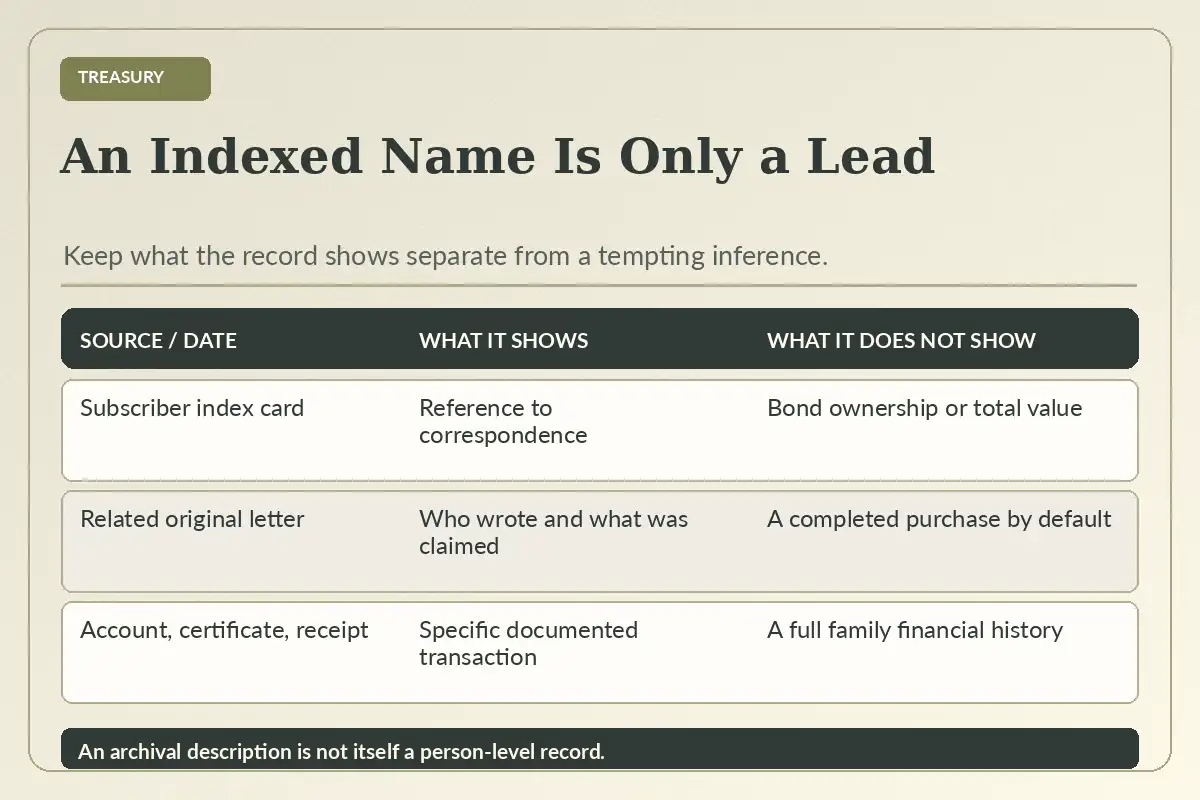
A name in an old Treasury subscriber index is a promising lead, not automatic proof that a relative held a bond or received interest. The National Archives’ guide to Record Group 53 identifies a card record and index to correspondence concerning subscribers of loans in 1898–1900. The exact scope is correspondence indexing: it can point a researcher toward a subject or communication. It cannot, without further documentation, establish the size, duration or ownership history of an investment.
The NARA RG 53 guide also describes public debt ledgers, correspondence of the Register of the Treasury and records relating to specific loans. These holdings answer related but different questions. For a family-history problem, start by writing whether you need to establish a name in the index, locate a letter, show a financial transaction or prove a legal owner. A single surname can occur in several records without referring to the same person.
Locate the 1898–1900 Subscriber Index
NARA lists the card record and index within section 53.2.1, correspondence connected with the public debt. Begin with that precise section rather than a broad search for every Treasury bond. Note whether the entry is an index reference, a card record or an original letter. The finding aid does not promise an online card image for each name. Request a specific filing method or index arrangement if the catalog description does not tell you how the cards are ordered.
Preserve full names, initials and any spelling variation before identifying a person. A surname that appears once in a national administrative index could refer to a correspondent, intermediary or another party named in a letter; interpretation requires the actual item. Copy the date, reference symbol, possible agency office and subject verbatim. Record uncertainty about ink, abbreviations or illegible numerals instead of quietly expanding them into a convenient financial narrative.

Move From the Card to the Letter
The card is useful principally because it may lead to correspondence. Follow any register, letter number or filing key to the source document. Read the sender, recipient, subject, location and dates before deciding whether the individual was subscribing, asking a question or acting on behalf of an institution. An agency might index a communication under a subscriber’s name without preserving a separate bond ledger for the same person in the same folder.
Use a source ladder: index reference, original communication, related account or certificate. The original letter can confirm words exchanged or a request submitted, but it may describe an intention that never resulted in a transaction. Distinguish “asked to subscribe,” “sent payment,” “received a certificate” and “was paid interest.” Each is a different claim. A researcher who collapses these into “owned government bonds” loses important evidence and may create a false family biography.
Separate Treasury Offices and Loan Years
RG 53 covers many older and later public debt records. Section 53.4 concerns the Office of the Register of the Treasury and separately notes correspondence about the loan of 1898. That does not mean all material in 53.2.1 belongs to the Register’s series or that a correspondence index must match a ledger in a one-to-one fashion. Follow the archival creator, record type and date before crossing from one section to another.
The archive also describes records of the Division of Loans and Currency and older state loan offices. Their dates, arrangements and functions differ. Avoid presenting an 1898–1900 name as a 1917 Liberty Loan subscriber or a holder of early federal securities merely because both terms involve government borrowing. Include the exact loan designation only when the original record supplies it. Broad RG-level similarity is a lead for further searching, not proof of continuity.
Resolve Two People With the Same Name
Financial correspondence can be especially difficult when an index card gives initials without an address. A complete identity match needs independent anchors such as residence, occupation, business affiliation, spouse, firm name or a reliable signature. Compare these details with census and directory evidence dated near the communication. If those anchors are missing, preserve two candidate identities rather than choosing the ancestor with the familiar surname.
Watch for institutional subscribers and agents. A person signing for a bank or company may appear in an index, but a signature in an official capacity need not imply personal investment. A letterhead may identify the sender’s place of business, not their home. Normalize addresses only after saving the original wording; a street number can change and two cities can share a business name. The disciplined result may be “name match not established,” which is more accurate than a claimed financial legacy.
Test Claims About Payment and Redemption
Even a proven subscriber may have redeemed or transferred a security, and an index card does not settle which happened. Search separately for an account entry, issued certificate, payment receipt or transfer entry that documents the specific action. The RG 53 guide names several kinds of account and interest records, but the existence of these series does not guarantee a linked surviving item for every correspondent. State which transaction has actually been evidenced and which remains conjecture.
A family anecdote that a great-grandparent “financed the war” may be based on a letter, a subscription campaign or an inherited bond. The source needed depends on the wording of the claim. For an amount, you need the transaction record or another reliable dated source. For ownership, you need a named holding and sufficient identifying context. For later payment, look for a payment or redemption document. A general patriotic advertisement or indexed surname proves none of those details.

Write an Auditable Financial Record Citation
Use a citation that identifies National Archives RG 53, the section and series, card or letter reference, full document date and repository. For any later account record, cite that item separately. NARA’s copy guidance can help once the correct series and item notation are known; it does not mean that an online name search retrieves the full correspondence automatically. Do not invent a bond serial number or account value when the consulted guide does not list one.
A careful final statement might say that the archival index contains correspondence under a stated name during 1898–1900 and that the writer’s identity and financial action await examination of the referenced letter. If an original communication and account entry have been obtained, report each fact with its own citation. This narrow approach can recover a real family connection without overstating what a card index, standing alone, was created to record.
How We Research the Sources and Separate Claims
This article uses the exact holdings descriptions at the National Archives and cross-checks research practice against the additional reference resource. The cited date range and quantity refer to archive descriptions, not a claim that every item has been read or digitized. We distinguish records explicitly described by the custodian from possible details that require consulting individual documents. Before relying on a personal identification, we require an independent source addressing the same person, place and time. Our affiliate disclosure explains our editorial and commercial transparency; no paid relationship is asserted for these archives.
More Records and Archives Guides
Frequently Asked Questions About These Records
No. It points to correspondence; ownership or payment requires separate transaction evidence.
NARA describes the card record and correspondence index for 1898–1900.
Follow the original correspondence reference and then any appropriate account records.
No. WWI Liberty Loan records belong to a different period and series within broader RG 53.
Compare address, occupation, firm and signature against independent period records.