
Queensland makes historical births, deaths and marriages searchable through an online government index, but free search and document access are different steps. The Registry of Births, Deaths and Marriages says historical images must be purchased, while a purchased certificate is sent through the post. Its records extend back to 1829, although the region’s later legal and administrative boundaries matter. This article shows how to use the index efficiently, what the result does not establish, and how to decide whether an original image is worth ordering. All example names are fictional and historical, not live-person investigations.
Check that the life event belongs in Queensland records
First establish an approximate event date and place. Queensland’s historical registry holds records going back to 1829, although the separate colony of Queensland was not created until 1859 and the earlier territory was administered by New South Wales. Do not assume the place printed on a modern family tree uses the jurisdiction that existed when the event occurred. Write down the contemporary settlement name, any alternative spelling and a date interval. If the family moved between Queensland and New South Wales, determine which locality hosted the event rather than using the place where the person was found years later. This prevents an unsuccessful query in one registry from being mistaken for a missing registration. Our guide “South Australia Historical Birth, Death and Marriage Records” goes deeper into a research workflow.
Run a free index search before ordering a record
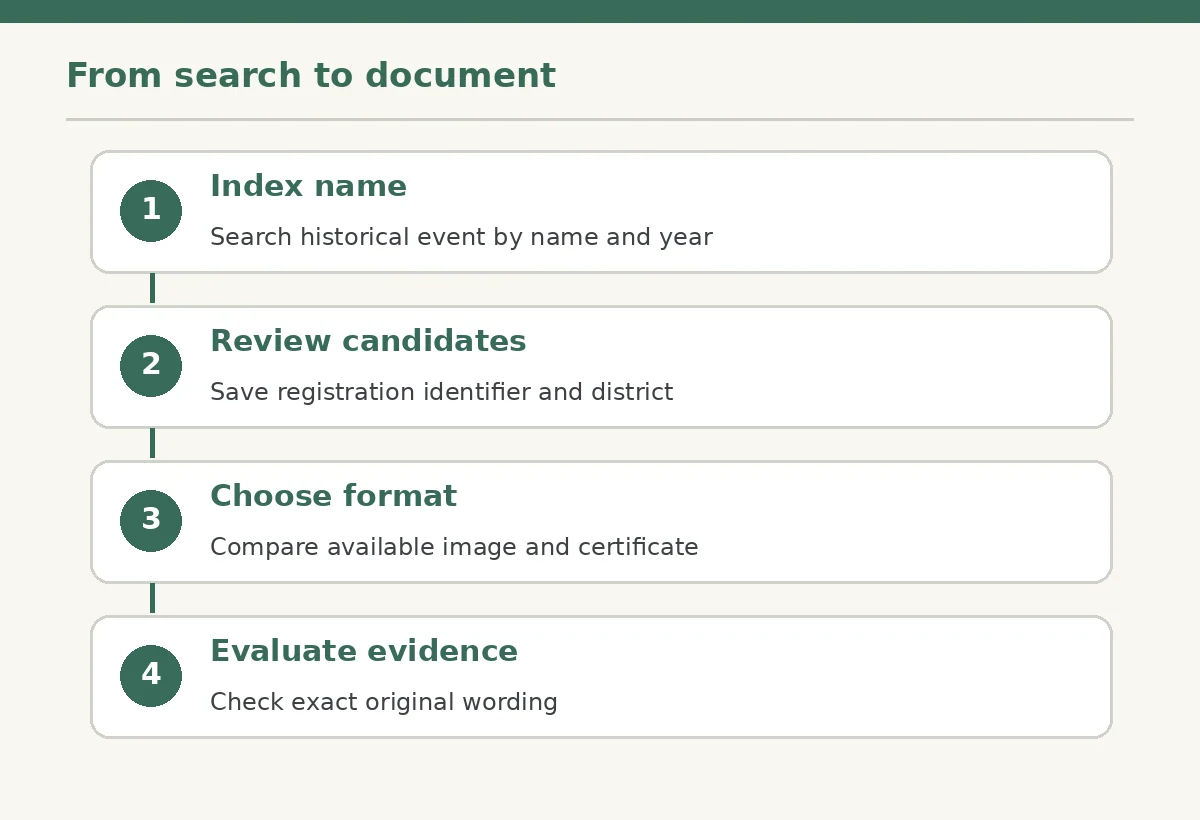
Queensland’s government describes free online searching of historical life events followed by a paid option to obtain images or certificates. Begin broadly with surname and event type, then filter by approximate period when several candidates remain. Try different spellings of a given name, especially where it was abbreviated on a family document. Copy the displayed registration reference exactly and capture the search date. A transcription can contain errors, and the original image may reveal a line or marginal note missing from the search result. Never claim that free name-search access guarantees a free scan or that every indexed name belongs to the person in your tree.
Use the published coverage without extending it
The Queensland Registry guide currently lists historical birth images and certificates through 1925, death images and certificates through 1979, later death certificates only for 1980–1995, and marriage images and certificates through 1950. Those are the ranges published on the checked guide, not assurances that all events were consistently registered. A separate high-level rule places public historical searches at approximately 100 years for births, 75 years for marriages and 30 years for deaths; the exact live year range should be rechecked before ordering. Some church baptisms and burials from 1829–1856 and church marriages from 1839–1856 also appear. Their historical context differs from a full later civil registration. For the fuller picture, see our guide “NSW Historical BDM Index”.
Choose an image, certificate or source image deliberately
The government describes three historical products: a certificate, a historical registration image and, when available, a historical source image. The quickest download option is generally an eligible image after payment; the purchased paper certificate is posted rather than supplied as an immediate download. Compare your research question with the product descriptions. An image of the original registry entry may allow closer inspection of handwriting, corrections or fields, while a certificate can be convenient for other legal purposes. A source image is not offered for every event. Avoid ordering multiple formats of the same entry merely because the index has not yet been compared with a second source.
Interpret the fields in historical Queensland registrations
An historical entry might provide witnesses, parents, residence, occupation or an informant, but available fields vary by event, year and record type. A reported birthplace may be the informant’s recollection; treat it as information within a record, not a newly verified fact. For deaths, age can be approximate. For marriages, a stated residence may differ from a person’s long-term home. Transcribe exactly what is written in the image, including uncertain handwriting, and distinguish original content from modern index expansion. If a record says a parent was deceased, check the meaning and timing rather than projecting an exact death date. The purpose is to preserve evidence for later evaluation.
Recognize exclusion and uneven historical registration
State Library of Queensland notes that Aboriginal and Torres Strait Islander life events were not consistently registered in Queensland until the 1940s. Do not interpret an absent registry entry as evidence that an event did not happen or that a person’s identity is invalid. Possible evidence may be held in mission, church, pastoral-station or other archives, each with its own provenance and access rules. Community consent and respectful research practices matter, particularly for named Indigenous families and records of past government control. Avoid publishing identifying details about living people or treating an externally imposed category in a historical form as the person’s own identity.

Use a second source to distinguish identical names
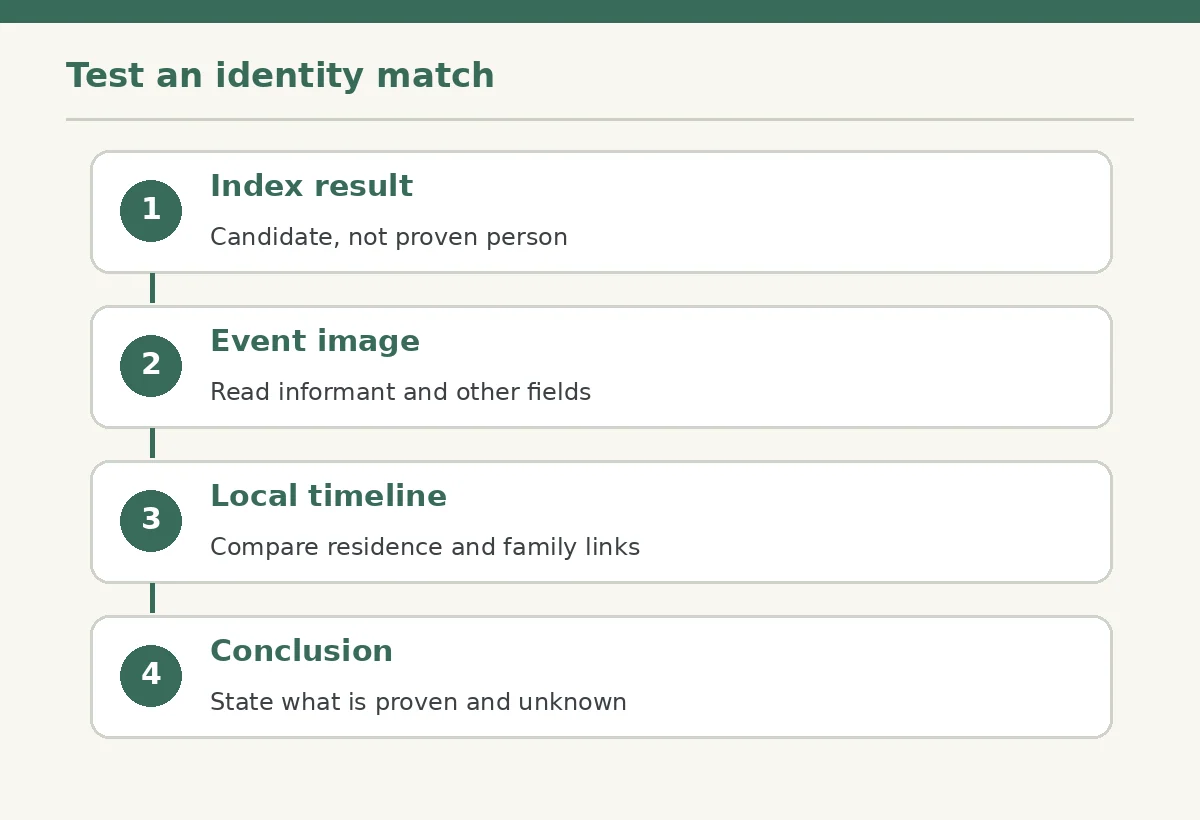
Suppose two men named John Martin appear in the death index within five years of one another. A matching age does not uniquely identify either as your ancestor. Compare cemetery registers, marriage images, newspapers, directories and dated residence clues. If one candidate belongs to an inland district and the other to a coastal town, reconstruct each timeline instead of selecting whichever has the more appealing parent names. Capture contradictory ages and spellings rather than editing them to agree. Make a short evidence table listing information stated directly by the document, your inference and the unresolved questions. It is acceptable to leave identity unknown until records support it.
Cite the register number and the particular image
For every candidate, record the government collection name, event type, registration number, displayed index fields, image or certificate identifier and access date. Keep the downloaded original beside a transcription, and label any cropped or enhanced version as derivative. A search-screen screenshot is not equivalent to the source page when the page is available. Also document negative searches: which surname forms and years did you try, and did you check another jurisdiction? This evidence log reduces duplicate purchases and lets a collaborator reconstruct why a particular birth or marriage was attributed to one family member. Confirm that any sharing complies with the current registry terms. Our guide “Western Australia Historical BDM” goes into more detail.
Plan the next step around a precise evidence gap
If a birth index lacks a mother’s maiden name, choose an independently created baptism or marriage record that could test the relationship. If a marriage image records witnesses of unclear connection, search those witnesses in period directories rather than instantly assigning them sibling status. Also, if a death record only offers an estimated birth year, seek an earlier census, school register or documented immigration record for a stronger age comparison. Match the next search to the missing claim; do not browse more indexes without a question. Queensland State Archives holds a different government-record collection from the BDM Registry, and its family-history page explicitly directs certificate researchers back to the Registry.
Quick Evidence Log to Keep with This Search
| Source | What to save | What remains open |
|---|---|---|
| Index or search result | Name, search settings, record reference | Is this the correct person? |
| Original record image | Series, page, exact wording | Who provided the information? |
| Independent corroboration | Place, date, author, separate citation | Do details and timeline agree? |
How We Research Queensland Historical Bdm Search
This guide follows the specific institution guidance linked below and distinguishes original records from searchable indexes. We checked descriptions of the relevant collections on 2026-10-20. The sample people and scenarios are fictional. We did not interpret absent index results as evidence that an event never happened, and none of the diagrams reproduces a government record. If an access or digitisation rule changes, the current repository instructions take precedence over our summary.
More Records and Archives Guides
Verified Institutional Sources and Further Reading
Queensland government states current historical date ranges and early church material (www.qld.gov.au).
It also confirms free index search, paid images and postal certificate delivery (www.qld.gov.au).
Queensland State Archives explicitly distinguishes its government holdings from Registry BDM certificates (www.qld.gov.au).
State Library of Queensland describes limits in historical registration for Indigenous communities (www.slq.qld.gov.au).
Research and disclosure: these are editorial information guides, not archive endorsements or paid placement. No affiliate offers are used in this article; see GenHis affiliate disclosure. Verify current access conditions and respect privacy restrictions, particularly in records potentially involving living individuals.
Yes. The Queensland government says its historical life-event index can be searched for free; original images have a separate fee.
Not a certificate. The government says purchased historical certificates are posted, while eligible purchased registration images can be downloaded.
The registry holds early records from 1829, including some church records from when the area was administered as part of New South Wales.
No. Survival, jurisdiction and historically uneven registration must be considered, especially for Indigenous life events.
Usually not. Compare an original image and at least one independent record with consistent names, place, dates and family details.