
RGO 14 contains historical Board of Longitude papers held by Cambridge University Library, whose catalogue describes the class as 1737–1828 and states that it has been digitized. These papers can establish what an inventor, navigator or correspondent proposed to the Board, and sometimes what officials examined or paid. They do not make every proposal a successful instrument or every payment a final award. Start with a document, reconstruct its administrative sequence, and test any claim of success with separately dated outcomes.
Find the Board Papers and Respect Date Ranges
The Board of Longitude dealt with the practical problem of determining position at sea, a subject involving astronomy, instruments, navigation and many petitioners. Cambridge University Library identifies its RGO 14 class as Board of Longitude papers, 1737–1828, digitized through the Board of Longitude Project. A separate Cambridge account describes the larger digital project as spanning 1715–1828. These ranges are not contradictions that authorize changing the RGO 14 class dates: the wider project contains related materials and context beyond that single labelled class.
Begin with the research claim. Was a named artisan said to have offered a marine clock, did a navigator request funding for observations, or was a ship associated with an experimental method? Write down the asserted action, approximate year, name spelling and whether the family source calls it a submission, prize or invention. Different labels can hide different kinds of historical documentation. A person writing to the Board need not have been a successful inventor or even the maker of the device described.
Cambridge reports an extensive digital resource with tens of thousands of images and a large volume of name, place and ship references. These numbers describe a research collection, not counts of people who won a prize. Search the original digital collection by relevant names, objects and dates where its current interface permits, and retain the image or manuscript reference from the record viewed. An index label may offer a modern editorial summary; it should not replace the actual letter or minute when making a historical claim.
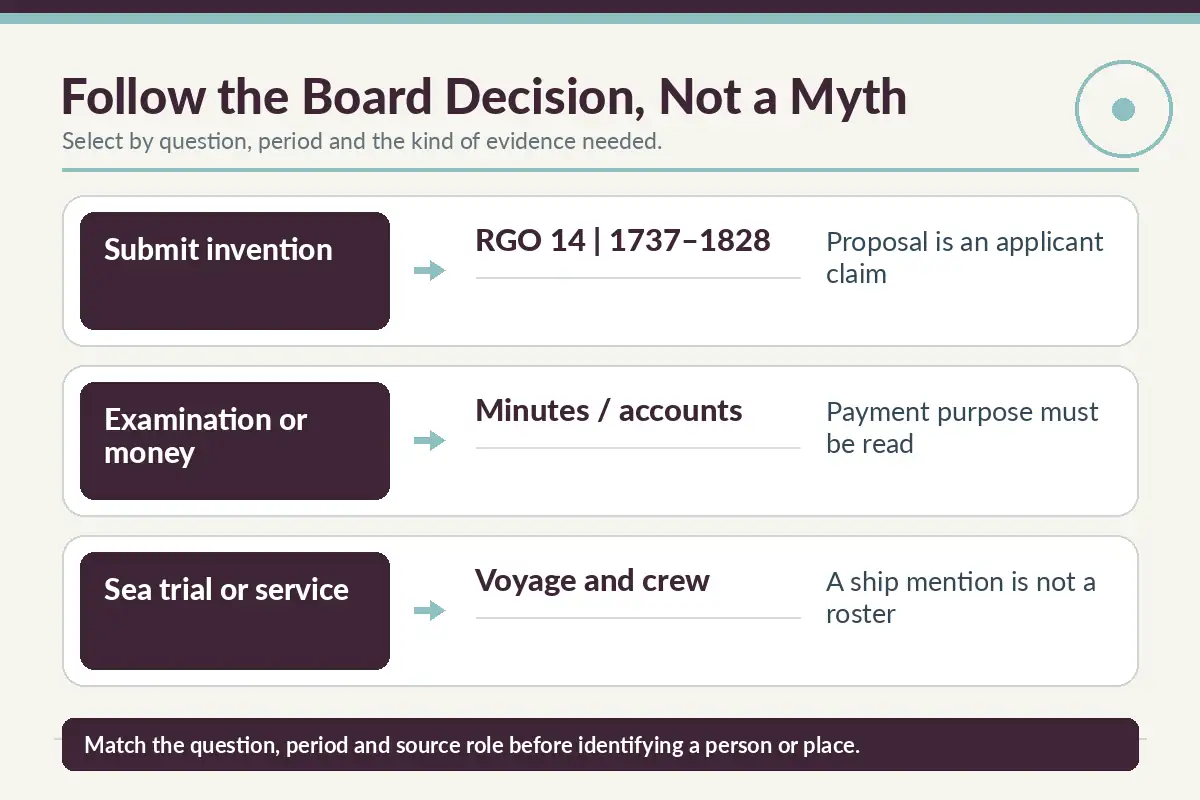
Tell a Submitted Proposal From an Official Decision
Historical submissions can contain grand claims about accuracy, expense, sea trials or novelty. Treat these first as the submitter’s statements. Transcribe what was proposed, who made the claim, the date of submission and any supporting drawings or reports. A letter explaining an instrument does not itself prove that the item was built. A technical sketch can represent a design under consideration rather than an instrument that operated reliably on a voyage.
Look separately for a Board minute, a referral to an examiner, a reply, or a later discussion of the same applicant. If the record reports that a proposal was referred to an astronomer or instrument maker, that may show an administrative process but not final endorsement. Repeated references to the same proposal can be summaries or copies rather than independent tests. Be alert to reused descriptions in inventories, editorial notes and original letters.
An especially useful worksheet has columns headed “proposed,” “examined,” “authorized,” “paid,” and “tested at sea.” For each claim, enter the actual document and date. A blank cell is not a negative conclusion, because the surviving archive may be incomplete for that step. It simply means the step remains unproved. A later payment could be for expenses or experimental work rather than a prize recognizing a final successful method; the words of the payment record matter.
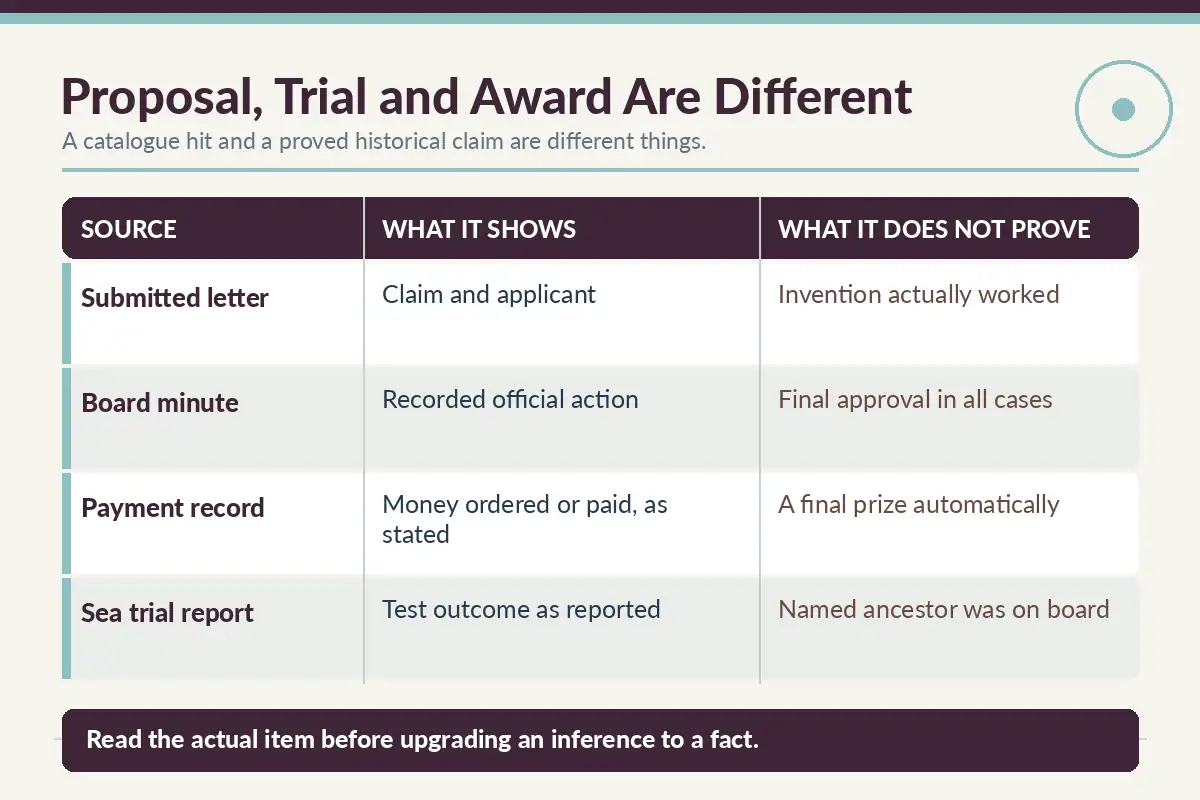
Reconstruct Money, Instruments and Voyages Separately
A claim that a Board correspondent “received a reward” should trigger a careful distinction between a financial allowance, reimbursement, contractual payment, partial reward and any final public award. Even a signed payment authorization is not automatically proof that cash was received. Compare the payee’s name, the purpose, the amount, the date of order and any surviving receipt. If only a digital image of an entry is known, cite what that entry says rather than silently moving forward in the transaction chain.
Similarly, separate an invention’s proposed operation from a witnessed test. A technical description can demonstrate an idea existed at a particular date. A report from a ship may document an experiment, but its author may not have inspected every claim the inventor made. Identify ship name, observer, port or voyage dates only when the source expressly gives them. Another ship using a similar navigation method is not proof that a particular design was successful aboard the ancestor’s vessel.
Cambridge’s project account notes that the materials are relevant to many ships and places, but a ship reference is not an individual passenger or crew record. If a family tradition names a sailor who helped test a clock, locate a dated service, muster or correspondence record connecting that sailor to the named voyage. Scientific history can be documented without converting associations into kinship or inventing personal participation.

Read the Digitized Pages as Physical Documents
The Cambridge Digital Library brings original images and descriptions together, but digital access does not eliminate the need for source criticism. A volume may contain later indexes, copied correspondence, attached plans and administrative annotations. Record the original document date separately from the date of any later note. Capture page numbers, item references and the exact manuscript wording where feasible. Where a page is illegible or a sequence is incomplete, do not claim it says what a modern summary suggests.
Watch for historical variants in names and place spellings, titles of office and technical vocabulary. An archival transcript may normalize spelling to help discovery; a quotation should still preserve the wording of the image. If two inventors share a surname or a ship name is reused, make separate identity tests. A Board applicant could be an inventor, an intermediary, a patron or a representative. Which role they held must follow the surviving documents, not the researcher’s preferred family narrative.
A careful final answer might state that the Board received a proposal for a method, with subsequent examination noted in a different item, while no confirmed award or operational use was found in the records checked. Include the limits of your search, especially whether you examined all relevant minutes or only the indexed letters. The resulting conclusion is both publishable and reproducible without asserting an unproved triumph.
More Research Method Guides
How We Research Board of Longitude Claims
We use Cambridge University Library’s archive guide for the RGO 14 class and dates. Cambridge’s Board of Longitude project description explains the larger digital corpus, while Cambridge Digital Library supplies the document-viewing route. We distinguish project scope from class scope and do not claim a proposal was successful merely because it was preserved.
All drawings are original explanatory visualizations, not facsimiles of a particular chronometer, vessel or Board manuscript. See our affiliate disclosure for editorial relationships.
Cambridge identifies RGO 14 as the Board of Longitude papers, 1737–1828, digitized as part of a wider project.
That is a wider digital-project scope; the RGO 14 class description gives a narrower class date range.
No. Look for separate construction, examination or trial evidence.
Not necessarily. Determine whether it was an expense, partial reward, grant or final award from the original wording.
No. Independent crew or service documentation is needed to connect a particular person to a voyage.