
A Foreign Office private-office paper can preserve a revealing ministerial opinion without proving that the British government adopted it. FO 800 covers private office papers of ministers and senior officials, including material outside the ordinary departmental registry. The National Archives explains how FO 800 and FO 794 relate to wider Foreign Office holdings, and offers some FO 800 materials as digital microfilm. Start with the name of the minister, a specific issue and a date window. Then determine whether the document is a note, draft, instruction, final communication or retrospective copy before making any claim about policy. For the archival search route, consult The National Archives guide on the series. The National Archives guide on related records.
Identify whose office created the document
The catalogue description of FO 800 is not a uniform series of every diplomat’s correspondence. It brings together private office papers of different ministers and officials; searches should therefore begin with the office holder’s name as well as subject. One minister might have files covering a crisis while another has personal correspondence, drafts or annotated extracts. The National Archives has a specific guide to Anthony Eden’s private office papers, for example, and points to FO 800/750–851 as an access route to some of them.
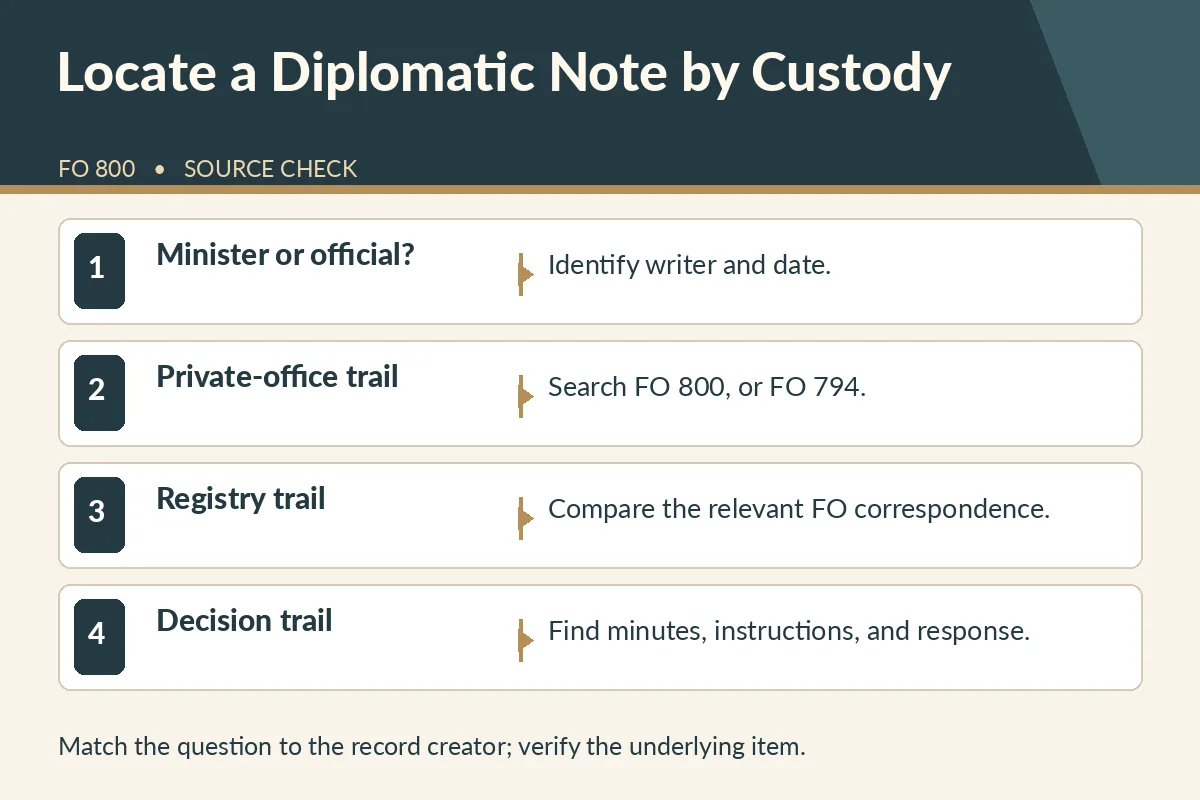
Write a custody header before you quote: originating office, writer, recipient, date, archive piece, and whether the item is a handwritten note, private letter, telegram copy or typed minute. A paper written in a minister’s hand may record a thought made before discussion. A letter copied for personal reference may have been sent elsewhere, but the surviving copy alone may not prove dispatch. Avoid presenting file survival as evidence of personal approval or receipt.
Search private-office papers and registered files separately
The National Archives separates private-office papers from ordinary registered Foreign Office correspondence. FO 800 holds one important private-office stream, while FO 794 is another and later FCO private office records use other series. For registered correspondence, the relevant series and finding tools depend on the era and registry system. Start with the office-specific FO 800 search, then use the Foreign Office correspondence guide to identify the parallel registry route. Search for variants of a country name, personal name, historical event or departmental subject.
The same situation can appear as a private briefing in FO 800, an outward despatch in a registered file and a summary in Cabinet material. The records are related but not duplicates. Make a column for each record’s role: background, incoming information, proposed recommendation, approved instruction or later report. If the private note contains a marginal ‘agreed,’ identify who made the annotation and when, if possible, rather than presuming it has the legal force of a diplomatic instruction.
Understand digital microfilm limitations
Some FO 800 pieces are free digital microfilm through The National Archives. The official guide cautions that these reproductions may be large PDFs without name-searchable contents. A catalogue search can help locate a piece, but looking for a name inside the scan may require browsing page by page. Retain the piece reference, page within the scan, any original folio number and the internal letter date. A PDF page counter is not necessarily an archival folio reference.
When using a scan, inspect adjacent pages. A note headed ‘For discussion’ may be followed by an annotated reversal, a draft amended before sending or an incoming telegram that changes the meaning of the earlier proposal. OCR or snippets from an external site should not replace the surrounding record. Even when a document is digitized, corroboration remains necessary if the research question concerns an action rather than the text of a private paper.

Distinguish decision, transmission and implementation
A policy claim needs a decision chain, not just a striking quotation. First establish the proposal and the authority of its author. Then seek an approved minute, signed instruction, dispatched despatch or reported decision in the registered series; where appropriate, cross-check Cabinet papers or published parliamentary material. Finally, investigate whether the intended recipient acted on it. Each step answers a different question and may survive in a different archive. Silence in one file is not evidence that the event never occurred.
Suppose a minister wrote that a foreign representative should be warned. That note can show what the minister contemplated. It does not by itself establish that a warning was sent, delivered or accepted. An outward telegram proves transmission if the text and dispatch details are verified; a reply may prove receipt; separate records are needed for the ensuing negotiations or enforcement. Phrase your conclusion at the stage actually documented.
Cite different versions without collapsing them
The archive may hold drafts, carbons, typed copies, personal copies and printed extracts of the same communication. Record whether two items are independent evidence or one text reproduced twice. Capture exact dates, names and catalogue references for each. Annotated copies can establish how a document circulated inside an office but may not provide the final authorized wording. For private letters, consider whether a title or personal friendship affected the tone. The source’s form is evidence about its function.
A balanced research note distinguishes direct quotation, paraphrase and inference. State explicitly when you have only the FO 800 item rather than the relevant registry file. Even an apparently clear ministerial preference may be contradicted by later minutes. The goal is not to diminish the value of private-office papers but to use their distinctive perspective without converting a preparatory conversation into a finished state act.

More Research Method Guides
How We Research FO 800 Records
We use The National Archives’ Foreign Office research guides to select FO 800 and compare it with the appropriate registered correspondence route. We distinguish physical and digital references and do not assume every PDF is full-text searchable. In examples involving a public figure, we verify the paper’s author and exact version, look for later official action and preserve uncertainties about delivery or effect. A private opinion remains a private opinion unless corroboration changes its evidentiary status.
Our explanations are independent research guidance, not access guarantees or legal advice. For transparency, see the affiliate disclosure. A link to an archive or a category is not a claim of a paid relationship.
Private-office papers of Foreign Office ministers and officials, including correspondence, memoranda and working papers.
Not necessarily. They may be notes or drafts; official approval and implementation need separate confirmation.
Some is available as free digital microfilm, but access and searchable detail depend on the specific piece.
Use the appropriate registered correspondence series and, when relevant, FO 794, Cabinet papers or published official material.
No. Seek a dispatch record, receipt, reply or other evidence that the communication actually reached its destination.