
The National Archives photographic guide identifies FO 1011 as the papers of diplomat Sir Percy Loraine (1880–1961), including nineteen photographic albums and three family portrait photographs. Their images extend across the Mediterranean and places such as Turkey, Syria, Persia and Egypt. This is a compelling source for historic views, travel and diplomatic context, but a person appearing in an album does not automatically have a documented meeting with the diplomat. Start from the album and its geographic clues, record the source of a caption or date, and turn to dated correspondence only when testing a concrete event. A surviving picture is evidence of an image, not by itself a transcript of government business.
Search the Photograph Albums as Objects with Provenance
Use the FO 1011 catalog and the name Percy Loraine, then narrow by album, location and photography-related terms. The official guide says the series includes nineteen photograph albums and three family portraits, but that does not mean that each image is individually described online. Record the piece reference, internal photograph or page number where available, album title and any ownership or compilation marks. Do not replace the original album title with a modern country label that assumes current boundaries.
An album can gather pictures received from different people or photographed at different times. Its eventual inclusion in the papers of a diplomat does not prove he took every photograph or personally visited every place. List physical clues such as paper, captions, mounts, page sequence, dates and recurring photographers’ marks. When using a reproduction, note whether it includes the verso or album page. An isolated crop loses the context that often distinguishes a travel view from a diplomatic publicity print.

Reconcile Historic Place Names Without Guessing Modern Borders
The photographic guide locates the collection across the Mediterranean, Turkey, Syria, Persia, Egypt and elsewhere in the Middle East. These are broad regional descriptors, not a guarantee that every image belongs to a particular modern sovereign state. Start with the exact caption spelling, then search period maps and alternative transliterations. Note landmarks, topography, harbor position and visible inscriptions. The goal is a documented location identification with a clearly dated reference point, not a seamless modern travel itinerary.
If two places share a historic name, compare architectural form and coastlines rather than selecting the most familiar search result. Border changes and naming systems may also make an address appear in multiple catalogs. Retain the original wording and provide a bracketed modern explanation only where supported. If the caption is illegible or absent, write a provisional geographic region and list what further comparison would settle the question. Never assign precise coordinates to an indistinct landscape.
Keep Album Compilation Dates Separate from Exposure Dates
The full FO 1011 papers span a different period from the personal lifetime of Sir Percy Loraine, and a series-level date cannot be used as a camera date. An album might include images made during separate postings or acquired later, then labeled in another hand. Divide the timeline into image exposure, caption writing, album assembly and eventual archival transfer whenever evidence permits. A later handwriting style is a clue about annotation, not automatic proof of when the depicted event happened.
An apparently contemporary photograph could have been printed as a later copy. If one page bears an exact date and adjacent pages do not, that date may apply only to the labeled frame. Test common landmarks against a dated street plan or travel record, and distinguish firm dates from broad estimated ranges. It is safer to record “in an album labeled with a period” than to assign that label to every picture. Source-specific uncertainty is part of the result.

Do Not Invent a Diplomatic Encounter from a Group Portrait
A group picture may show officials, hosts, visitors, servants, guides or family members. Unless a reliable caption names them, association in the photograph does not establish identity, office, or the purpose of a gathering. Even when two identifiable public figures appear together, the image is not a transcript of their conversation or evidence of the policy outcome. Check the exact date and event in separately documented diaries, official correspondence or contemporary press accounts when making those claims.
If tracing a family connection to an embassy or delegation, test the ancestor’s occupation, location and dates in named sources. A similar face or matching uniform is insufficient. Keep role labels as literally described; do not promote a household employee to a diplomat or a local guide to a member of the delegation. The archive’s three family portrait photographs may help confirm a known identity only when provenance and attribution are reliable; do not generalize their identification to anonymous album figures.
Read Captions as Historical Testimony, Not Neutral Truth
Captions may reflect the terminology, assumptions or biases of the writer, especially in photographs made during periods of imperial and diplomatic influence. Transcribe potentially outdated place labels faithfully for citation, then describe their limitations without adopting them as modern neutral categories. A label can support “the album calls this view X” while independent maps or local sources might be necessary to establish the place or name of a person. A blank caption does not imply the scene was unimportant.
Compare descriptions from local repositories or communities where relevant and accessible, and distinguish contemporary terminology from later curatorial interpretation. An image with unfamiliar clothing or architecture cannot be assigned a person’s ethnicity, nationality or identity by appearance alone. A historian can document landscapes and encounters while avoiding speculative classifications that exceed the evidence. This restraint improves both accuracy and the respectfulness of the family story.
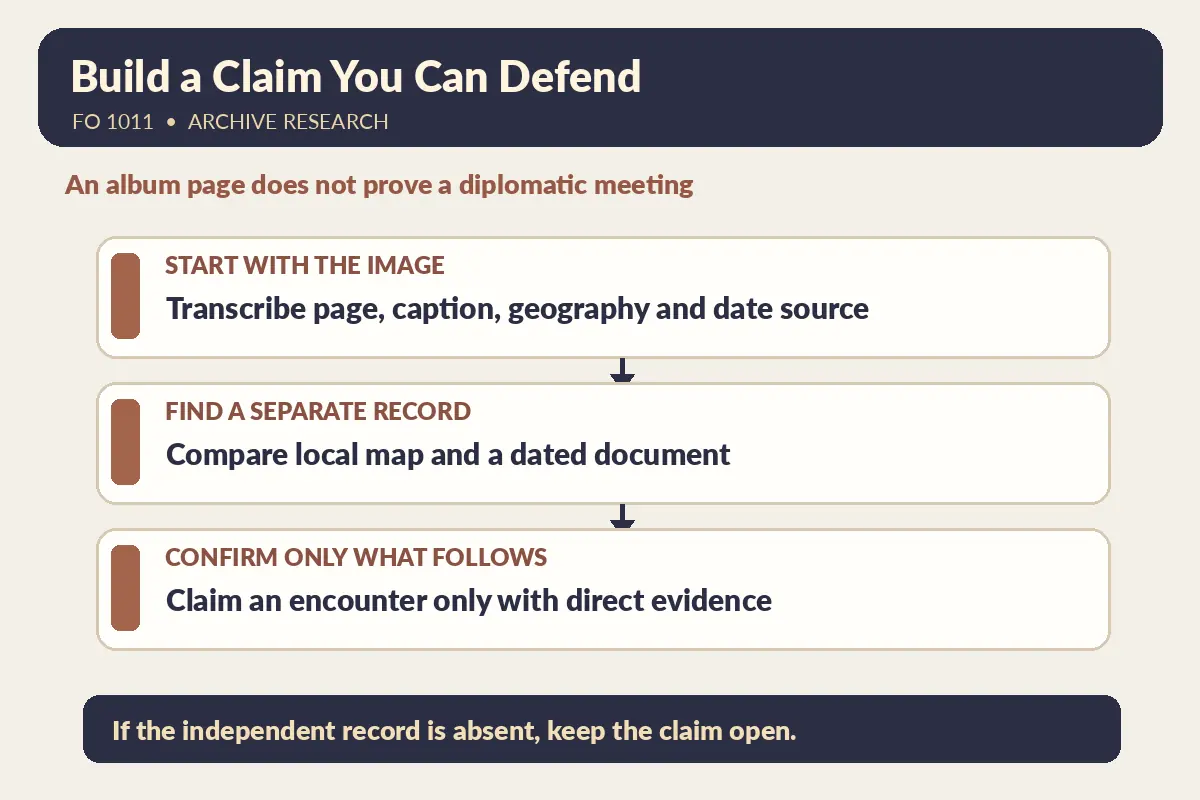
Write a Reproducible, Limited Finding
A final research card should give the complete FO 1011 piece, page or photograph number, original caption, described scene, date evidence, and any map or letter used to verify a claim. Explicitly state whether the original was consulted or only a catalog summary. Search terms, transliterations and rejected candidate locations make the analysis repeatable. If album pages are not digitized, request appropriate access instead of inventing detail to fill a gap.
The strongest conclusion may simply establish that a particular landscape appears in an album among Loraine papers, with an independently verified place but an uncertain photographer. Add a diplomatic meeting only after a dated primary source actually describes it. This distinction is especially important for photographs that look formal or historically significant: their visual drama is not a substitute for documented context.
More Research Method Guides
How We Research This Archive Collection
The starting point is The National Archives photographic collections guide, which specifically identifies FO 1011 and describes the collection at series level. We checked the series scope and any additional official guidance cited below, not every item or original image. This distinction is essential: an archive summary is not a substitute for viewing an individual photograph, its caption or related paper records. Use the archive’s Discovery search guidance to check the series, search terms, historic names and filters, then browse the full piece if descriptions are incomplete.
Our three research aids separate a starting-point decision, a source-by-source evidence limit and a route to independent verification. We distinguish visible details, archival caption claims, later comparisons and remaining uncertainty. The National Archives citation guidance explains the importance of a complete department, series and piece reference with an item or page identifier where applicable. The illustrative artwork and example workflows here are explanatory designs, not facsimiles or reports of an undocumented discovery.
The examples do not identify unnamed people or establish operational, legal or household outcomes merely by association with an image. If the paper original or verso was not accessible, retain that limitation, request access as needed and avoid fabricated details. Our affiliate disclosure explains site transparency; archival citations do not assert commercial partnerships.
It is the archive series for Sir Percy Loraine papers, including photographic albums and portraits.
The National Archives photographic guide identifies nineteen albums, as well as three family portrait photographs.
No. The guide names multiple areas, including the Mediterranean, Syria, Persia and Egypt.
No. The purpose and participants must be checked through accurate captions and independently dated correspondence.
Use the full archival piece and any page or picture identifier, transcribe the caption and record that the exposure date is unknown.