
The National Archives describes 246 photographs in RG 155, series CL, showing children in industry and agriculture from 1930 to 1960. The pictures belong to records of the Wage and Hour Division and its associated public-contracts administration. They are powerful historical evidence of depicted activities, but a photograph alone does not establish the exact age of the person shown, the employment terms, which law applied, or whether any violation was found. The official RG 155 inventory also describes hazardous-occupation policy files and selected inspection records as separate materials.
This distinction matters particularly in family research. A child pictured in a farm setting may have been working, visiting, posing, or taking part in a staged illustration; the catalog’s identification and any original caption determine what can responsibly be claimed. A case record may explain enforcement, but it must be matched to the right site and date. The method below moves from a specific CL image through contemporaneous law and local sources before making conclusions about a named child or employer.
Find the CL Series Before Searching Case Files
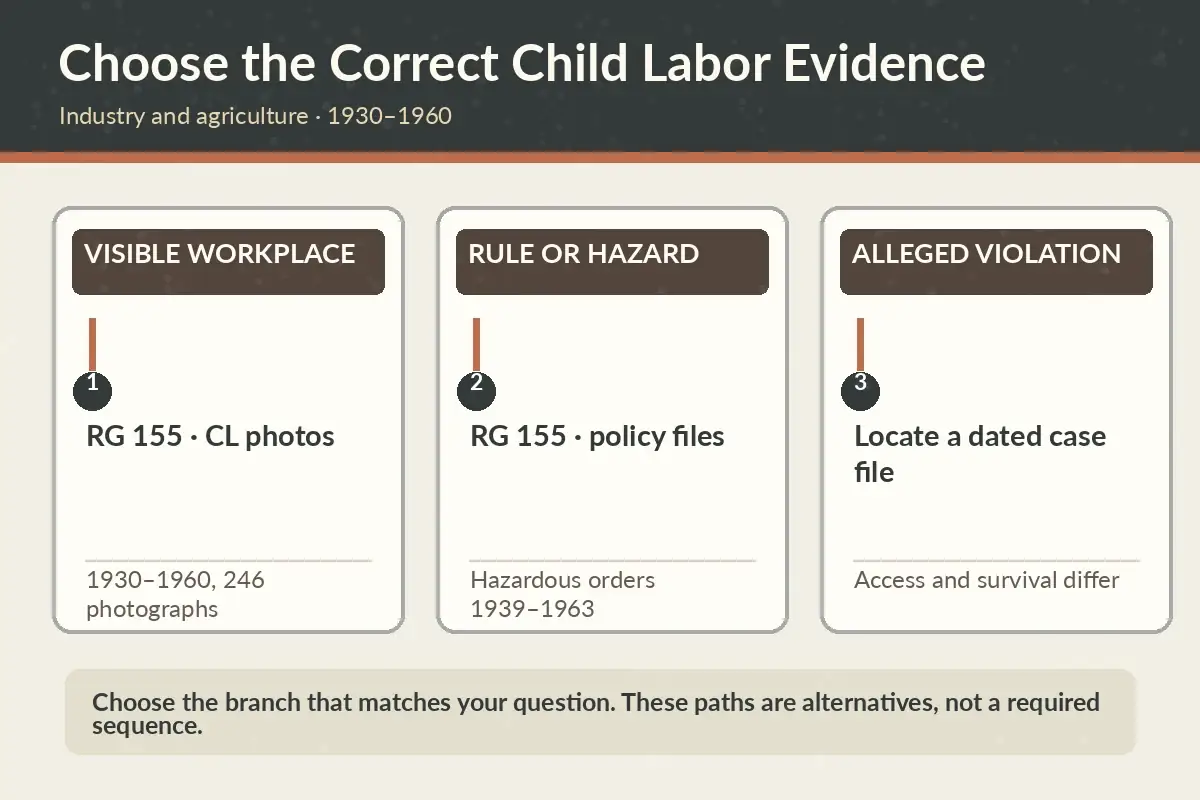
RG 155 section 155.3.2 identifies the photographs as CL and gives the period 1930–1960. Use that reference when searching the National Archives Catalog and when writing to the Still Picture unit. A generic search for “child labor 1930” may instead return Lewis Hine’s earlier images, state files, newspaper photographs, or museum reproductions. Those holdings are valuable but not interchangeable with the Wage and Hour Division’s specific CL series. Preserve the original collection attribution even if an online caption is brief.
Begin a research table with the photographed location, supposed year, image identifier, visual activity, any captioned age, photographer if named, and the cataloged agency. Note whether the image is a contemporaneous photograph or a later reproduction. Do not fill in an exact date based on hairstyles or machinery alone. The archive’s 1930–1960 range is a series-level interval, not a birth date, a single inspection period, or evidence that all 246 images were taken after a particular federal statute.
Recognize Different Standards for Different Jobs
The work depicted might be in a factory, field, household business, or other workplace; legal standards can vary with time, occupation, exemptions and jurisdiction. RG 155 contains hazardous-occupation orders dated 1939–1963 and a proposed shipbuilding order from 1940–1942. Those policy documents help identify what officials debated or regulated, but they do not by themselves prove that the exact child in a picture was covered by a particular rule on a particular date.
For a scene thought to show an illegal job, first identify what task is actually visible and whether the date is documented. Next identify the relevant law as it stood then, including any applicable exemption, not the law in force today. Finally locate a relevant inspection or enforcement file. A minor-looking worker may in fact be older than assumed; assigning age from facial appearance alone is unreliable. A visually alarming machine is a reason for careful research, not a substitute for age, hours, employer, or jurisdiction evidence.
Separate the Photograph From an Enforcement Finding

The RG 155 guide describes selected inspection and investigation case files in field offices, with differing surviving ranges by region. Their presence shows a possible path to enforcement evidence but does not establish that every CL image was taken during an inspection or linked to a prosecution. A photo may have been collected for illustration, policy discussion or public education. Match the alleged employer, town, date and type of work before suggesting a relationship to a case file.
If a case is located, read its procedural outcome carefully. A complaint is not an agency finding; an investigator’s observation is not always a final decision; an order or settlement has a defined legal meaning. A news report about a nearby mill may involve another company. When access to a historical case is limited or its file did not survive, record the gap without presenting “no file found” as proof that a photograph was staged or that no violation occurred.
Protect Identities and Avoid Visual Guesswork
An unidentified subject should remain unidentified unless an inscription, roster, family document, or another reliable record establishes identity. Similar clothing, ethnicity, appearance or family resemblance is not proof. Some images concern vulnerable young people, so avoid speculative captions that stigmatize a family or label an individual as a victim of a specific offense. An accurate and respectful description can say “a child shown working in an agricultural setting in a photograph cataloged under RG 155.”
For a plausible family connection, compare location, household members, employment census entries, school attendance and contemporary local records where appropriate. When two people share a name, require matching age and residence or another distinctive identifier. A family story that an ancestor worked in a mill may be supported by pay records or oral testimony while the photograph remains merely contextual. Keep these two evidentiary roles visibly separate rather than attaching a portrait to the wrong biography.
Build a Caption That Preserves Uncertainty

A responsible publication citation should give RG 155, CL, the item’s catalog information, the date as actually provided, and the archival description before making any interpretation. Say whether you examined the original image, a scan, or just the guide. If a caption includes a reported age or employer, attribute it to the specific source. Avoid cropping a photograph so closely that machinery, posted notices or companions important to the interpretation disappear.
The final research product can be a two-column comparison of direct observation and unresolved questions. “Two children appear beside sorting machinery” describes a view; “the employer violated federal law” requires legal and case evidence. If the item date is unclear, show a range. If no identity is supported, leave it open. This discipline makes an emotionally difficult collection more useful, prevents mistaken accusation and protects the meaning of the original archival record.
More Research Method Guides
How We Research and Verify the Original Record
We began with the official RG 155 federal records guide and compared the stated series, formats, subjects, and dates with the National Archives still pictures research guidance. The specific inventory claim checked was: RG 155 section 155.3.2 lists 246 CL photographs of children employed in industrial and agricultural occupations, 1930–1960, separate from hazardous occupation orders and selected enforcement cases. The guide describes archival holdings but is not proof that a particular image has been digitized or that every individual mentioned in a related family story appears in the collection. An item-level description and a directly examined copy are necessary before making claims about pictured details.
For reproduction or further reading, preserve the NARA item identifier, series title, uncertain dates and any separate person-level source. We did not assume access to every original photograph or underlying case. If an item is unavailable online, use NARA research-visit and inquiry instructions to ask for its location and access conditions. See the GenHis affiliate disclosure; this article does not assert a sponsored archive partnership or paid access route. The method is deliberately conservative: Interpret an employment photograph responsibly without assigning a legal offense, a victim identity, or an enforcement outcome that the picture cannot establish.
The federal records guide identifies 246 photographs of children working in industrial and agricultural settings, dated 1930–1960.
Not from appearance alone. A documented age, dated work situation and relevant legal rule are needed.
The guide does not say so. Photographs and selected inspection case files are distinct record descriptions.
No. They document regulatory rules or proposals, not automatically the conduct of a named employer.
Seek a named archival caption and independent census, school or family records; do not use resemblance as proof.