
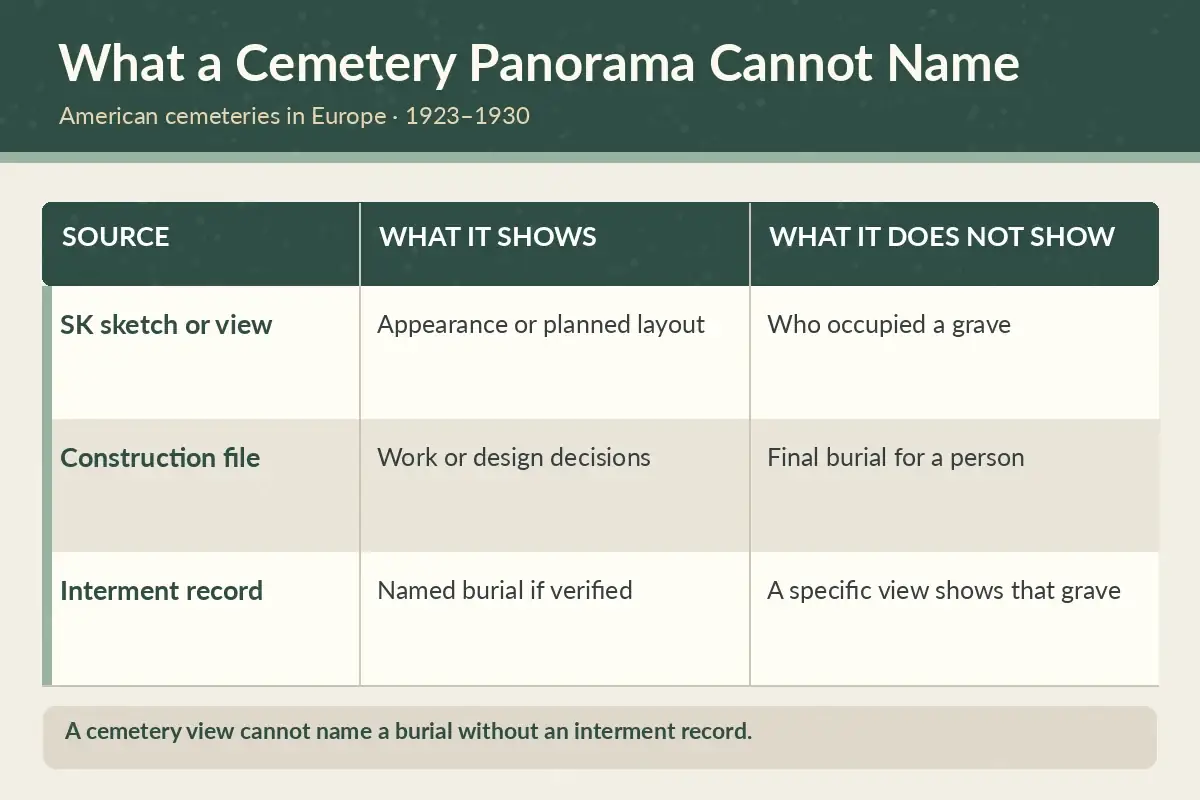
RG 117, records of the American Battle Monuments Commission, includes 135 original sketches and panoramic views of World War I cemeteries in Europe, dated 1923–1930, in photographic series SK. These are valuable views of cemetery design, setting and early development. They are not the same as a grave-by-grave register: a row of crosses in a panorama cannot identify an individual soldier without separate burial evidence. The official RG 117 guide places the images alongside construction, maintenance, interment and other cemetery records.
This is a place-history method for family researchers and preservation writers. It distinguishes a proposal from a completed landscape, an early panorama from a later memorial photograph, and a cemetery name from a specific grave entry. The commission’s files cross several decades, but the SK material has a narrower 1923–1930 range. Start with the item’s cemetery and the kind of view it actually is, then locate the independent sources needed to say where a named person was buried.
Find the SK Views by Cemetery and Image Type

NARA identifies series SK in RG 117 section 117.3.1. Start by recording the named cemetery, its country, the series letters and the stated image date. Do not assume that an aerial-looking panorama is a survey map or that a drawn perspective represents a structure as completed. The series description groups original sketches and panoramic views together; a particular item may be artistic design work or a photograph of conditions at a specific stage. Ask for the item-level description before describing it as a finished cemetery.
Use historical place names from the catalog, including spelling variants, and distinguish the cemetery proper from a nearby battlefield or temporary wartime burial ground. A World War I landscape image made in 1928 records a later landscape, not a view taken during combat. If a family letter names a cemetery, verify which institution the writer intended at the time. Wartime temporary graves could be relocated or reburied; a later site picture does not establish where a body lay in 1918.
Separate Design Intent From Built Landscape
An original sketch may show planned paths, lawns, plantings, walls, headstones and memorial structures. Such an image is evidence of a proposed arrangement unless a caption or construction record confirms that the pictured features were completed. A panorama may show installed elements, yet it still covers one viewpoint and a particular period. Compare it with dated construction and maintenance records in RG 117 to track changes rather than assuming every design was built precisely as drawn.
The guide describes the American Battle Monuments Commission as a body responsible for design, construction and maintenance of U.S. military cemeteries and memorials abroad. That institutional role explains why the commission preserved both drawings and site images. It does not guarantee that any one image can be used as a modern walking map. Changes in paths, plantings and grave markers over time can alter how a feature appears. Keep a separate column for observed feature, planned feature and unverified interpretation.
Choose a Later Photograph Only When It Fits
RG 117 also contains series MC and CM concerning World War I cemeteries and memorials in Europe, 1924–1932, and series MP showing memorials and cemeteries from both world wars across 1924–1966. These other series may be useful for comparing design stages but should not be silently merged with SK. A 1960s MP image cannot be captioned “cemetery in 1925” simply because the location is unchanged. Record the distinct series, photographer if known, and date associated with each view.
For a visual timeline, align images by physical landmark rather than by title alone. A chapel may be seen before and after landscaping, while another item documents an unbuilt proposal. Make notes on the camera angle and area included. If you do not have a view from the same location, avoid treating differences in photographic composition as physical changes. A carefully annotated pair of images can explain preservation history without making an invented claim about the people buried beneath the landscape.
Verify a Named Burial From Person-Level Sources
For an ancestor’s burial, follow the family name through reliable cemetery or service sources and seek the actual interment data. The RG 117 guide refers to records relating to interments for 1923–1964 and separately to later headstone inscription and interment materials for overseas cemeteries. These can establish propositions that a broad SK panorama cannot: a name, burial location, transfer, or administrative action where the record explicitly states it. Check the relevant period and location before choosing a particular set of records.
A visible grave marker is not always legible in a distant picture. Do not label a specific cross as belonging to a relative because its approximate position seems to match a modern plot. Use verified plot, row and grave references where available, compare changes in numbering or layout, and note any reburial. If a wartime casualty notice names only a general cemetery area, treat later formal grave location as a separately dated fact. The panorama supplies physical context, not an automatic link to the individual.
Prepare a Site-History Citation That Others Can Audit

For each image keep the exact RG 117 SK reference, view type, location, creation or depicted date if given, and whether it is a sketch or photograph. Label any reconstruction as a new illustration. If you overlay a modern plan, tell readers where the plan comes from and explain its date. The broad inventory total of 135 refers to images, not to cemeteries, graves or construction phases. It cannot be used as a count of preserved burials.
When a claim matters for family history, publish the landscape citation next to an independent burial citation, not as a substitute for one. For a local heritage article, compare paths and memorial arrangements without guessing cemetery occupants. A useful conclusion may be modest: this view documents the appearance or proposed arrangement of a site during the 1923–1930 period, while burial location and identity come from records specifically created to document those events.
More House and Local History Guides
How We Research and Verify the Original Record
We began with the official RG 117 federal records guide and compared the stated series, formats, subjects, and dates with the National Archives still pictures research guidance. The specific inventory claim checked was: RG 117 section 117.3.1 describes 135 original sketches and panoramic views of World War I cemeteries in Europe, dated 1923–1930, series SK; the record group also has separate burial and cemetery files. The guide describes archival holdings but is not proof that a particular image has been digitized or that every individual mentioned in a related family story appears in the collection. An item-level description and a directly examined copy are necessary before making claims about pictured details.
For reproduction or further reading, preserve the NARA item identifier, series title, uncertain dates and any separate person-level source. We did not assume access to every original photograph or underlying case. If an item is unavailable online, use NARA research-visit and inquiry instructions to ask for its location and access conditions. See the GenHis affiliate disclosure; this article does not assert a sponsored archive partnership or paid access route. The method is deliberately conservative: Use a cemetery panorama to study layout and memorial design, while verifying actual named burials in a separate interment record.
NARA lists 135 sketches and panoramic views of World War I cemeteries in Europe, dated 1923–1930.
No. A named interment or burial record is needed to establish that connection.
Not necessarily. Distinguish designs and original sketches from photographs of built landscapes.
RG 117 separately describes MC, CM and MP photograph series with their own dates and subjects.
Verify the cemetery, person and plot using burial evidence and account for layout or numbering changes before matching the view.