
The National Archives describes 2,440 lantern slides in the St. Elizabeths Hospital record group, RG 418 series S, and 96 color glass slides in series W. These images were purchased for therapeutic and entertainment purposes from 1872 through 1910. Subjects range from buildings and landscapes to historical scenes. That information establishes the purpose and contents of a collection, not whether a particular patient saw a particular image or received a particular treatment. The most productive search begins with the two series and their accompanying catalogs and caption lists. See the National Archives record-group description for the exact scope of this material.
Because the photographs and colored glass pictures were acquired rather than necessarily created by the hospital, their subject dates must be separated from their collection dates. A view of the Philadelphia Centennial Exposition of 1876, for example, is a subject represented within the S series, not a claim that St. Elizabeths patients attended that event. The hospital also held separate records of medical cases and administration. This guide keeps the image collection, its institutional use, and confidential person-level evidence in different columns.
Choose the S Lantern Slides or W Color Glass Slides

Open the RG 418 guide at section 418.4.2, the Public Information Office holdings. The S designation covers 2,440 lantern slides dated 1872–1910, while W designates 96 glass slides in color from the same broad period. Both are described as purchased for therapeutic and entertainment purposes, but they are not interchangeable physical formats. Copy the series letter into every request. Ask the archive whether the relevant caption list, catalog, or item-level description supplies an image number before ordering an individual view.
S includes illustrations of buildings, monuments, people, and scenes from the United States and overseas. The archive mentions the Spanish-American War, a journey by the Prince of Wales in India, and the 1876 Philadelphia exposition as examples of subjects, not a complete slide-by-slide inventory. W is described more generally as artistic, historical, and moral subjects. Those categories guide the first search but should not be treated as an exact index to all content. The physical slide and its original accompanying description are stronger than a modern paraphrase.
Read the Catalog and Caption List as Finding Aids
Look for the catalog and caption list explicitly associated with each slide series. A catalog might provide sequence information, an image title, or a topical grouping; verify which fields actually appear rather than supplying expected details yourself. Record the original title exactly, including dated or unfamiliar spelling, and add a separate modern subject heading if necessary. An undated label does not become a securely dated image merely because the slide was acquired within the broad collection period.
When matching a caption to an image, note whether the identifying number is on the glass, a mount, a container, or a separate listing. An archivist may have reorganized material after the hospital acquired it, so a present-day sequence need not reflect a program shown to patients. Request information about missing slides, replacements, copies, and catalog revisions if the description raises uncertainty. Such notes can explain gaps without turning an absence from a current catalog into proof that a historical slide was never used.
Distinguish Institution History From Patient Treatment

St. Elizabeths was previously known as the Government Hospital for the Insane. NARA states that St. Elizabeths Hospital was formally established under that name in the Department of the Interior in 1916. The slides’ dates therefore cross an earlier institutional name, and a historical citation should preserve the creator or facility name applicable at the time. The existence of educational or entertainment material does not demonstrate a standardized treatment, a specific clinical decision, or the experience of an individual patient.
RG 418 section 418.4.1 separately identifies case records, a register of female patients, and later medical files. Their existence shows that the hospital maintained other kinds of evidence, not that they can be freely consulted or joined to a slide list. Medical files may contain sensitive information and access restrictions. Do not speculate about an individual’s diagnosis, admission, or attendance from the image collection. Handle names and medical facts only when an appropriate original source can lawfully be consulted and supports the precise statement.
Separate the Depicted Event From the Picture Date
A historical exposition depicted in a slide might have occurred in 1876, while an illustration, copy, or commercial lantern slide could have been made or purchased at another time. Build a chronology with separate columns for depicted event, picture creation when documented, acquisition by the institution, and any later archive description. If none of those dates is supplied for an individual item, leave it blank. Treat the guide’s 1872–1910 range as a series boundary, not a universal exposure or viewing date.
Illustrated slides may be reproductions of artwork rather than camera photographs of the event. Examine a particular image for printing edges, hand coloring, maker marks, title cards and mount annotations, without assuming that any of these features must be present. The correct source statement might be “a slide depicting the exposition” rather than “a photograph taken at the exposition.” This subtle distinction becomes essential when a family historian uses visual material to describe the cultural environment of an institution.
Build a Responsible Image-to-Context Citation
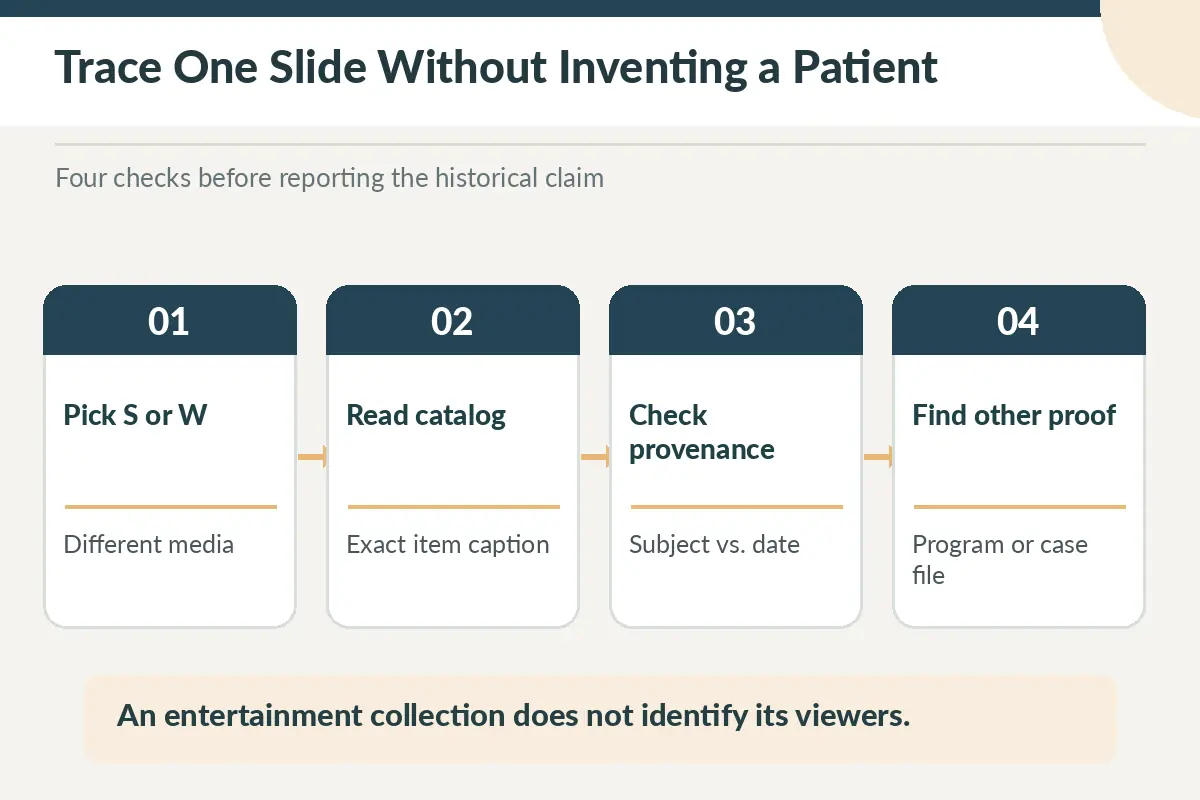
A useful research worksheet has columns for RG 418, series S or W, item number, exact caption, attributed creator, depicted subject, possible creation date, source of each date, and archive reference. Only describe a slide as documented to have been shown at the hospital if a program, inventory, report, or other original record says so. Even a proven program does not place a named person in the audience. An image collection may help contextualize an era without becoming evidence about any particular family member.
If you publish an illustration or reproduction, verify rights and credit requirements for that particular item. Purchase by a public institution does not automatically establish government authorship or unrestricted copyright. Describe the slide’s function conservatively as documented by NARA, and state whether you saw the object, its digital surrogate, or only a finding aid. An accurate caption about acquisition, format and subject is more valuable than an evocative but unsupported story about a patient’s experience.
Use Other Records Only for the Question They Answer
For institutional policy, follow superintendents’ reports and Board of Visitors material in RG 418. For a specific patient, begin with a lawful and appropriate pathway to an actual person-level source, not the picture collection. For the subject of a lantern slide, look for independent contemporary accounts of the depicted building, exposition, or journey. Different questions require different sources. Do not draw an arrow from a slide category to a case file as though the latter automatically refers to the same picture.
An example illustrates the boundary. A family letter says that an ancestor lived at the hospital in 1902, while a lantern-slide caption identifies an Indian monument. Both could be genuinely historical, yet nothing currently links the ancestor with the image. The defensible result is that the collection contained such views during a broad period. To argue for personal exposure, you would need a contemporary program and evidence placing that person at the event. If those do not survive, preserve the unanswered question.
More Family Story and Preservation Guides
How We Research and Verify Archival Claims
We compared the record-group guide with the relevant National Archives research guidance, checked the cited record-series distinctions and dates, and reviewed overlap with existing GenHis titles and the supplied WordPress inventory. Our decision charts summarize the scope of the inventories; they are not reproductions of historical maps or documents. Where an individual item has not been examined, the wording makes that limitation explicit rather than claiming a personal find or a confirmed event.
The purpose of this guide is to make the next check reproducible: record RG 418, the exact series or entry, title or item number, original date, later-copy date where applicable, and an independent confirming source. Online descriptions do not guarantee that every sheet or photograph is digitized. Check terms and access requirements for the specific item. Read our affiliate disclosure; this educational guide does not assume any compensated records service or an unverified partner arrangement.
The RG 418 guide lists 2,440 lantern slides in series S, alongside separate caption lists and catalogs.
W is a separate group of 96 color glass slides described as artistic, historical, and moral subjects.
No. The institutional purchase purpose says nothing about a particular person’s treatment or viewing.
No. It is the series period; the event, image production, purchase and viewing may have different dates.
Quote RG 418, section 418.4.2, series S or W, and any catalog item or caption number.