
The National Archives identifies 64 photographic prints in RG 24 series FS showing Spanish naval vessels and ship damage during the period 1895–1898. The same record group separately lists four manuscript maps of American and Spanish naval operations in Cuban waters in 1898. A damaged hull in a photograph can help identify a vessel or condition, but it cannot alone establish the date, cause, location, casualties or actions of a particular sailor. A mapped naval movement is likewise not a roster of everyone on board. See the National Archives record-group description for the exact scope of this material.
The collection begins in 1895, three years before the main war of 1898, so not every Spanish vessel view must depict damage caused in battle. The still-picture holdings and the manuscript maps are separate record types with distinct research purposes. This guide builds a conservative photographic and cartographic comparison, then outlines the independent ship and person-level evidence required to turn a striking visual into an accurate family or maritime history.
Start With FS Prints, Not an Unidentified War Image
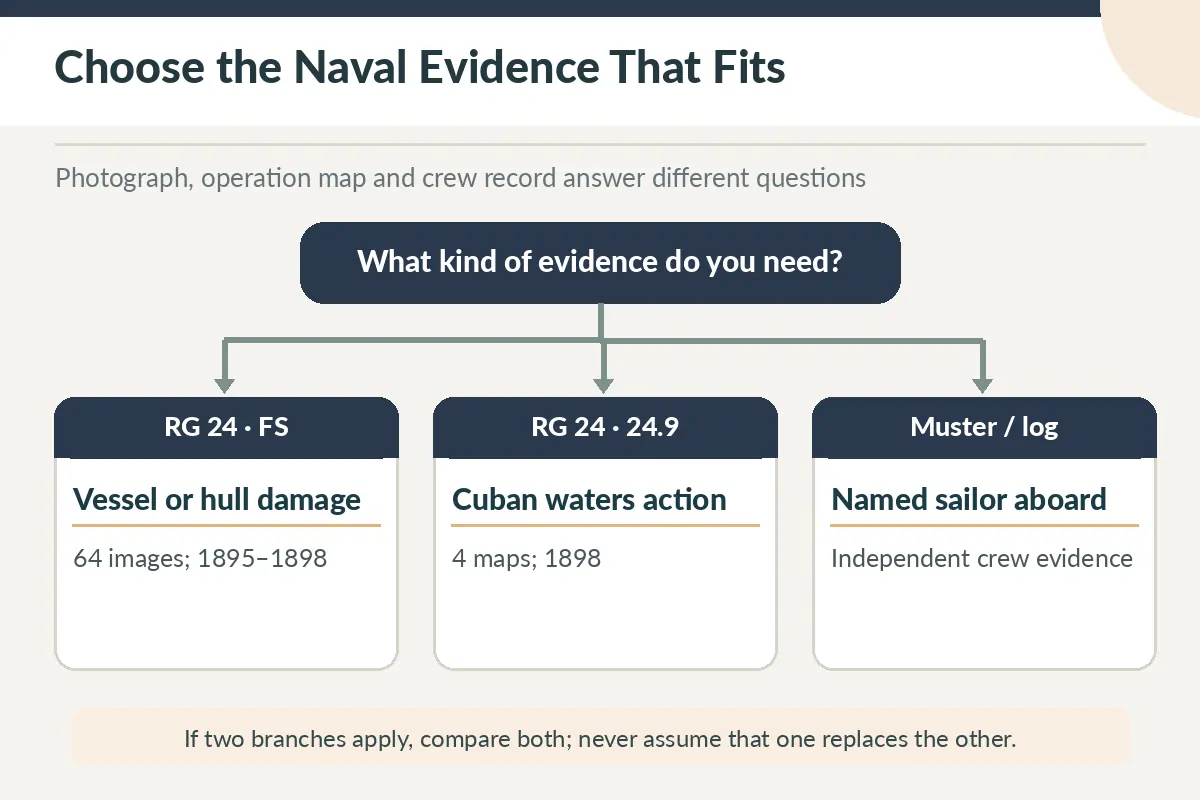
Find RG 24 section 24.12, Still Pictures (General). NARA describes 64 FS photographic prints of Spanish naval vessels and damage to ships during the Spanish-American War, dated 1895–1898. The broad caption does not identify all the ships, photographers or incidents. Request an exact FS print identifier and associated caption before attaching a vessel name. Record whether the photograph is a view of an intact ship, a damaged ship or an uncertain subject, rather than assuming the entire collection depicts combat losses.
Inspect the image edges, mounting, labels, perspective and visible ship features. Nameplates may not be visible; silhouettes of vessels of similar type can mislead. A copy or postcard reproduction may have acquired a later title. Write down the original wording from the source, then put any modern identification in a separately attributed column. If two captions disagree, keep both and investigate. A digital copy without the back of the original print may omit critical provenance information.
Compare the Photograph With the 1898 Naval Maps
RG 24 section 24.9 inventories four manuscript maps showing American and Spanish naval operations in Cuban waters in 1898. These maps are not photographic negatives and should not be treated as frames from the same incident. A map may help locate an engagement, port or vessel movement described elsewhere, but it may simplify action or omit individual ships. Request the particular map title, scale, legend and date, and determine whether it was created during the event or compiled afterward.
Use two side-by-side timelines: one for the photograph’s exposure or documented date, and one for the operation dates on the map. A ship seen in harbor after a battle may not appear at its battle position on a contemporaneous operations map. Avoid projecting modern coastline changes back into 1898 without checking historical charts. Where a map lacks a vessel name, do not insert the ship from a photographic guess. The comparison should narrow questions, not manufacture a continuous eyewitness narrative.
Separate Visible Damage From a Cause or Casualty
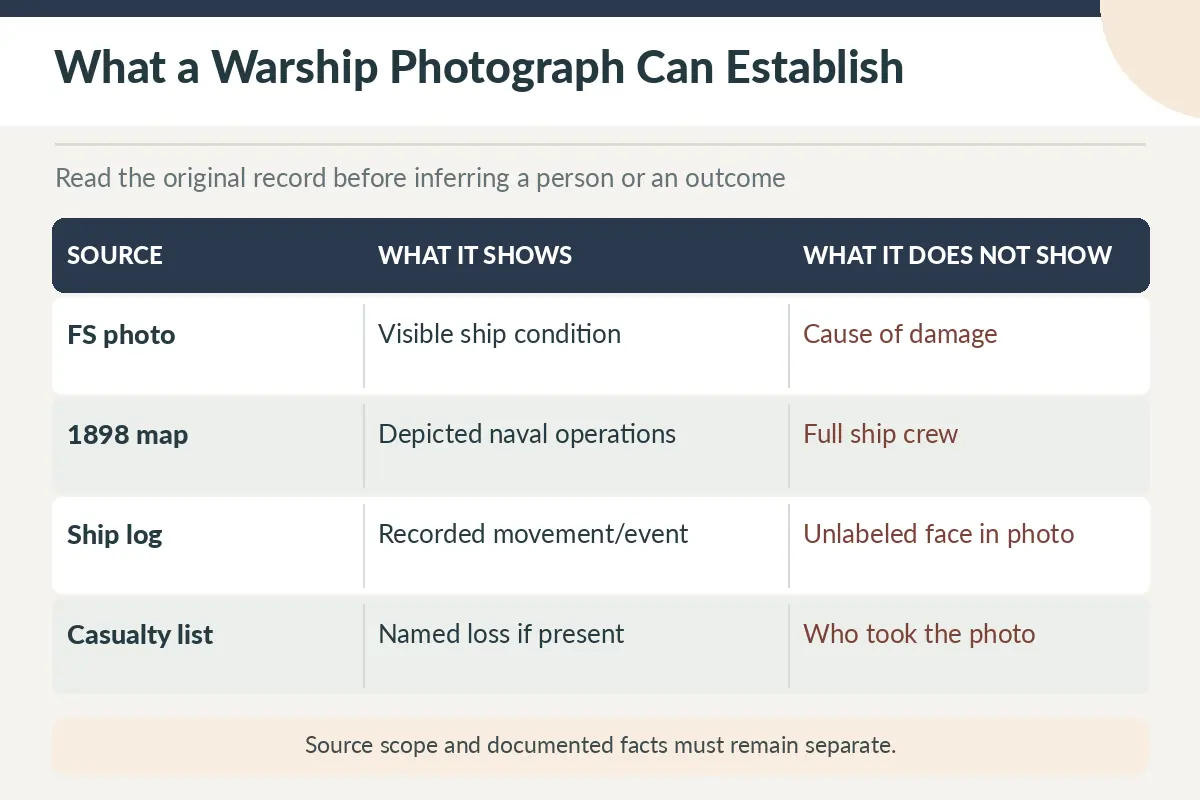
A broken mast, scorched superstructure or damaged plating is a visible condition, not a proven explanation. A photograph alone usually cannot distinguish gunfire, collision, accident, storm damage or post-battle salvage without additional records. Even damage firmly associated with an engagement does not provide a casualty list. Look for official reports, ship logs, naval correspondence and medical or casualty records appropriate to the navy and the relevant vessel.
The photograph’s date also matters. An image taken during later inspection could show the aftermath of several events. Ask whether the caption documents when the damage occurred, when the ship was photographed, or when the print entered a collection. Do not convert a heading such as “Spanish-American War” into a specific place and day unless the item supports that level of precision. For an unknown loss, keep the cause unresolved until a direct record addresses it.
Identify a Sailor Through Service Records, Not Deck Figures
Even if individual sailors appear on deck, an FS image is not a complete crew list. A uniform and apparent age do not provide a reliable name. Use the relevant ship’s muster roll, personnel record, pay document or casualty list if surviving and applicable. Confirm that a named vessel in the photograph matches the ship in the service record, including spelling and dates. An ancestor who served on that ship in another year should not automatically be placed at the photographed event.
Where a family story says that a relative took part in a Cuban naval action, build a comparison grid of service dates, ship, port, documented movement and photographs. Distinguish someone assigned to a vessel from someone actually present at an engagement. Transfer, illness, detachment and temporary duty can interrupt apparently straightforward service narratives. If records name several similarly titled ships, verify the exact vessel rather than accepting a matching first word. Do not call an unnamed deck figure an ancestor.
Check Wartime Context and Prewar Spanish Vessel Views

The FS collection’s 1895–1898 date range includes photographs from before the 1898 war. A Spanish cruiser shown in a peaceful harbor in 1896 could be useful for vessel identification but would not record a wartime battle. Compare documented ship configuration, armament, paint scheme and known refits as context, but seek reliable technical or operational sources before assigning a year. A flag or uniform style may assist a hypothesis without providing a securely dated exposure.
Photographs may have circulated as press illustrations after their creation. If a postcard caption claims to show a warship at an engagement, locate the earliest attributable print or original photograph. A later mass-market caption can introduce a dramatic but inaccurate location. Keep the source history visible: original image, reproduction, caption added, and any evidence of retouching. Avoid claiming that the National Archives has authenticated a press anecdote simply because it holds a version of the photograph.
Write a Citation That Survives Later Correction
Cite National Archives, RG 24, section 24.12, series FS, exact image identifier, original caption and date when documented. For a map, cite RG 24 section 24.9 and the individual manuscript map title and identifier separately. Add any ship log or roster used to establish the event or the person. Readers should be able to see which source identifies a hull, which places an action, and which names a sailor. Do not blend all three into a single unsourced photo caption.
Consider a tentative case: a family album holds an unlabeled wreck photograph and a letter mentions the Cuban campaign. The RG 24 FS images offer a comparison pool, but not an automatic match. First examine the original album photograph, next compare identified FS views, then corroborate the ship and date with official maritime records. Only after a reliable personal source connects a relative should the family story state participation. A carefully qualified illustration is more useful than a dramatic misidentification.
More Records and Archives Guides
How We Research and Verify Archival Claims
We compared the record-group guide with the relevant National Archives research guidance, checked the cited record-series distinctions and dates, and reviewed overlap with existing GenHis titles and the supplied WordPress inventory. Our decision charts summarize the scope of the inventories; they are not reproductions of historical maps or documents. Where an individual item has not been examined, the wording makes that limitation explicit rather than claiming a personal find or a confirmed event.
The purpose of this guide is to make the next check reproducible: record RG 24, the exact series or entry, title or item number, original date, later-copy date where applicable, and an independent confirming source. Online descriptions do not guarantee that every sheet or photograph is digitized. Check terms and access requirements for the specific item. Read our affiliate disclosure; this educational guide does not assume any compensated records service or an unverified partner arrangement.
The RG 24 guide lists 64 FS prints for Spanish vessels and ship damage, 1895–1898.
No. The stated span begins in 1895 and includes Spanish vessel views as well as damage.
No. Four Cuban-waters naval operations maps are described separately in RG 24 section 24.9.
No. A casualty or person-level record must establish any individual outcome.
Identify the FS print, any relevant 24.9 map, and an independent ship log, roster or report for specific events or crew claims.