
The National Archives guide to Record Group 24 identifies 78 lantern slides labeled RS, described as humorous views of navy life used by the Navy Recruiting Bureau in New York City in 1925. The medium matters. A lantern slide was intended for projection, and the stated recruiting use means the image should first be interpreted as communication to an audience, not as an unfiltered snapshot of everyday naval service.
Researchers can use the slides to study what recruiters chose to show, how humor represented naval occupations and how a public program packaged an image. They should not treat a pictured sailor as a named veteran or infer that a joke illustrates a typical incident on a particular ship. The first task is to distinguish the slide itself, any written caption and the historical claim a viewer hopes it supports.
Find RS Before Browsing Other Navy Photographic Groups

In section 24.12, RS is the designation for the 78 humorous recruiting slides. PAN and TC, by contrast, describe Navy training camps and schools around 1916–1920. CD, RP and RPA are photographic groups of various Navy personnel from the World War I period. Those groups are not interchangeable with RS, even when uniforms, barracks or ships look similar.
Write “RG 24, RS, 1925” in your search ledger along with the complete item title or identifier when discovered. The label selects a format and purpose; it does not identify a specific projected program, the location of every performance, or which slides were screened together. If the Catalog describes the group without showing individual scans, request item-level information rather than assuming 78 public images are online.
Treat the Slide as a Made Object, Not an Event Photograph
Inspect the slide mount, border, handwritten numbering, projected image and any accompanying title. An image may be posed, illustrated, rephotographed or combined with words. The NARA group description calls the views “humorous”; it does not guarantee that every slide captures an actual incident or a real identifiable sailor. Do not claim that a comic scene records misconduct, a regulation, or an officially measured working condition.
If you encounter a digital scan, check whether it represents the full mounted object or just the image area. A mount can preserve sequence numbers, trade names or clues to how a presentation was assembled. Those details are part of the artifact’s provenance, even if they are not legible on a small web preview. Keep a transcription of wording separate from your interpretation of the joke.
Distinguish Recruitment Messaging From Regulations
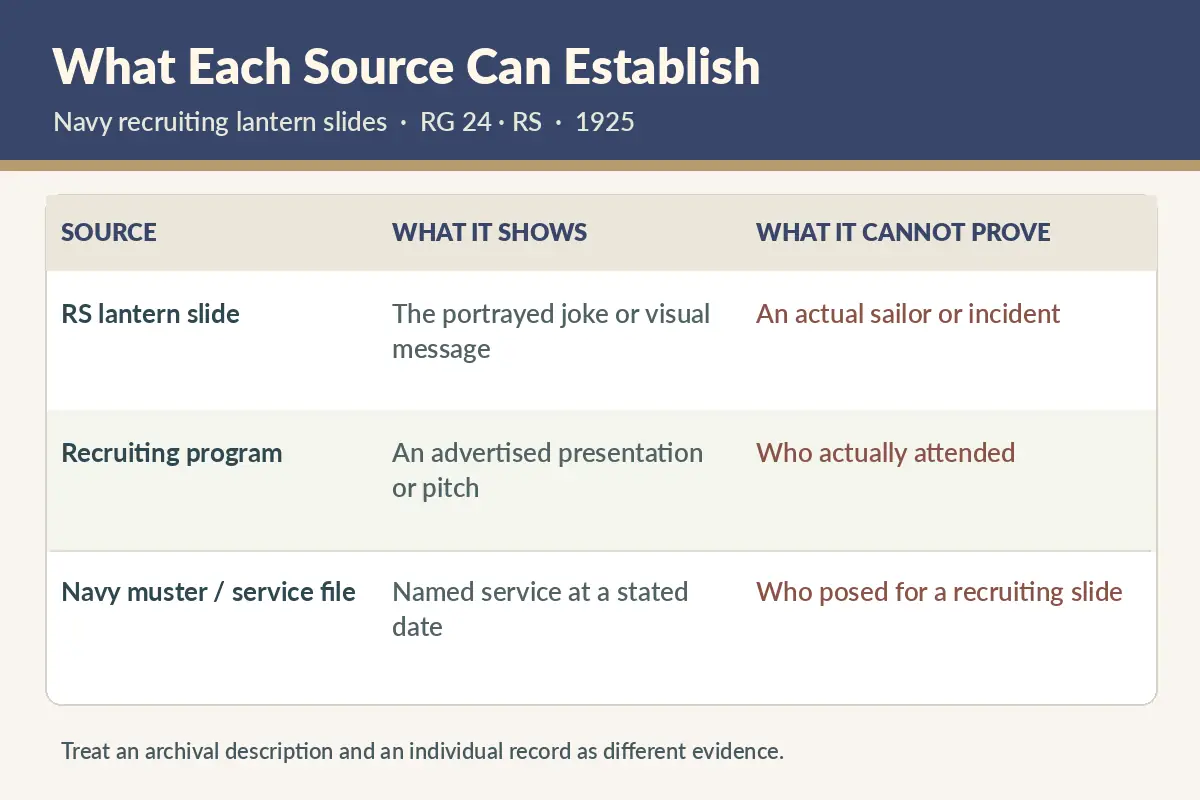
A recruiting slide may portray shipboard routine, food, discipline or leisure in exaggerated form. Ask what message a prospective recruit might have been intended to notice, and identify whether the humor depends on a particular stereotype or convention of the era. Historical representation is not evidence that the depicted behavior was required by Navy rules.
When a punch line involves pay, rank or training, test any factual implication against a contemporaneous Navy manual, recruiting publication or regulation with the relevant date. Publications may state policy, but they still cannot show that an individual sailor experienced it. Avoid translating a visual gag into a factual paragraph about all sailors in 1925.
Reconstruct a Presentation Without Inventing Its Audience
The description connects the RS slides to New York City’s Navy Recruiting Bureau in 1925. It does not supply the attendance list for a particular screening. A slide sequence, program, theater advertisement or recruiting-office notice would be needed to identify an event. If those independent records survive, cite each separately and distinguish an advertised performance from a documented one.
A family memory that a relative heard a Navy recruiting talk may be plausible, but the presence of a lantern slide in the collection does not prove that person saw it. Establish residence, the timing of the story and any surviving invitations or correspondence. Keep the reconstructed presentation as a conditional account until the event and its audience are anchored.
Research a Sailor With Musters, Not with a Comic Figure

If the goal is to identify a named family member who joined the Navy, change record type. Search appropriate Navy service documentation or ship muster rolls using a name, service number, ship and date where available. RG 24 contains records created for personnel administration; their evidence differs from a projected RS illustration. A cartoonlike sailor may not correspond to a specific person at all.
Do not infer enlistment because a relative kept a slide or postcard showing a uniformed figure. Souvenirs and publicity could be acquired by people who never enlisted. Equally, a verified sailor’s service on a particular vessel does not establish that the vessel inspired a joke. Separate the two narratives unless an identifiable original caption or contemporary account explicitly connects them.
Compare Lantern Slides With Related Publicity Without Merging Collections
NARA’s RG 24 guide also lists recruiting posters and other photographs covering different years and agencies. These can supply context for shifts in imagery, but a 1940s recruitment poster is not evidence of the exact message projected in New York in 1925. Label dates and media whenever two items are compared.
Watch for a popular image reproduced later on a postcard, pamphlet or online gallery. Two reproductions of the same visual are one chain of transmission, not two independent witnesses to an event. The slide’s physical mount, any archival description and a separately dated recruiting publication may help establish a chronology without assigning an unsupported author to a joke.
Cite the Slide as a Publicity Artifact
Create a citation with the full RG 24 description, RS designation, title or opening caption, item identifier if supplied, date, and repository. A useful research note includes the medium, what is visible, any stated creator or user and whether those claims come from an original label or later cataloging. Do not supply an invented artist or presentation title.
When reproducing the material, be clear whether viewers are seeing an original slide, a modern redraw or an explanatory diagram. Check the repository’s rights and reuse information for the actual item. A 1925 government-associated recruiting image may involve third-party source material; broad assumptions about public-domain status cannot replace specific provenance review.
More Family Story and Preservation Guides
How We Research the Archival Trail and Its Limits
Our method begins with the NARA record-group description and records the exact subject, group code, medium, year span, and stated holdings before interpreting a particular item. We distinguish what the published guide confirms from what a caption or original image would have to establish. The Catalog guidance explains why a series description is not the same as a digitized item.
For specific claims about people, places or property, we compare at least one independent dated record and retain negative or ambiguous results instead of filling gaps with plausible stories. We do not assume that all items are online, that an illustration is a faithful facsimile, or that a proposal was completed. NARA’s copy-request guidance explains why a precise citation matters. Our affiliate disclosure explains the site’s policies; no affiliate relationship is asserted by these archival links.
NARA uses RS for 78 humorous Navy-life lantern slides associated with New York recruiting in 1925.
Not necessarily. Recruiting humor can be staged, illustrated or exaggerated.
No individual service identity follows from the group description; use personnel and muster evidence.
The guide gives no complete performance program or audience list.
Not always. Request the mount and any marginal lettering if provenance matters.