
Start With the Archival Series and a Specific Question
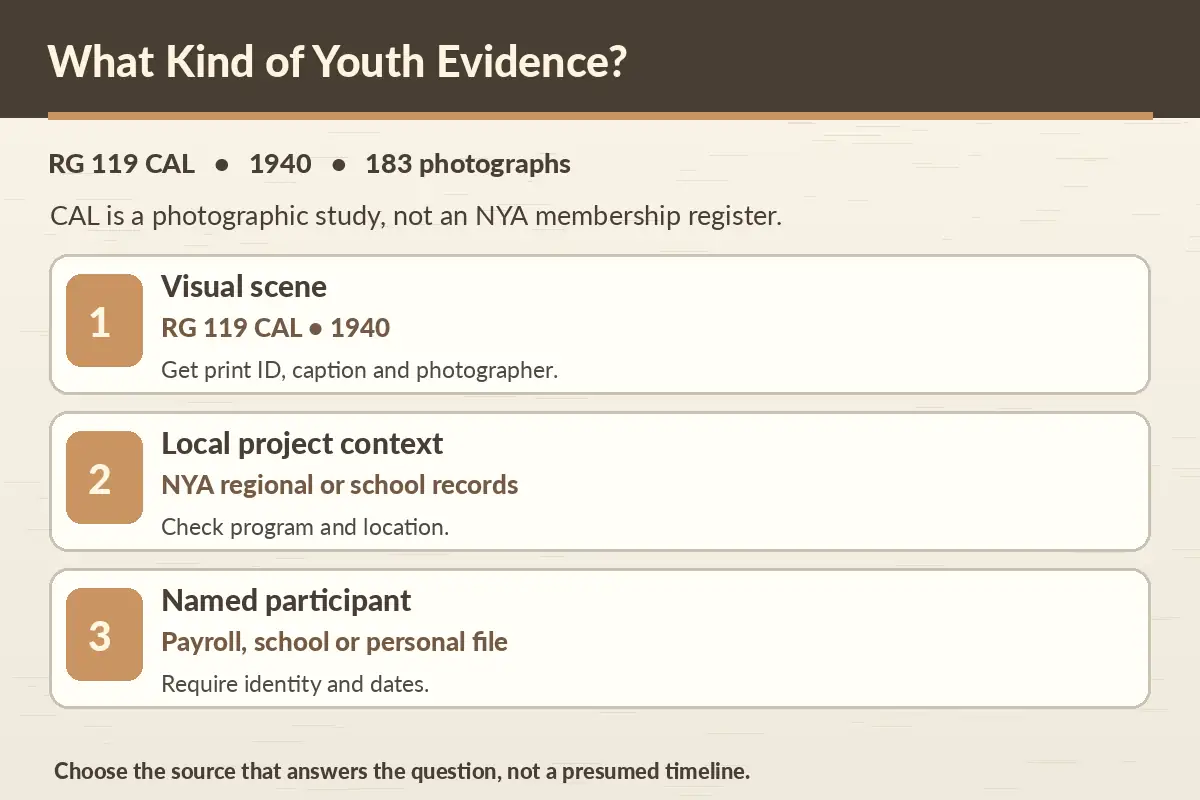
The RG 119 CAL collection is not a roll of National Youth Administration members. It consists of 183 photographs made in 1940 by Rondal (Ron) Partridge, showing youth unemployment, student antiwar activity, idleness and work training. NARA explains that the images were created for an NYA pictorial essay about youth needs and programs. Begin with the photographer, series and item number, then ask what the particular photograph actually depicts. A person pictured beside a farm, road or workshop may not have belonged to any NYA program.
The collection is especially useful for place, occupation and the visual rhetoric of New Deal youth policy. It is less suitable as stand-alone evidence for identifying a stranger in a photograph. When a family story says an ancestor worked in a youth project, search personnel, school or local administrative records separately. A negative or print shows an instant; it does not automatically reveal whether someone applied, enrolled, received wages, attended a protest or later moved.
Identify the CAL Print Before Reading the Story
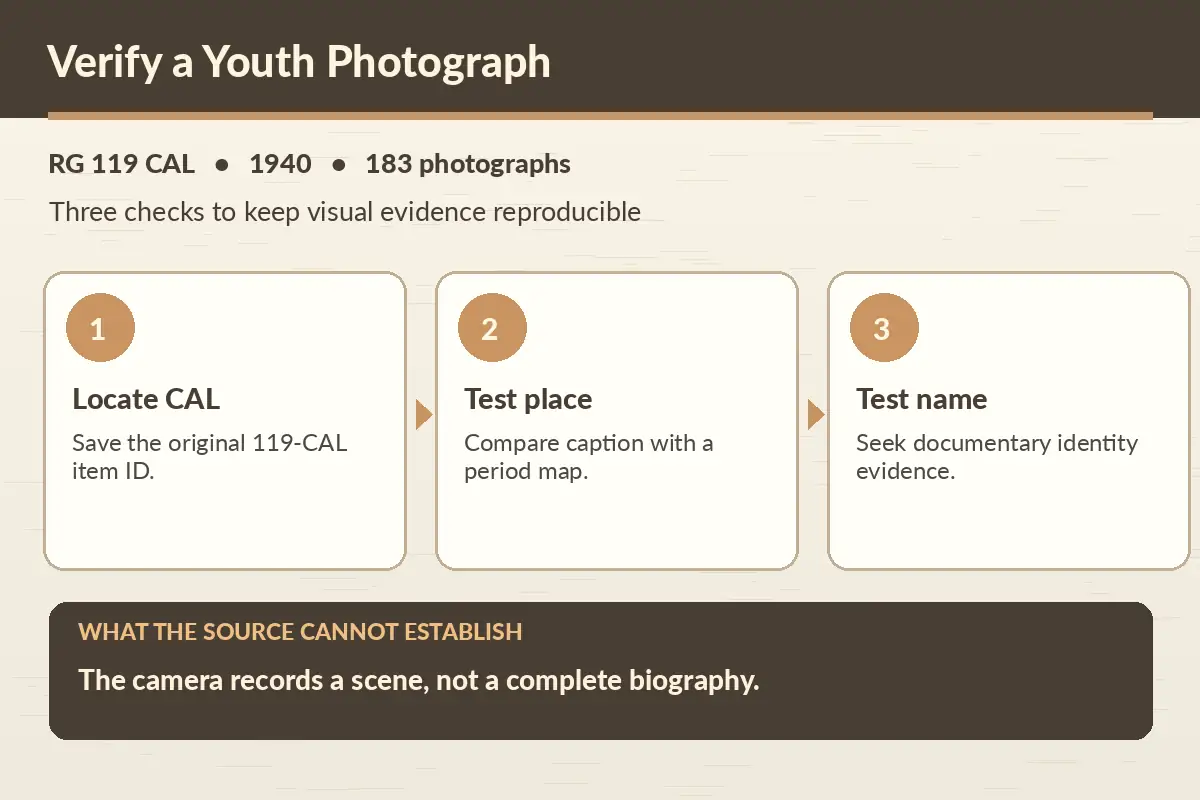
NARA’s New Deal photo guide labels this digitized series 119-CAL, Study of Youth Photographs, and gives the example 119-CAL-81, a migrant youth doing field labor in Kern County, California. That exact example demonstrates why location, original caption and item identifier must be recorded separately. ‘Kern County’ is a geographic clue; ‘migrant youth’ is a descriptive classification; neither gives a full name. Other images may use different captions, and the presence of one known California view does not prove every CAL print was made there.
Inspect the item page for title, photographer credit, image identifier, original caption and any creator-supplied date. If the catalog shows only a digitized face of the image, note the possibility of additional annotations on a mount or reverse. Retain the original caption’s wording even when its social categories are historically dated or incomplete. A researcher can explain the terminology in contemporary, respectful language while preserving the distinction between an archival description and a proven biographical fact.
Separate NYA Publicity From Employment Evidence
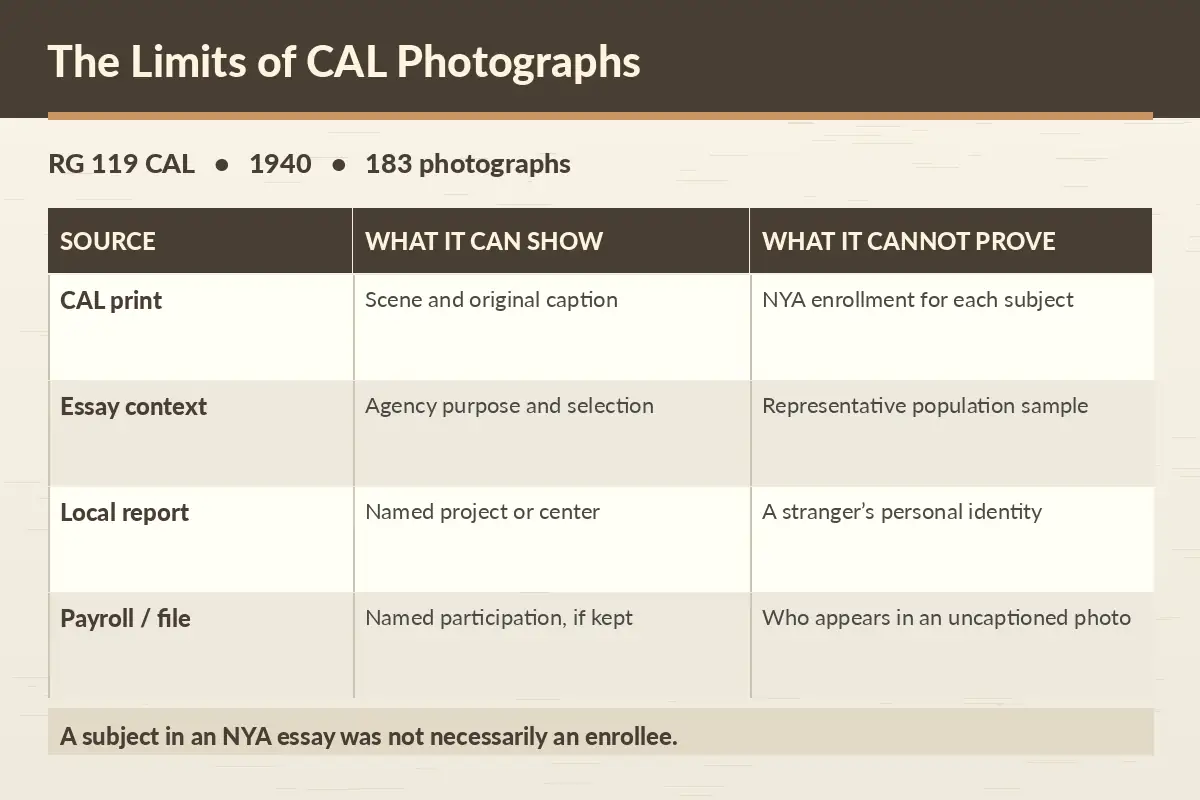
Partridge’s pictures were used for a proposed or actual pictorial essay illustrating youth problems and potential program benefits. That purpose matters: selection for a public narrative is not equivalent to sampling all participants. A job-training scene may represent a particular program, a demonstration, or ordinary labor shown as context. Establish whether the agency’s original caption explicitly names a school, work center, participant or location. Do not infer NYA enrollment merely from the subjects’ apparent age, tools, work clothes or proximity to a federal photographer.
For a named ancestor, seek local NYA employment forms, payroll, school placement documents or administrative correspondence if extant. The broader RG 119 textual holdings include regional records, and the agency’s structure changed in 1942. That later administrative geography is not necessarily the correct filing system for a 1940 image. Confirm the person’s residence and school first, then identify the relevant state-level or regional record series. An apparent visual resemblance between two people is not a substitute for identifying information.
Distinguish Protest, Travel and Training Scenes
The CAL description explicitly includes student antiwar activities, unemployed or idle youth and job training. Those subjects should not be collapsed into one political or occupational category. A person at an antiwar gathering is not automatically an organizer; a young person standing near a road is not necessarily hitchhiking for a particular reason. Use signs, public buildings and original captions to define the narrow scene. If a photograph is cropped, obtain the complete frame before using an edge detail to determine the setting.
Training scenes may contain tools, machines or classrooms whose functions are identifiable even when faces are not. Research the local training project’s existence through dated notices or agency reports, and establish whether the activity was sponsored by NYA or another institution. Describe what is visible before interpreting the photograph as economic policy. A photograph may illustrate vulnerability and agency messaging, but it cannot measure the effectiveness of a whole employment program without separate statistical evidence and a reliable comparison period.
Compare the 1940 Picture With Local Records
If a CAL frame seems connected to a family locality, use its place label as a starting hypothesis. Confirm the relevant street, school, camp or worksite against a period map or local newspaper. Search for a matching NYA center or public project by formal name, not only a colloquial term. A photograph labeled ‘migrant youth’ may feature a person temporarily passing through; county residence and birthplace remain unproven. Record each proposed geographical match with a confidence statement and the date of the independent source.
In family work, build an identity table with full name, date of birth, known residence, school attendance and employment history. Compare the candidate’s physical description only after independent documentary links make the identification plausible. Even a family-held similar photograph requires source criticism: who annotated it, when, and how was it kept? Without a name-bearing contemporaneous caption or corroborating source, the defensible conclusion is often that the image documents a type of experience, not the named ancestor.
Respect the Photographer's Frame and the Subjects' Agency
The artist’s choice of subjects, camera angle and captions can give a powerful but selective impression of Depression-era youth. That does not make the photograph fraudulent; it makes the production context essential. Distinguish photographer intention from what the subject would have said about their own situation. If an original caption describes a person in a stigmatizing way, quote only the minimum necessary for identification and explain the term. Do not supply a personal story, diagnosis or political commitment unsupported by any record.
A collection may include a series of adjacent frames from one event. Compare negative identifiers, clothing, background structures and lighting to identify a possible sequence, but do not assume consecutive numbering equals a continuous exposure without the original filing information. Maintain clear distinctions between the date the image was taken, the date it was selected for an essay and the date a later archive cataloged it. The 1940 date of CAL is a series-level guide, not automatic precision for every print.
Cite the Image and State the Limit of Identification
Cite NARA Record Group 119, CAL, the exact local identifier and caption, credited photographer, attributed date and catalog URL. For the Kern County example, 119-CAL-81 is more helpful than a generic description of the National Youth Administration. Make a separate citation for any associated school report or employment file. Preserve screenshots of metadata only as research notes, never as a substitute for the archival record. If a digital item includes additional linked images, review them rather than assuming the first thumbnail is the complete file.
A good finished account might say that Partridge photographed young agricultural labor in Kern County and that the original federal caption used a particular phrase; it should not supply the person’s name or enrollment history from imagination. If a family source provides a name, explain the independent corroboration and unresolved differences. Keep a log of false matches, because several workers of similar age might appear in a single sequence. Precision about uncertainty is a positive research result, not a failure to reconstruct a narrative.
More Research Method Guides
How We Research This Collection and Its Limits
The series description, dates, and record designation were checked against the official National Archives research guide on November 16, 2026. Independent context was compared with a second official research source, while NARA still-picture citation guidance establishes the information needed to locate an exact image. The site topic list and earlier production titles were compared for duplication. A series description does not identify every subject, date, or object in every frame, and access to a fully digitized item cannot be assumed. The figures in this guide are newly drawn explanatory editorial illustrations, not historical negatives or genuine reproductions. We make no unverified claims of commercial endorsements. See the affiliate disclosure for site policy.
NARA attributes the 1940 youth study to Rondal (Ron) Partridge.
NARA identifies the series as entirely digitized in its New Deal photograph guide, although individual metadata may still need checking.
It is a NARA example showing a migrant youth working in a Kern County potato field; the description does not establish a full personal identity.
No. CAL also includes unemployment, idle youth and antiwar activities as subjects.
A matching school, payroll, enrollment, or other name-bearing source with date and location is needed.