
Identify the Album Before the Scene
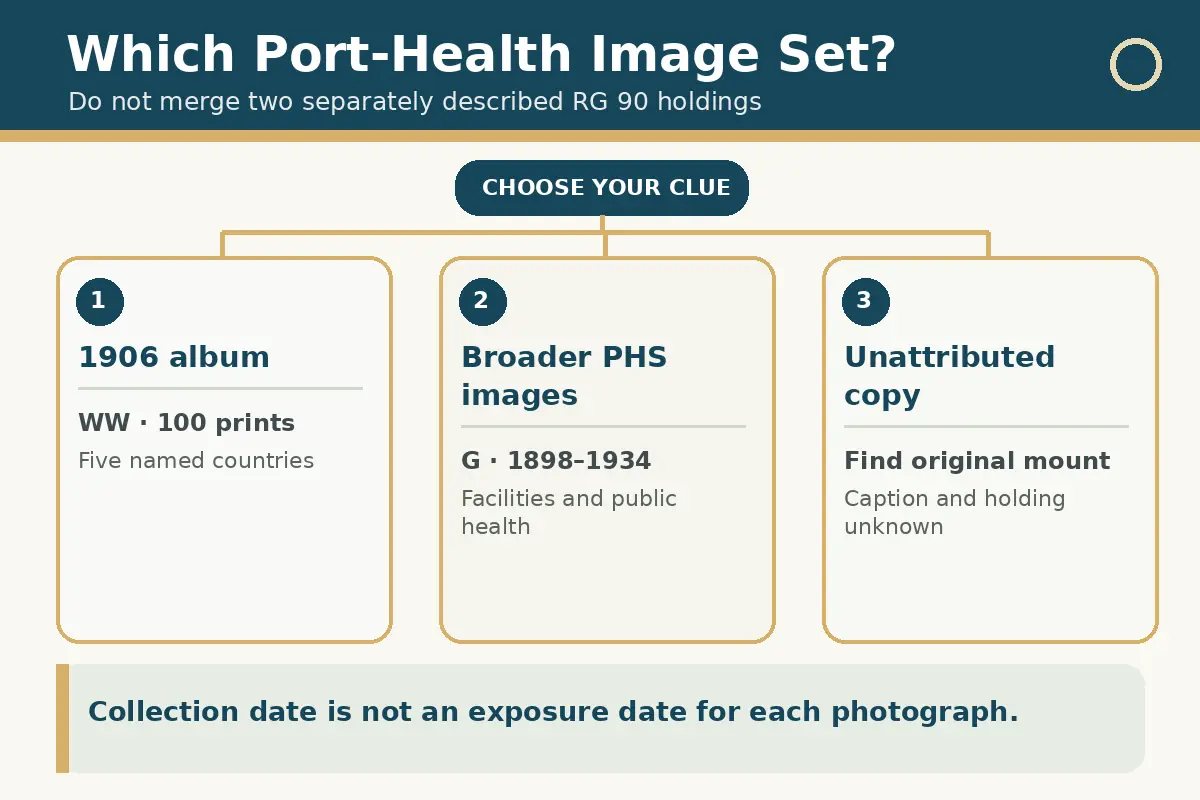
The National Archives Guide to Federal Records describes a specific set of photographic prints in Record Group 90: an album on health conditions at ports in Panama, Costa Rica, Nicaragua, Honduras, and Guatemala, presented to the U.S. Surgeon General by the United Fruit Company in 1906. The guide describes the WW set as 100 images. This is a documented collection description, not proof that every image was taken in 1906 or that the government personally photographed each location.
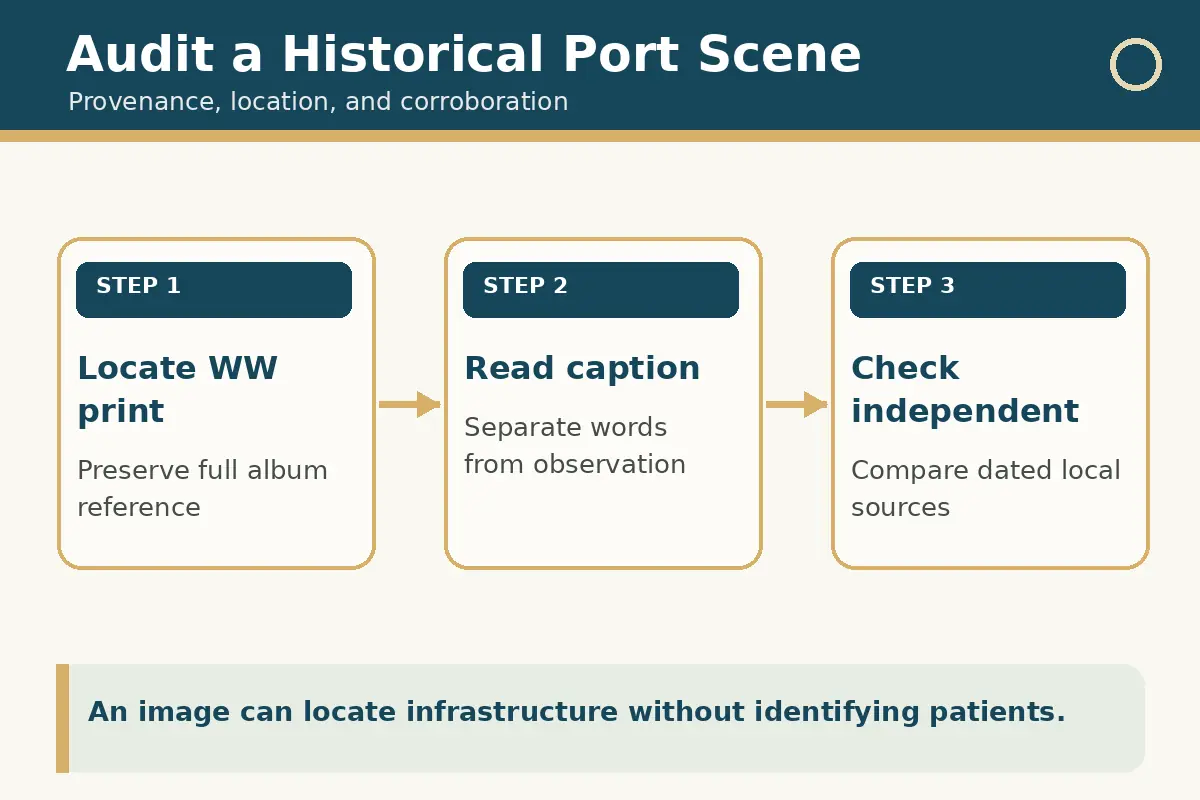
Begin with the picture’s provenance. Record whether the image comes from the WW album, the broader Public Health Service still-picture series, a later publication, or an unattributed online reproduction. A photograph reposted without its original mount may carry a modern caption that was never on the source item. A source chain matters particularly when one image is used to illustrate several countries. Do not select a country by the appearance of a waterfront alone.
Keep Five Countries and One Presentation Date Distinct
NARA associates the album with five named countries and the year 1906. Those facts identify the scope and presentation context of the described holding. They do not supply a port-by-port image inventory, exposure dates, photographer names, or the precise number of images from each country. Avoid applying the album year to every pictured building and person without examining the caption, image mount, and any associated record. The visible harbor itself may have changed between photography and album assembly.
Create a geographic ledger using original caption language first, then a modern place-name field. Country, port, district, and nearby landmarks belong in different columns. Some printed place names may reflect the 1906 administrative geography or spellings used by the album compiler. Translate a place name only after preserving its original form. If two ports share similar warehouse architecture, use identifiable shoreline, signage, harbor plan, or corroborating records rather than stylistic guesses.
Ask What Health Conditions Can Be Seen
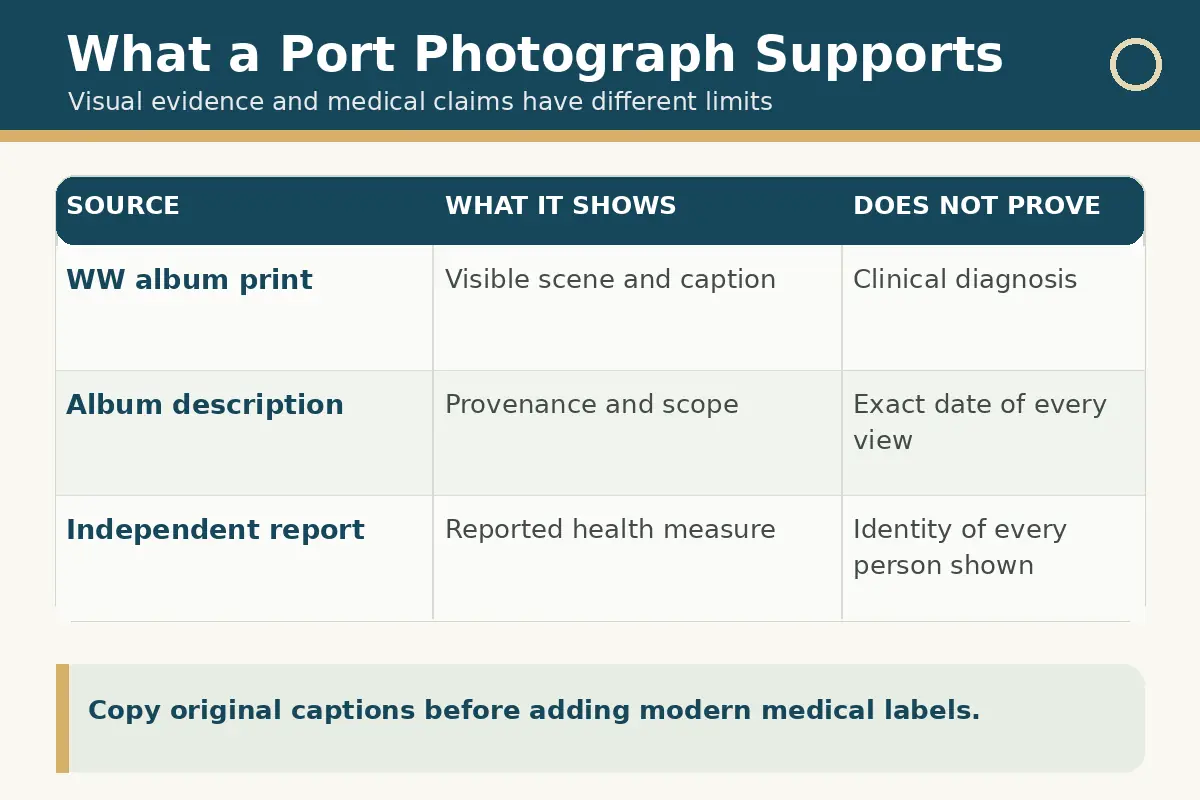
The guide’s wording is “health conditions at ports,” not a list of named patients and confirmed illnesses. An image can sometimes show a drain, water source, building, cleaning activity, quarantine facility, or harbor infrastructure. It does not, by appearance alone, show that a particular person had yellow fever, malaria, or another disease. Nor can a still photograph establish how often a sanitation practice occurred. Separate visual observation from a historical public-health explanation.
For each frame, write a literal description without medical inference: “people beside a waterfront building” is safer than “infected workers awaiting treatment” unless a trustworthy caption makes that claim. Even an original caption may reflect a presenting company’s terminology and interests. If a caption names a condition, quote it as a claim made by that source, not an independent diagnosis. Search for a contemporary medical or sanitary report that can test the claim at the correct place and date.
Recognize Who Assembled and Received the Images
The 1906 album’s presentation by the United Fruit Company to the Surgeon General is a critical provenance fact. Presentation does not establish a company employee took every photograph, and government custody does not make the photographs a government inspection report. An album assembled for a particular audience may select certain views and omit others. Treat the selection process as a research question: what kind of facilities were emphasized and what evidence is not pictured?
A picture of a company-associated harbor does not establish that everyone shown worked for the company, lived at the port, or was examined by a federal doctor. For a claim about a named employee or traveler, obtain independent payrolls, passenger documents, local civil records, or contemporaneous correspondence if available. It is useful to identify an object or building without attaching a person to it. Mark any speculative identification explicitly and avoid adding names to image metadata without grounds.
Compare the WW Album With Other RG 90 Photographs
NARA separately identifies a broad Public Health Service general photographic collection, 1898–1934, labeled G, showing facilities, personnel, research and treatment subjects, and other public-health scenes. The G set and the 1906 WW album are different descriptions. A visually similar photograph does not prove that it belongs to both. Compare archive references, captions, print mounts, dimensions, and duplication notes where available, and record any later negative or reproduction identifiers.
A duplicate print can carry a different caption, cropping, or publication date. Those differences may reveal an editorial change rather than a change in the depicted location. Do not turn a photo’s reuse in a report into a second independent observation of the same scene. If you need to date a hospital or sanitation project, seek construction reports or inspection correspondence from the relevant creating organization. The image provides visual context; the dated report supplies a different kind of evidence.
Request the Item-Level Caption and Citation
Consult RG 90 still pictures, where the WW album and broader G photographs are listed. Use the Catalog search guidance to look for WW, “health conditions at ports,” and specific historic place names. Do not treat a broad online keyword result as evidence that a particular WW print has been identified. The guide describes an archival collection, not necessarily a fully digitized item catalog.
For a reference inquiry, specify the WW group, 1906 presentation, five-country context, and any copied caption or image reference. Ask whether album pages, backs of photographs, or contemporary inventories are available and how to cite the original. Preserve the difference between the collection-level date, individual photographic exposure date if actually known, and modern download date. A file name supplied by a third-party website is not a substitute for an archival item identifier.
More Research Method Guides
How We Research Historical Port Photographs
We classify every assertion as an observation, an original caption, a collection description, or a separately documented historical claim. The NARA guide supports the WW album’s provenance, named countries, and 1906 association, not diagnoses or personal identities that the guide does not describe. When a site or building is identified, the supporting image and independent geographic evidence should be cited separately. An uncertain identification should remain visible in the research notes.
Keep a record of print order, caption transcription, crop, source URL, and any requests for missing album metadata. Our affiliate disclosure is available to readers; no affiliate service is necessary for this method. A responsible caption is useful even when it ends with “exact port not established.” It prevents an appealing historical image from becoming a false statement about a patient, company worker, or outbreak.
No. NARA describes an album presented in 1906; an individual exposure date must be established from the item or independent documentation.
The guide says the album was presented by the United Fruit Company to the Surgeon General. This does not establish who took each image or its original purpose.
Not by appearance alone. A diagnosis requires medical or documentary evidence about a specific person or case.
They define the collection’s stated geographic scope. They do not label every individual photograph or confirm a precise port.
Ask NARA for the WW item or album page, including its mount and any accompanying list, and cite the returned reference.