
The Württemberg emigration index now accessible through LEO-BW is a valuable lead to an emigrant’s hometown and historic Oberamt (district). But the Hans Glatzle compilation is incomplete; it draws chiefly from archives in Stuttgart and focuses heavily on movement around the middle of the nineteenth century. An indexed name may identify a migration record or compilation entry, not guarantee that a person actually arrived in America. Use the village and archive reference as the bridge to original records, then verify a separate arrival or residence document.
Understand what the Glatzle index actually compiles
LEO-BW describes the Württemberg/Hohenzollern portion of the emigration database as a compilation of roughly 53,000 entries assembled through long-term research by Hans Glatzle. Many come from files of the main state archive in Stuttgart, with smaller contributions from Ludwigsburg and Sigmaringen. Entries often include emigrant names, a home place and an Oberamt, sometimes with date, family members, reasons or assets. That mixture matters: not every field is present on every record, and the database is a derivative access tool rather than the original emigration file. Transcribe exactly which pieces are available before constructing a family story from a single result.
Begin with a documented German place and an approximate date
The Landesarchiv migration guide identifies name, dates and home community as useful prerequisites. Take a birthplace from a U.S. marriage, naturalization document or independent German church record, retaining the original spelling and historic district if given. Württemberg changed administratively and place names can recur, so a modern postal address is not enough. If the immigrant is said to have arrived in 1854, give the departure search a reasonable wider interval rather than presuming a vessel left on the same date. Record spouse and children known independently; they help test whether an apparently identical name in the index is genuinely your family.
Search the person and place listings without discarding variants
LEO-BW exposes search and alphabetical person and place browsing within its historical emigration module. Try the surname as recorded by descendants and variants in German script or U.S. documents. Compare the place associated with a hit; two emigrants bearing the same common name can be from different Oberämter. Record the index display, spelling, locality, dates and any archive reference. If the result reports assets or companions, those are reported details to verify, not an automatic genealogy chart. A missing search hit says nothing until you have checked spelling, time period, geographic scope and the documented gaps of the compilation.
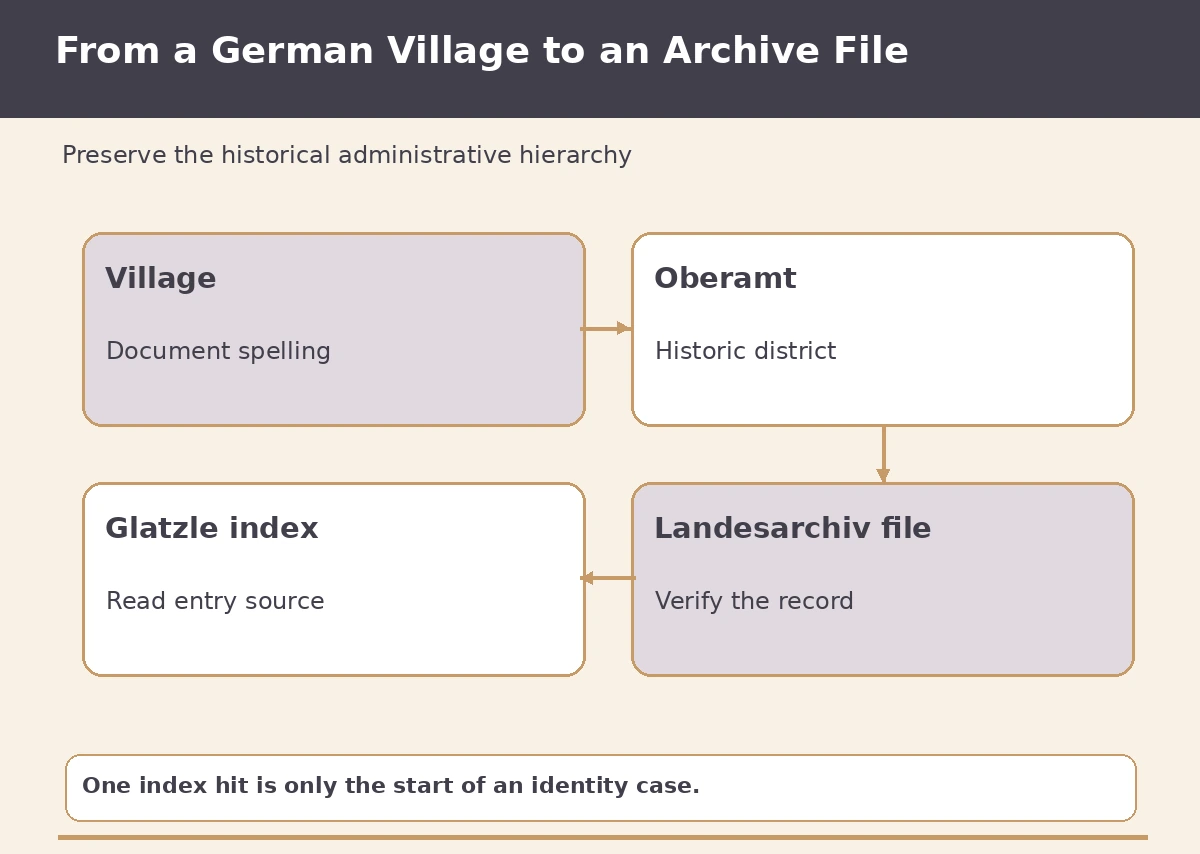
Distinguish the village, Oberamt and present-day district
An Oberamt was an administrative district in Württemberg; its name is often the locator needed for official emigration lists and regional files. Copy it as a historical label. Link the village to the relevant Oberamt in the period of departure, not merely the current district. Place history can explain why a U.S. document names a different administrative center from a German church book. Use the archive reference to route the next search to the responsible holding institution. Treat the hometown as a candidate place of origin until a contemporary vital or church record confirms that the indexed migrant is the person in the overseas family.
Move from a database entry to its archival series
LEO-BW describes source groups including Württemberg administrative and interior-ministry papers, local office files and name lists compiled for statistical reporting. A result may point to correspondence, a permit process or a list rather than a complete individual dossier. Read the repository description and series or file identifiers carefully, then use the Landesarchiv finding aid to request or view the original where possible. Do not assume that an archival citation names every traveler in a family. Explain exactly whether a source documents an application, permission, planned departure or a contemporaneous report of a move; those are different historical claims.
| Document | Possible assertion | What it cannot ensure |
|---|---|---|
| Glatzle index entry | Name, village, Oberamt | Complete emigrant coverage |
| Administrative file | Request, permission, report | Physical departure |
| Passenger list | Reported journey or arrival | Matching German parentage |
| Parish vital entry | Local birth or marriage | Later overseas identity |
Know why a genuine emigrant may never appear in Glatzle
LEO-BW openly states that the Glatzle section does not cover every emigrant. Some relevant archives and Oberamt files were not systematically incorporated. Much of its coverage clusters around approximately 1800–1860, particularly the mid-nineteenth-century migration wave. A family departing earlier or later, leaving without official permission or appearing in an unexamined series may have no index record. An unexpected absence is therefore not proof a family stayed in Württemberg, and it does not justify inventing a departure date. Document the exact variant searches and switch to church departure notes, local files or other documented migration collections.

Keep permission to emigrate separate from arrival overseas
An administrative file can record a request or approval even if a family delayed or canceled travel. A passport, emigration notice or hometown list also cannot by itself prove a ship, a U.S. port or a later residence. Conversely, a foreign arrival record may name a country but not the specific village. Make a two-track timeline: German documentary evidence on one side, overseas immigration, census and marriage records on the other. Only join the tracks when matching spouse, ages, residence, occupation and other distinctive details make a coherent case. Any inconsistency deserves explanation rather than a forced match to the first indexed name.
Use a targeted follow-up search in the Landesarchiv
When an index entry identifies an Oberamt or a plausible series, consult the archive’s research guide and online finding aids for additional lists or local administrative files. Mention the full personal name, plausible birth dates, locality, approximate migration year and any existing citation in a focused inquiry. The archive cannot verify an entire ancestry project from a vague name request, and not every item is digitized. Check access rules and reproduction possibilities before promising that a family file can be downloaded. If the suspected emigrant remains absent, search the historical parish for marriage, children or departure annotations instead of repeating the same database query.

Cite the index and underlying original as separate sources
Your index citation should specify LEO-BW’s emigration module, the Württemberg/Hohenzollern Glatzle portion, the entry or person, historical place and consultation date. A file-level citation should separately identify Landesarchiv repository, record group, series and archival identifier as visible. Describe fields transcribed from the index and the facts actually read in the original. An overseas record receives its own citation, even if the name and place agree. A defensible conclusion may be that a Württemberg man of that name is a strong candidate for an immigrant; state the remaining test needed before writing that he is definitely the same person.
More Records and Archives Guides
How We Research Württemberg Emigration Index
We used LEO-BW’s original description of the Glatzle compilation and the Baden-Württemberg State Archives’ current emigration-research guide to separate index scope from file-level evidence. The guidance explicitly acknowledges unindexed Oberamt holdings and migrants outside the principal time span. This article never equates permission with completed departure, and all example identity comparisons are hypothetical.
Official references checked on October 24, 2026: primary archive; secondary archival guide; collection description. Collection pages describe archive scope; they do not mean we examined or verified every individual historical manuscript. This page contains no paid product recommendation. For the site-wide policy consult affiliate disclosure.
No. LEO-BW describes unexamined files, geographic omissions and a strong concentration around 1800–1860.
It is the historic Württemberg administrative district associated with the recorded home community.
No. Seek a separate arrival, naturalization, census or other overseas record.
Search surname variants and broader archive files, including periods and local offices not systematically indexed.
Provide a known name, approximate dates, home town and any archive citation or Oberamt identifier already found.