
Find Italian marriage attachments by first identifying the comune, the marriage year and the specific archive holding, then looking for Matrimoni, allegati or Matrimoni, processetti. These packets supplement but do not replace the marriage act. Review the site’s affiliate disclosure before following any research-service links.
Locate the Comune and Its State Archive First
A marriage in Italian civil records begins with a geographical question. Record the municipality, the relevant year and the historical civil-registration system, then use Portale Antenati’s register search to identify the State Archive and matching locality. An online database may label a town using a modern administrative name while the source book carries an earlier spelling or district.
A similarly named comune elsewhere in Italy is a realistic source of false matches. Select the archive and comune before browsing individual image thumbnails. If only an approximate marriage year is known, start with marriage acts or indexes and record the date that points to an attachment bundle.
Distinguish Matrimoni From Processetti and Allegati
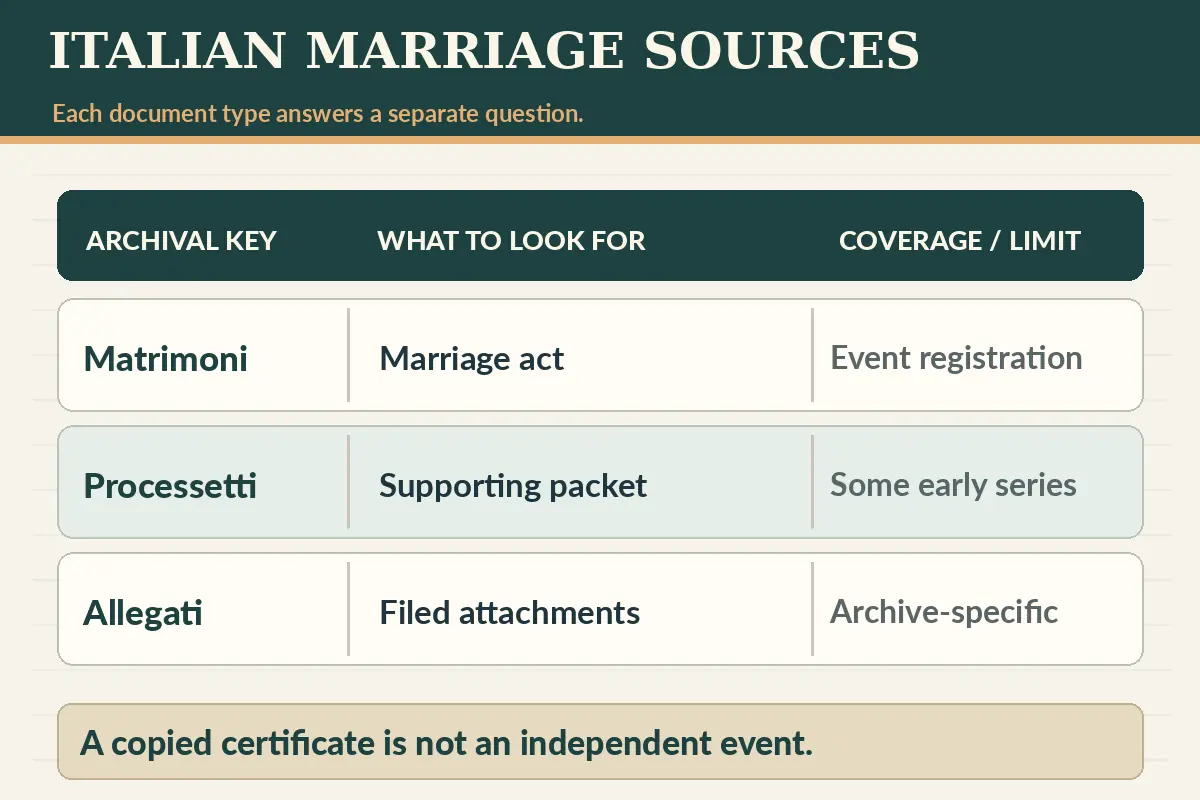
Matrimoni means marriage registers, while Matrimoni, pubblicazioni concerns marriage banns or publication formalities. Matrimoni, processetti and Matrimoni, allegati identify supporting paperwork attached to civil marriage procedures. The precise arrangement varies by region, government, period and archive. On the official Mercato San Severino results, early nineteenth-century processetti are separately listed alongside marriage books.
In Bergamo-area examples, later Italian civil records list allegati as a separate document type. Do not assume these modern website categories were identical legal terms in every era. A supporting packet and the marriage act can have distinct signatures, dates and image order.

Read Each Certificate in Its Own Context
An attachment may contain a birth extract, a parent or former spouse’s death certificate, publication papers, consent, a statement about residence or other required evidence. Such documents can offer a link to an earlier locality, but no fixed checklist applies to every marriage. Transcribe each document’s issuer, date, person named, event reported and apparent relationship to the marriage.
A certificate copied years after an original event may reproduce an older record and should be cited as that copy, not as an independently witnessed birth. A parent’s name reported for permission or eligibility has a particular legal context and should be tested before merging two people with identical names.
Browse the Packet Beyond Its First Page
A common search failure is stopping on the first digitized sheet after finding a familiar surname. Use the image viewer’s page navigation to look for consecutive certificates, cover sheets and any numbers that link the attachments to a marriage entry. Because volumes may group multiple marriages, locate boundaries and compare parties in the preceding and following files.
Page numbering can restart or be absent; log image number as well as any original folio. Where pages have been copied out of order, state the problem instead of inventing a continuous dossier. Some archives have an attachment register for a year without a corresponding searchable person index, so browsing remains necessary even after a surname search fails.
Handle Missing Years and Unequal Regional Coverage
Not every comune or year has surviving, digitized supporting papers. The Vicenza archive description illustrates the distinction between collections digitized online and later registers deposited elsewhere with reading-room access limits. Do not extrapolate one province’s digitization or date coverage to all Italy.
Check whether a catalog result is a year range, a partial volume or only an unindexed image set. If Matrimoni appears without allegati, use the marriage act and ask the appropriate archive whether a supplementary series survives. An absent online image is not evidence that the couple had no required documentary proofs.
Verify a Parent From Two Distinct Events
Consider fictional spouses Maria Bianchi and Antonio Ricci. Their marriage act may name Maria’s parents, while a processetti packet includes a birth extract referring to Maria and a death entry concerning her father. Check the stated ages, residence, both parents’ names and the time elapsed between the source events.
A certificate may have been prepared for a different same-named bride if the bundle was misfiled or the page grouping misunderstood. Compare the birth extract with the original birth register where available; if it contains a transcription mistake, record both forms. Parentage is supported by concordant sources and a defensible identity match, not by the mere fact that two documents occupy adjacent images.

Make a Source Chain Others Can Repeat
Capture the archive’s name, civil-status collection, comune, specific series label, volume year, register or signature, image number and original document date. Separate a marriage entry citation from a supporting birth or death extract. A browser URL to an image can be useful, but also retain the archival hierarchy so that another reader can locate the source if a portal interface changes.
Record Italian terms as displayed with a concise English explanation. Avoid translating a phrase such as Stato civile della Restaurazione into a universally applicable date range. It is an archival collection label whose actual holdings must be checked at the chosen repository.
More Records and Archives Guides
How We Research Allegati and Processetti
We verify the precise record type in the official Antenati register listing before assuming that a name-search hit points to the full documentation. Then we locate the associated marriage and build a certificate-by-certificate evidence ledger. Every birth, death, publication or consent statement receives its own source and date.
We mark whether a document is an original event entry, an official extract made later or a transcription. The identity test checks comune, parents, spouse, years and original pagination. If the packet is missing, we describe exactly which online collection was searched and seek custody information rather than manufacture a parental link from an index alone.
Italian civil-status record groups reflect successive administrations; a register may be filed under Napoleonic, Restoration or Italian civil collections without an identical starting year across regions. Search as the custodian arranges the materials, not as a modern map would predict. For a widowed spouse, supporting evidence about the previous spouse may explain eligibility to marry but does not automatically establish when a remarried household formed. For a younger spouse, parental consent may have been supplied under historical legal rules; do not interpret the presence or absence of that consent through contemporary law. A useful worksheet has a field for each document’s stated legal purpose and a separate field for what it can establish genealogically. This distinction prevents a rich packet from becoming an overconfident family tree.
The act registers the marriage; allegati are supporting papers submitted or copied for the marriage procedure.
No. Survival, terminology and online access differ by period, comune and State Archive.
Choose the State Archive, comune and year, then inspect record types such as Matrimoni, processetti or Matrimoni, allegati.
It can support a claim when the person is securely identified; compare the extract with the original birth register where possible.
No. The marriage book and the attachment series have separate preservation and digitization histories.