
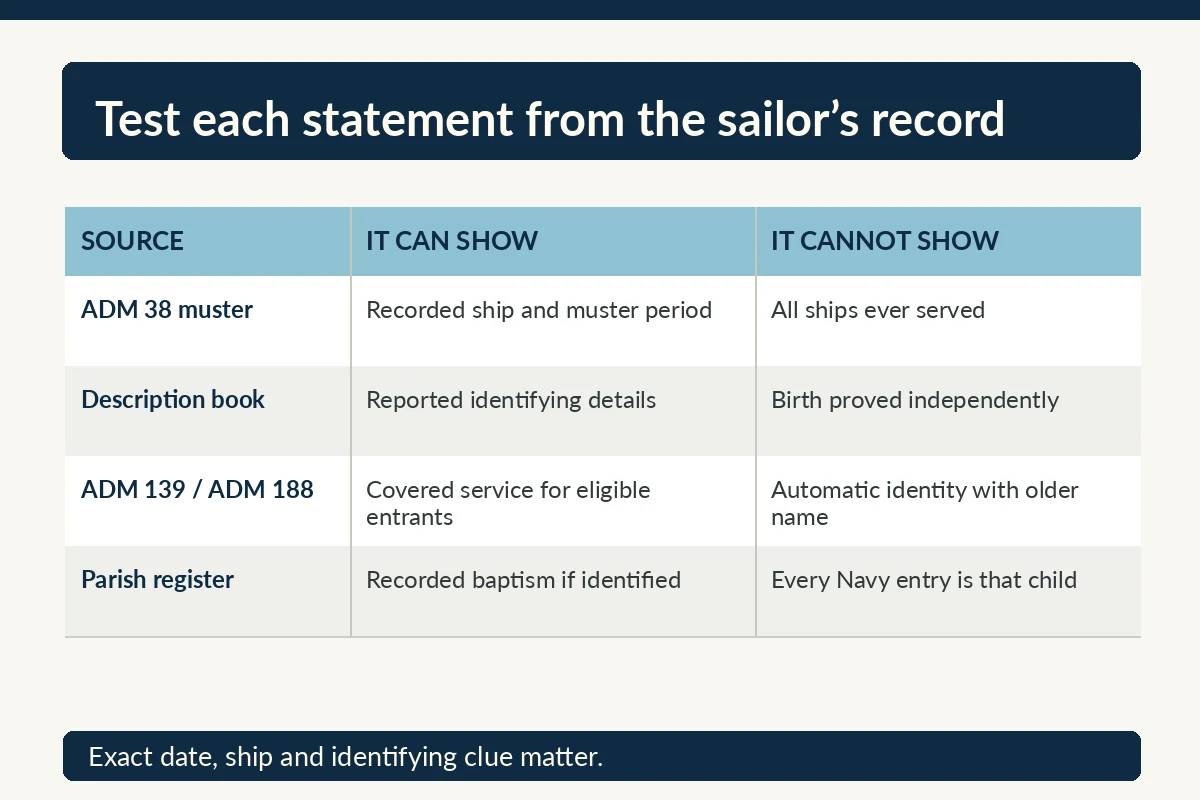
ADM 38 contains Royal Navy ship musters and, for some relevant periods and vessels, description books that can help identify a sailor beyond his name. The National Archives says that description books, most of which are in ADM 38, may accompany musters from the 1830s onward. Such material can include a reported birthplace or identifying details, but a ship entry is not a continuous career register or independent proof of a baptism. Start with the vessel and dates, then compare the exact entries before merging a sailor with a family.
Navy musters were compiled primarily for pay and accounting, normally monthly or quarterly, and their biographical details can be vague or inaccurate. From 1764 a seaman’s age and place of birth should be included in relevant musters, but not invariably. A place recorded as birthplace is the Navy’s recorded information, not proof that a birth or baptism has been found there. Distinguish that assertion from an independently dated parish or civil record, and be particularly careful with common surnames.
Find the vessel and correct ADM 38 book
A ship name, approximate sailing or posting date and rating are stronger starting clues than a surname search alone. Search Discovery for the ship and date span and inspect the catalogue’s item description. Royal Navy ships could share names across different periods; spelling and renaming can complicate the search. Save the full ADM 38 reference and the exact page or muster period before trying to follow one individual through multiple vessels.
FamilySearch’s British Royal Navy Ships’ Musters collection explains that ADM 38, Series III, spans 1793–1878, and distinguishes book designations such as D for description book, M for quarterly muster, C for complete muster and V for victualling list. These marks are descriptions of record types, not proof that the same biographical details appear in every volume. The subset accessible through one platform is not a claim that every surviving ADM 38 book is online.

Read birthplace and age as recorded statements
When a description or muster names a birthplace, copy its spelling exactly, along with any age, rating, former ship or other identifying information actually present. An abbreviated county or place name may have more than one interpretation. Resist translating it into a modern town until comparative maps or other evidence resolves the meaning. If the same sailor’s later record gives a different age, write down both readings rather than silently correcting one.
A naval clerk’s entry may reflect what a recruit or officer reported, with rounding, copying and transcription errors possible. It records what the service document says; it does not establish a unique birth event. Look for a plausible baptism or other contemporary local record using the resulting date range, then compare parents, occupation, name variants and migration pattern. Avoid claiming a match where multiple local candidates remain indistinguishable.
Pair the description with the accounting muster
The description book and muster serve different roles. A description may distinguish men through physical features, place or former service; a muster records association with a particular ship and accounting period. Even where both are part of ADM 38, do not assume they are one continuous register. Check dates, page context, and any recorded ship or book numbers that can connect the entries. If the identifiers do not align, preserve separate candidate persons.
Use a comparative table with columns for original reference, entry date, name as written, rating, birthplace or age where stated, ship and matching clues. A rank or job label can change. A disappearance from one muster may indicate transfer, an accounting change, a gap or a different reason; the muster alone may not settle which. Only use terms like discharged, deserted or died if the record actually says so or a separate source establishes the event.
Know when to switch to service registers
Before 1853 the surviving ship-by-ship musters and pay books are especially important for everyday ratings. The National Archives distinguishes later service arrangements: ADM 139 contains continuous service engagement books for entrants from 1853 to 1872, while ADM 188 contains registers of seamen’s services for entrants from 1873. Those series can make a person’s successive ships easier to follow, but they have their own scope and must not be projected backward onto all sailors in ADM 38.
If a nineteenth-century family story spans both eras, first establish whether the individual is the same rating and whether a later service number or other consistent identifier survives. It is tempting to attach an ADM 188 service trajectory to an older same-name muster entry; resist until dates, age, birthplace and career details are compatible. A description book from an earlier vessel is not proof the person later reenlisted, received a pension or remained in service for decades.
Document conflicting birthplaces without choosing early
Imagine two entries for a William Harris, one reporting a coastal village and another a nearby market town. That is not enough to say they are the same man or to choose the prettier genealogical connection. Compare rating, dates, prior vessel, age and the sequence of ship postings; then review parish registers, local residence evidence and any independent service information. State which detail is copied, which is corroborated and which remains in conflict.
Your final citation should distinguish a catalogue summary from the particular ADM 38 volume consulted, with ship name, muster date, page or folio, entry and any legible notation. Report a birthplace as ‘recorded as’ until matched with independent evidence; report naval service only for ship periods actually documented. This approach keeps the attractive biographical clues in view while avoiding an invented lifetime of voyages based on one administrative line.

More Records and Archives Guides
How We Research and Verify These Records
This guide uses the record-series descriptions and the boundaries explained in The National Archives guide Secondary archival guidance Additional source guidance. The sources identify the kinds of documents, their arrangements and possible access routes; they do not certify any particular ancestor, institution or map as independently inspected. Check each original item and the current catalogue access status before quoting a detail as a documentary finding.
We separate a catalogued lead from an original document, an administrative statement from an event, and a possible identity from a proven link. Historical names, jurisdictions and date ranges can be uncertain; missing entries are not negative proof. Reader information is editorial, not a claim of professional archival representation. Review our affiliate disclosure before following any commercial material on the site.
No. Details vary by book and period; birthplace and age clues can be absent, ambiguous or inaccurate.
No. It is a vessel- and period-based accounting record; reconstructing a career requires comparing separate entries and sometimes later service registers.
The FamilySearch collection guide uses D for a description book and M for a quarterly muster book, among other designations.
The National Archives identifies ADM 139 for entrants in 1853–1872 and ADM 188 for entrants from 1873.
Keep them separate until date, ship, rating, recorded birthplace and independent personal evidence establish a convincing link.