
The National Archives identifies salary books dated 1892–1904 among the records of the U.S. Department of Agriculture’s Division of Accounts and Disbursements in Record Group 16. These records offer a route into the administrative history of people paid through the department, but a salary entry is not a complete personnel file. A historical pay book may record an accounting event, an amount or a date tied to a particular ledger system. It does not automatically prove a person’s entire employment period, job duties or the reason work began or ended.
For genealogists, the critical task is to connect a possible employee name to the correct office and then corroborate identity through different records. NARA separately describes records of payments, expenditure ledgers, contracts, correspondence and other fiscal material under RG 16. The distinction between those record classes matters: funds authorized, funds paid and employment formally established can leave different paper trails. The safest route is to copy the exact original entry before translating it into a family story.
Find the Salary Books Under Their Historical Division
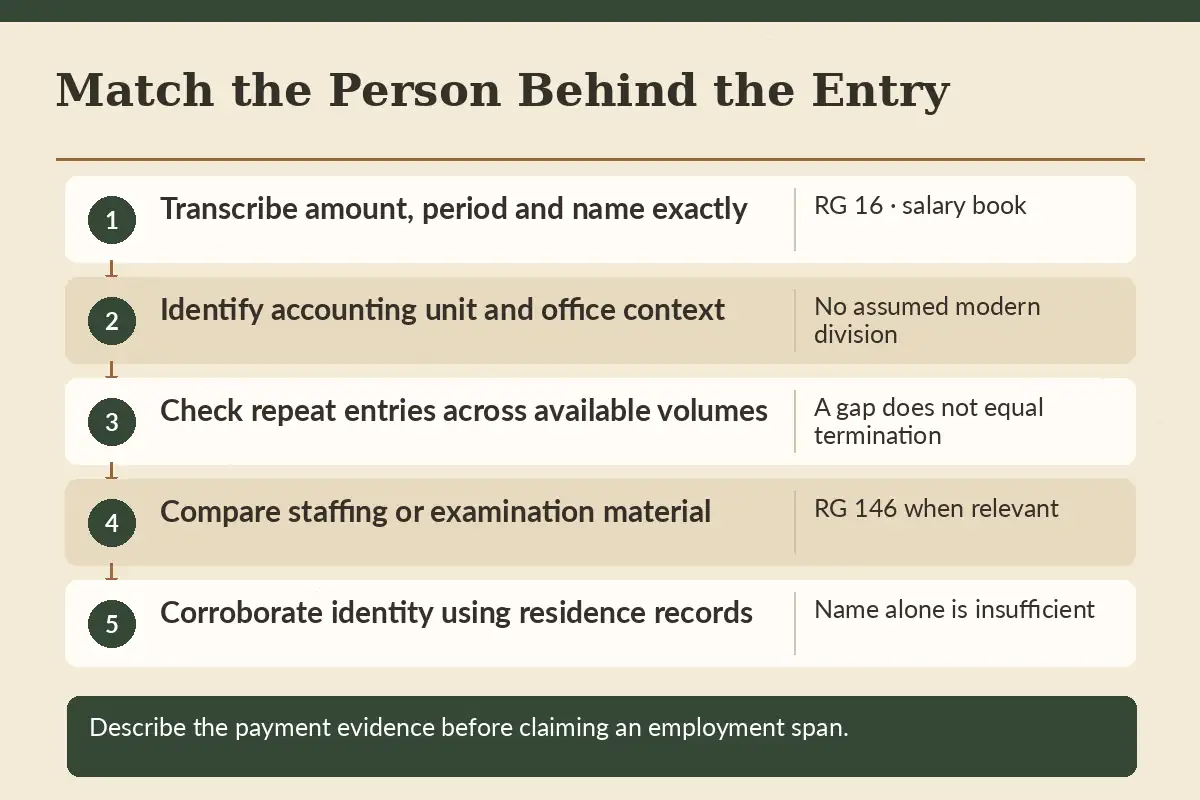
Start at NARA RG 16, section 16.8.1, which names the Division of Accounts and Disbursements and dates its salary books to 1892–1904. That is a record-series date span, not a statement that a particular employee worked throughout those twelve years. Search the Catalog by record group, creating office and the phrase “salary books.” If the public finding aid shows only the series, ask for its arrangement, number of volumes and available access arrangements before assuming an individual name is indexed.
The department’s administrative organization changed. An individual might appear under a division name that differs from the modern USDA unit performing comparable work. Preserve the division or bureau name exactly as used in the original record and add a later explanation only when independent evidence supports it. Avoid inventing a bureau from the person’s known occupation or from a present-day organizational chart.
When reading an entry, take note of the book’s title page, column headings, page number, period, amount, and any ledger reference. Some labels that look like job titles may actually be accounting classifications. Do not expand abbreviations without checking other entries on the same page. A neighboring line can demonstrate how a column is used, but it cannot establish that your candidate shared the neighbor’s employment circumstances.

Decode Period and Amount Before Assuming Tenure
A salary amount has meaning only when the accounting interval and units are understood. Keep the displayed value as written: a monthly figure, an annual rate, a particular payment or a posting could look similar when separated from the book’s heading. Determine whether the source describes an authorized amount or an actual disbursement. Do not convert a single line into a yearly income estimate unless the page expressly identifies that interpretation.
NARA identifies “record of payments,” 1867–1921, and other expenditure or appropriation ledgers separately from the 1892–1904 salary books. These may provide corroboration in some cases, but their inclusion in the Guide does not guarantee a one-to-one cross-reference for every staff member. Check a volume’s own references and preserve any voucher or ledger number before tracing it into another series.
A missing entry in the following book is not necessarily proof of dismissal. The person may have changed an accounting unit, been paid under a different name form, been omitted from that particular volume or worked during a period not covered by the surviving series. Record the negative search with its exact dates and volume scope. That method prevents uncertain accounting gaps from turning into invented resignation or death dates.
Separate Pay, Appointment, and Examination Records
An appointment, a civil-service examination and a payroll entry answer different research questions. A successful examination need not imply appointment, and an appointment date need not be the first date paid. NARA’s RG 146 describes records of the U.S. Civil Service Commission, making it an appropriate context to investigate when the candidate’s position was subject to its procedures. It does not follow that every USDA worker has a complete RG 146 file.
Use the position title and office to decide which additional record to seek. A departmental letter, register of appointments, personnel action or annual directory may show employment status; a fiscal ledger may show only accounting treatment. If the records appear contradictory, place every event on a dated timeline rather than forcing one beginning and ending date. Job titles and pay rates may change without a break in actual work.
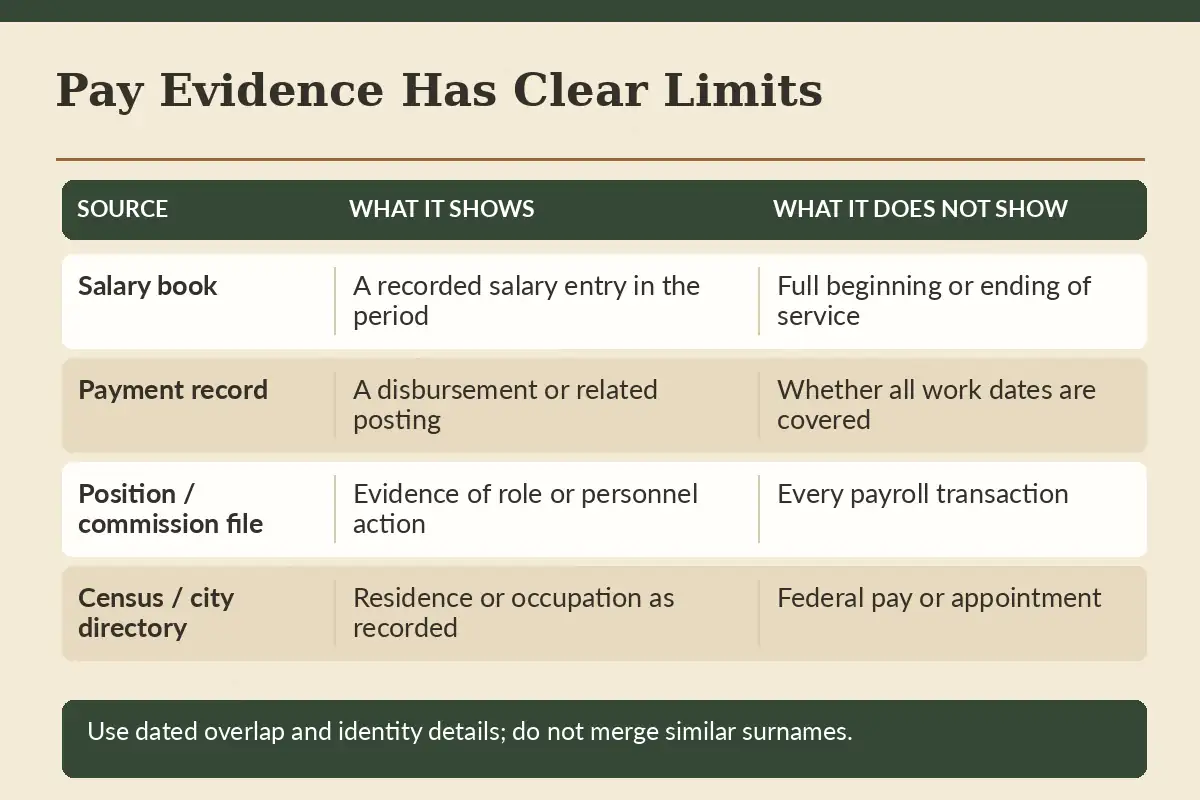
Consider what records do not say. A salary book does not establish an employee’s family relationships, household, religion, birth date or place of residence unless those fields are actually present. The fact that a person earned federal pay also does not establish military service. Conflating these kinds of information is a common source of weak family narratives, especially when two individuals share a surname and initial.
Build an Identity Test With Local Sources
Treat the salary entry as one identity clue. Compare the candidate with the census closest to the recorded period, city directories, known addresses, family correspondence, occupational descriptions and other official evidence. A “clerk” in the census and a person with the same surname on a department ledger may plausibly match, but plausibility is not proof. Require agreement on enough attributes to distinguish the candidate from similarly named people.
Make a table with columns for the exact name form, date, office, amount or role, independent source, and discrepancies. Mark inferred connections clearly rather than silently treating them as facts. If an entry contains only an initial, examine nearby dates and staff lists before deciding which relative it identifies. A later marriage or relocation may create name changes; those links also need documentary support.
To describe an interval of service, look for multiple dated entries and outside corroboration. A line in 1896 and a different line in 1900 do not prove continuous employment throughout the gap. State the earliest and latest observed entries as observations, with the record books cited, while leaving the intervening period unresolved until further evidence is found.
Publish a Careful Pay Record Conclusion
A defensible summary could state that a person of the recorded name appears in a USDA salary book for a specified accounting period, with a stated amount or office if those elements can be read reliably. Follow it with any independent identification evidence and an explicit note about the unknown employment span. This is more informative than asserting “worked at USDA for twelve years” from a series that merely covers twelve years.
Save a complete citation including the Division of Accounts and Disbursements, RG 16, series, volume, page, date, repository and access method. Keep transcriptions and interpretations separate in notes. Future researchers can then revisit your reading of the pay period, amount and identity without relying on an unsourced family-tree claim.
More Records and Archives Guides
How We Research This Historical Record Group
Our source review used NARA RG 16 section 16.8.1 to verify the named 1892–1904 salary-book series and to distinguish it from payment and expenditure records. The RG 146 guide supplies context for a separate federal civil-service record group, not a promise of a complete personnel file. These guides document collections and institutional responsibilities, not any named worker’s actual salary or full tenure.
Consult RG 16’s salary records, the Civil Service Commission holdings, and NARA Catalog guidance. The affiliate disclosure explains the site’s relationships; no paid records product is implied.
The NARA Guide lists Division of Accounts and Disbursements salary books for 1892–1904.
Not necessarily. Read the accounting period and column headings before interpreting the amount.
The Guide does not promise a complete name index or digital copy for every volume.
It may offer civil-service context for applicable positions, but a specific matching record must be located.
No. Consider gaps, changed offices, accounting practices and alternative name forms.