
Record Group 130 preserves a White House daily record of presidential nominations sent to the Senate for 1857–1913 and a narrower nomination register for 1857–1865. Finding a person in the daily record can support the fact that the administration recorded a nomination, but it is not, on its own, evidence that the Senate confirmed the individual or that the person entered the office. For a family historian researching an official, nomination, confirmation, commissioning and service must be traced as separate events.
NARA’s Guide places these nomination materials alongside appointment registers, recess-appointment registers and other personnel records. Those related records are useful precisely because a name may appear at one stage and not another. A nomination can be withdrawn, fail, be rejected or be followed by a later nomination. The researcher should not infer any particular outcome from a blank cell or an absent name without investigating the arrangement and survival of the relevant series.
Identify the Presidential Record and Office
Start with NARA RG 130, section 130.2.5, and give the reference as the “daily record” of nominations, 1857–1913, rather than a vague “White House appointment list.” The Guide also distinguishes an 1857–1865 register from that longer daily record. If you are researching 1862, both descriptions may be relevant; for 1902, the earlier register is outside its stated span. A catalog entry is not a guarantee that a given day was recorded or that scans are available remotely.
Record the nominated person’s name exactly as written, including middle initials, suffixes and possible variant spellings. Capture the date and the office, state or jurisdiction stated by the record. The office often matters more than a familiar surname: a federal marshal in one district is not interchangeable with a consular officer or an appointee in another state. Note whether your evidence is an index, summary or page from the original daily book.
The source’s administrative context also matters. RG 130 groups records from offices and officials predating the formal White House Office created in 1939. Therefore a nineteenth-century nomination record should be described by its specific provenance, not by assuming the paperwork came from the modern office with its later organization. That distinction makes requests to archivists more precise.
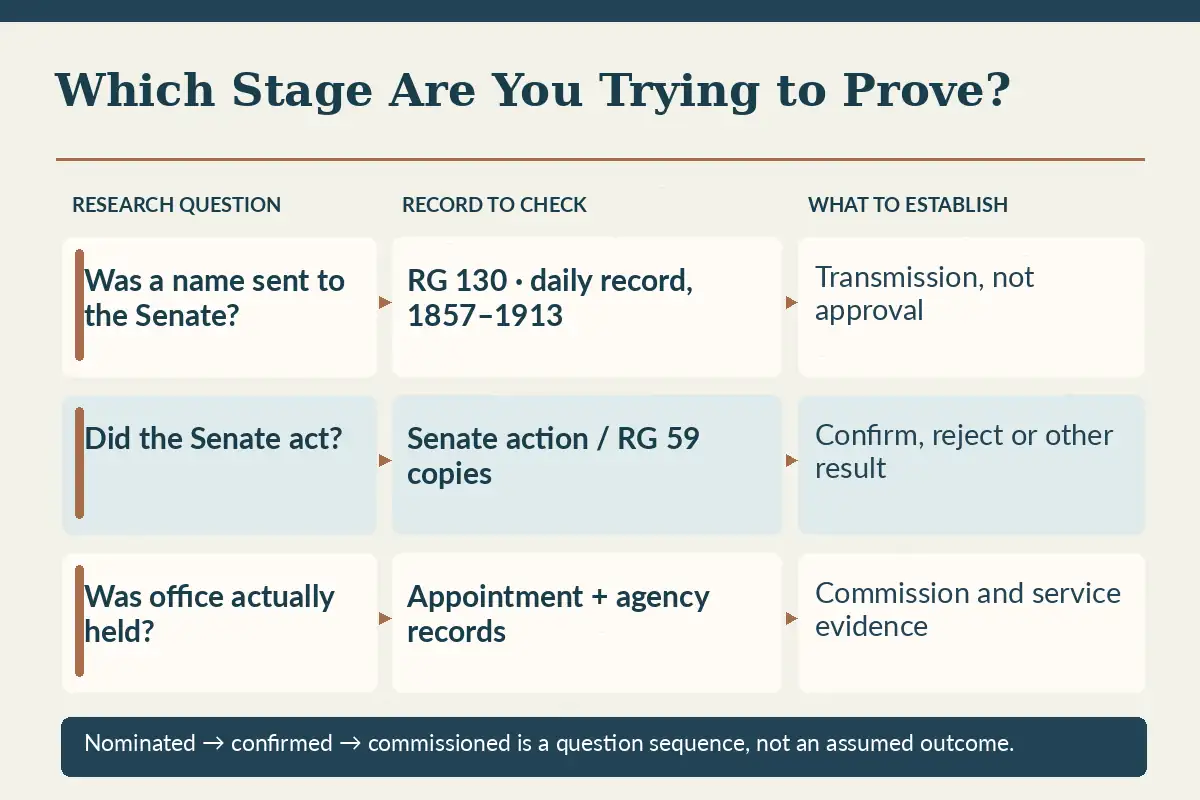
Separate the Senate Step From the White House Step
A presidential nomination typically needed the Senate’s advice and consent for the relevant office, but the original page may not include a full Senate history. Search for the Senate’s action with date and office held constant. NARA’s RG 59 guide, section 59.4.2, lists copies of Senate resolutions confirming or rejecting nominations, 1794–1970, among other appointment and commission materials. Those copies can be useful as a separate evidence stream, not proof that every individual case file is digitized.
Do not translate a notation of transmission into “confirmed.” Equally, do not mistake the date of Senate action for the date someone took office. If an entry is withdrawn or the office name changes, write down the exact language before comparing records. A later nomination for the same individual may be a second event; keep it distinct until you have the formal record linking them.
When dates conflict, compare the type of date recorded: nomination, Senate vote or resolution, commission, oath or payroll. These can legitimately differ. A careful chronological table prevents a family history timeline from claiming several incompatible start dates. It also makes it possible to explain why the same person appears in multiple official series without flattening each into a generic “appointed” statement.
Use Appointment Registers for a Different Question
RG 130 separately identifies registers of appointments for 1889–1909, recess appointments for 1857–1912, state positions for 1857–1912, and diplomatic or military positions for 1861–1912. These ranges overlap the daily nomination record but are not duplicates of it. Choose the register by the office and the precise event you need to document. A recess appointment should not be described as an ordinary Senate-confirmed appointment without additional evidence.
For an asserted commission, consult the pertinent record in the office responsible for recording commissions. RG 59 offers an additional institutional route, but the location and specific series should be confirmed before ordering. The fact that a commission-related series exists does not show that every nominated person appears there. In an audit trail, mark a successful match only if person, office and event date are consistent.
Different administrations and office types may have used different documentation. Avoid the tempting shortcut of finding a name in one appointment register and assuming it resolves a nomination from years earlier. It may reflect a different term, office or person. The goal is a chain of dated evidence, not the largest possible collection of loosely matched name hits.

Verify Real Service Outside the Nomination Files
Even confirmation or a commission may not answer how long someone served. Look for a dated roster, a departmental register, a payroll, an oath or correspondence produced by the employing office. These records document different aspects of service and should be evaluated as such. A payroll entry on one date, for instance, supports payment or service context at that date but does not prove a full term with no interruptions.
Public office names and territorial jurisdictions changed across the nineteenth and early twentieth centuries. Identify the office as it was styled on the relevant date. If the family story says a person was “the ambassador,” but the nominated position was a consul or another rank, retain the historical title instead of modernizing it for convenience. A person’s political affiliation, relationship or reason for nomination cannot be inferred from a name alone.
To reject a false match, look for contradictions: distinct middle initials, overlapping offices in different states, incompatible dates or biographies with different occupations. A confirmation notice in a newspaper is a useful lead but should not override contradictory official action. Record both the source of the claim and the stronger document that qualifies it.
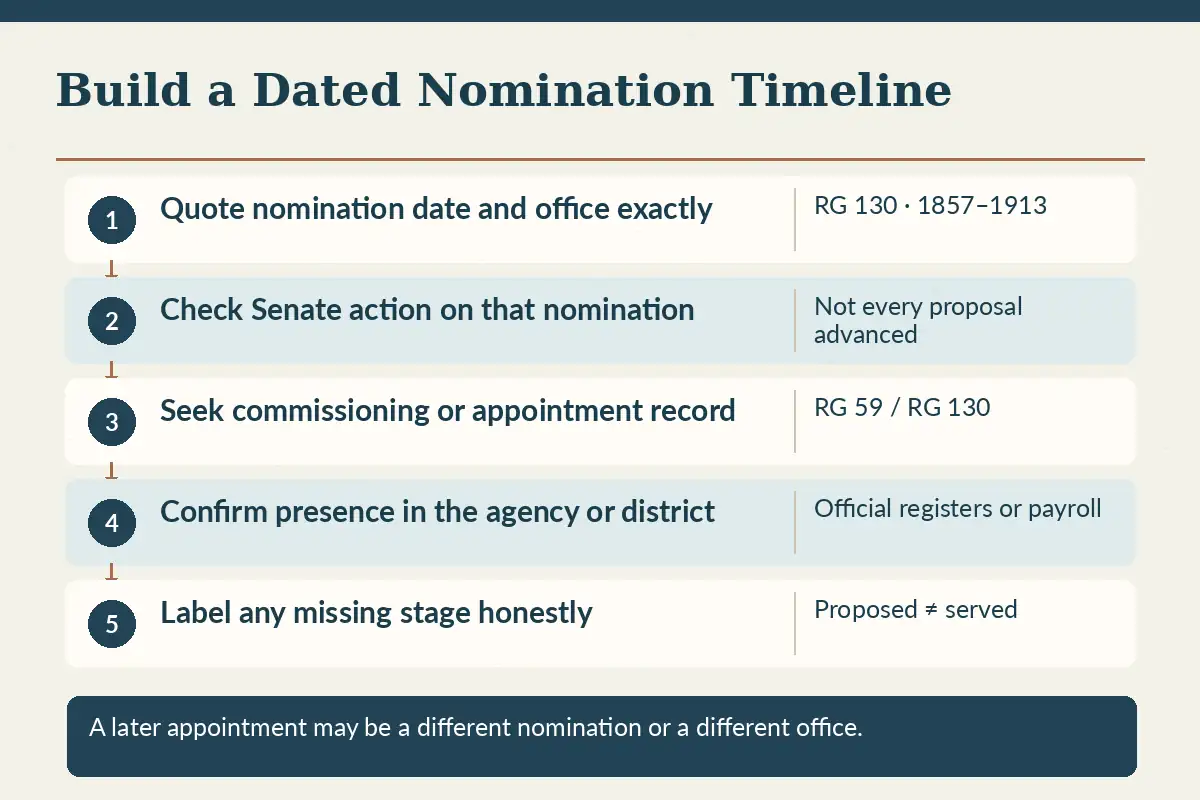
State a Supported Result and a Remaining Gap
An accurate finding might read: “The White House daily record notes a nomination to the named office on this date. Senate action and the person’s actual service have not yet been verified.” If you locate those subsequent stages, cite each record individually. This concise form respects both the value of the nomination and the distinction between a proposal and a completed appointment.
Keep a search log listing which RG 130 and RG 59 series were inspected, the name forms tested and the date windows covered. The absence of a hit in one index is not proof that a person never held the office. A transparent negative search is valuable because future researchers can target the surviving gap rather than repeating unsupported assertions.
More Records and Archives Guides
How We Research This Historical Record Group
We compared NARA RG 130 section 130.2.5 with RG 59 section 59.4.2, which describes Senate resolutions and commission-related material. The ranges are not collapsed: the White House nomination daily record spans 1857–1913, while its shorter nomination register spans 1857–1865. The sources describe holdings, not a particular nominee’s eventual Senate result or office tenure.
Read NARA RG 130, compare State Department RG 59, and use the NARA Catalog guidance for series-level searching. The site’s affiliate disclosure is provided for transparency.
No. The White House daily record identifies a nomination stage; Senate action must be documented independently.
NARA lists a shorter nomination register for 1857–1865 and a daily record covering 1857–1913.
Check the Senate action and relevant copies of resolutions noted in RG 59, with exact office and date.
No. RG 130 lists recess-appointment registers separately; identify the legal and documentary pathway.
Compare the documented appointment with a roster, oath, payroll or departmental record for that office.