
Start with the historic hotel’s name, locality and publican, then use the PROV index to defunct hotel licences, 1857–1932. Treat a licensing record as evidence of an official action, not immediate proof that the publican owned the property or that the hotel remained open for decades.
Search for the licensed premises, not just the family surname
The Public Record Office Victoria lists an index to defunct hotel licences covering 1857–1932 among its online collections. This is a focused way to trace a person associated with a former Victorian hotel, but it is not a complete census of all hotels or everyone who stayed in them. A surname result points first to a licensing record. It does not establish that the person built, owned or continuously operated the premises.
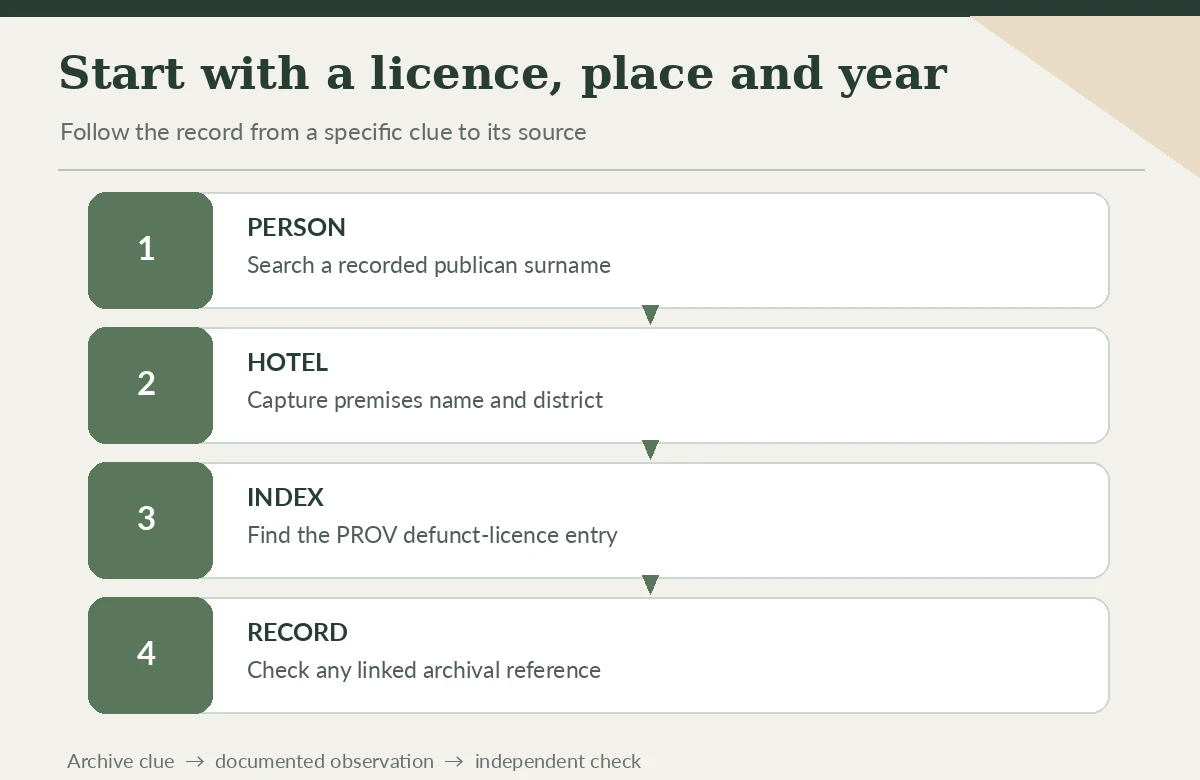
Begin with the publican’s exact name and one place clue. A hotel name may have changed, and the same familiar name might have been reused in several towns. Search combinations of town, street, hotel title and publican surname; keep all candidate premises in the log. A family directory or newspaper advertisement may supply the correct locality, but it should be cited separately because an advertisement is not the licensing authority’s decision.
Check the archive result and identify what the index describes
Use the PROV online collections pathway for “Index to defunct hotel licenses (1857–1932)” and inspect the record description. Note the search name, historic locality, relevant dates and any archival identifiers offered by the index. Some archives make digitized images available while others supply catalog entries or physical-record references only. Do not describe a catalog result as an original licence unless you have actually viewed that licence.
If no image is attached, use the provided record series or item information to determine whether the underlying document is available for request or inspection. PROV explains that nineteenth-century government correspondence can involve an index, a register and a file in separate series; many files must be ordered for a reading-room visit. Record which layer you actually used. This protects a reader from a citation that falsely claims manuscript-level verification.
Separate licensee, manager, tenant and owner
A liquor licence is an administrative authorization, and it can be connected to someone other than the owner of the building. A publican named in an index might have leased the hotel, worked for another proprietor or succeeded a previous licensee. A single change of licence name therefore does not prove that the property was sold. Make columns for licence holder, business operator, ratepayer and landowner; leave unknown cells blank until a separate source fills them.
For property evidence, look for local government rates, land titles and property maps that match the actual parcel. A historical directory can corroborate a business address or occupation but cannot replace a deed. If the same person appears in both the licensing and rate material, verify that the addresses and dates refer to the same premises. The name of a hotel by itself is too unstable an identity key for a parcel. Our guide “South Australia Historical Land Titles” covers a related question.

Construct a year-by-year operating history
List each dated licensing or trade reference as a separate observation. A newspaper notice may report a transfer, an application or an objection; distinguish those verbs because applying is not receiving approval. A directory might have a printing lag relative to the actual licensing year. Keep publication date, event date and licence date in different fields, particularly when the apparent last licence is being used to claim a closure.
Suppose the fictional Rose and Crown Hotel has a licence record associated with an A. Murray in 1889, and the directory for 1891 lists an A. Murray at the same hotel name. This suggests a possible continuation, not automatic proof of uninterrupted trading or identical proprietorship. A later transfer notice or municipal rate entry can help test the link. If a neighboring town contains another Rose and Crown, keep both candidates separate until location evidence resolves them.
Compare adjacent namesakes and renamed hotels cautiously
Publican names can be shortened, misspelled or copied from one edition to the next. Search surname variants, initials, town names and addresses. An indexed surname is more persuasive when it agrees with a contemporary occupation, associated spouse named in an independent record, and licensed district. Avoid merging two publicans with the same surname merely because they appear within a decade of one another.
A hotel might also have been demolished, renamed, moved to different premises or continued under another licence holder. Track physical location separately from business branding. If evidence points to a new building on the same land, note the change rather than describing a single original hotel operating unchanged across decades. A map or rate record helps place the building; it does not automatically prove the same licence continued. Our guide “NSW Publicans’ Licences, 1830–1861” covers a related question.
| Document checkpoint | What to record | What not to infer |
|---|---|---|
| YEAR | Anchor the first dated licence | Unstated family relationships or events |
| NEXT | Compare later licences and directories | Unstated family relationships or events |
| LOT | Use title and rate books for parcel identity | Unstated family relationships or events |
| LIMIT | Renewal is not proof of uninterrupted trade | Unstated family relationships or events |
Handle missing results with an evidence-based search pivot
A missing name can mean the chosen index does not include the case, the hotel was not categorized as defunct in the relevant collection, or the search terms use modern rather than period place names. Verify the series scope before forming a negative conclusion. Try the licensed premises name, known district and approximate year. If the collection description offers a record identifier or a related series, follow those links rather than repeating only a surname search.
Supplement the index with state or local government gazettes, licensing court materials, rate books and newspaper notices, each with its own limits. Do not take a newspaper’s “licence sought” advertisement as evidence that a transfer was granted. Keep a no-result row listing dates searched and the documents that actually survive. This makes later research reproducible without claiming the hotel never existed.

Cite licensing evidence and state exactly what it proves
A useful citation gives PROV as repository, the defunct-hotel index or underlying series, the name and locality recorded, item or licence reference, date and access route. Cite original government licensing material separately from directories, property titles or press accounts. If a source is only an online catalog description, write that explicitly. The strongest analysis is not the largest pile of unrelated links but a short chain connecting the licence, place and independent identity evidence.
The final claim should be precise: a named person is associated with a specified hotel licensing entry at a particular time. Whether that person owned the property, worked there over a longer period or lived with an identifiable family requires further records. State what has been checked and leave an explicit next step, such as a municipal rate assessment for the same plot and year.
How We Research These Historical Hotel Licence Records
This guide is based on the official archival catalogues and public research guidance cited below, examined on October 22, 2026. The procedure distinguishes a series-level description from an original record and an administrative event from a family-history inference. Illustrative names and scenarios are fictional, not transcriptions of historical files. Item survival, reading-room access, online search and fees can change; check the original repository before requesting records. Uncertain details remain open rather than being filled in from an unsourced family tree.
More Records and Archives Guides
Primary Archive Descriptions and Finding Aids for Victorian Hotel Licences
Public Record Office Victoria lists an index to defunct hotel licences, dated 1857–1932, among publicans and hotels online collections (prov.vic.gov.au).
PROV guidance: indexes and registers may be needed to retrieve underlying files, many of which are undigitized (prov.vic.gov.au).
PROV topical index includes municipal rate records and land or house-history holdings for independent property checks (prov.vic.gov.au).
Editorial disclosure: There is no paid recommendation or approved affiliate placement in this guide. See the GenHis affiliate disclosure. Historical records may contain discriminatory language, personal allegations or imprecise identifications; attribute those statements to their source and avoid exposing information about living people.
PROV lists an index to defunct hotel licences covering 1857–1932; coverage of any specific locality or hotel still needs checking.
No. The named licensee, business operator and owner of the land or building can be different people.
Spelling changes, geographic labels, indexing limits or a licence outside the defunct-hotel collection can produce a no-result search.
A last located licensing entry is not sufficient on its own to establish closure. Check later directory, gazette and licensing evidence.
Match historic premises name and locality, licensing record date, municipal rates and title references rather than relying on a reused hotel name.