
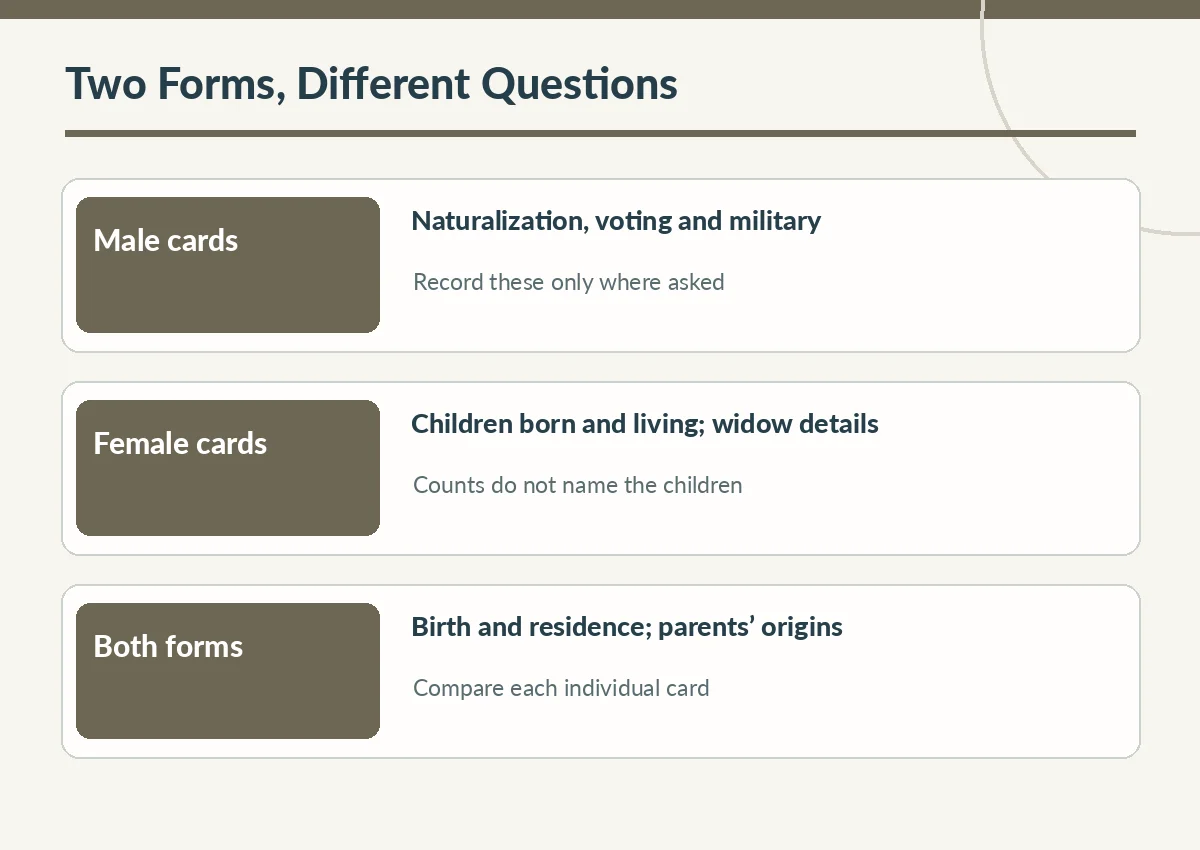
Rhode Island’s 1905 state census should not be read like a standard federal household schedule. Each resident has a separate handwritten card, and the forms used for men and women ask several different questions. Both card types can supply a reported birth date, place of birth, immigration year, time in Rhode Island, parents’ birthplaces and a relationship to a household head. Female cards also ask about children born and living; male cards include such matters as voting, naturalization and military service. The FamilySearch collection offers an index and images derived from State Archives holdings. But the way cards are sorted makes it essential to reconstruct the family deliberately.
Start with the right 1905 collection and resident card
Open the Rhode Island, State Census, 1905 collection and search name variants with a plausible town or ward. The collection describes cards filed by county, city or town, ward or enumeration district, then gender and surname. This is not a sequence of door-to-door household entries. An adjacent image may belong to an alphabetically neighboring stranger, not another member of your target’s family. Record the county, town, district, card identifier and image location before inspecting details.
If the indexed surname fails, browse the relevant district and alphabetic run using the image waypoints, and look for spelling variants or married versus maiden surnames. Do not copy a FamilySearch household list as if it were assembled from contiguous cards. Note the relationship-to-head response and household number on each individual, then connect candidate relatives only where place, family number, residence and independent records support the grouping.
Inspect both sides and the correct male or female form
FamilySearch documents different questionnaires for men and women. Male cards may record service, naturalization and voting details, while female cards have fields for widowhood connected to military service and counts of children. First identify the form type, then check the entire available image sequence and headings before assigning a field to a person. If only one side of a card is displayed, investigate whether a reverse image exists rather than calling the blank a true absence.
A daughter, wife and widow might each have separate cards carrying family numbers that can be compared, but identical surnames in one town are insufficient. Copy the original question wording into the research log, especially for a blank or slanted tick mark. Historical administrative racial or religious labels reflect the recorder and era; they do not establish how the person or living descendants identify today.

Treat the recorded birth date as a hypothesis to test
Unlike the Rhode Island 1915 state census, the 1905 card collection can report a specific date of birth. Record day, month and year as written, and separately write the stated age so errors remain visible. If the birth was reported as November 1870 and the listed age conflicts, check both for transposition and consult another dated record. Never silently correct a published tree’s birth year simply because the census form appears precise. Our guide “Rhode Island State Census 1915” goes into more detail.
Test the date with Rhode Island civil registration, baptismal registers and later certificates, taking note of registration limits for older residents. Parents’ reported birthplaces can help distinguish same-name candidates; they cannot alone prove parentage. A form may have been completed from a household informant or clerk’s knowledge. Weight each claim according to who likely supplied it and whether an independent document survives.
Interpret women’s children-born and children-living answers
The female card asks about the number of children a mother had and the number alive as of June 1, 1905. This is a powerful clue for locating children missing from a later family tree, but it does not name any child or establish paternity. Make two columns: number reported as children born and number reported living. Add separate rows for documented births, baptisms, cemetery records, and death registrations; keep unknown identities explicitly unknown.
For example, a card reporting five children and three living suggests a research question about two deaths or other discrepancies, not permission to invent names or causes. The woman’s exact relationship to the household head must be checked independently; a boarder can be a mother too. Compare 1900 federal child-count questions where applicable, then identify each child through a source created close to the event. Do not interpret a blank child count as meaning that the woman had no children.

Reconstruct immigration and residence without false arithmetic
The 1905 forms can report immigration year, total time in the United States, years in Rhode Island and months in the state in the current year. These measures answer different questions; residence in Rhode Island need not begin on the original entry date. A person may have entered through New York, lived in Massachusetts and later moved to Providence. Build a place-by-date timeline for each separately, including the source of the report and whether a move is assumed or actually documented. Our guide “Rhode Island State Census 1885” adds more detail on this.
Compare the 1900 and 1910 federal censuses, local city directories and passenger or naturalization records, but do not manufacture a precise arrival day by subtracting reported years. On male cards, a naturalization notation is a prompt for court research, not proof of citizenship proceedings. Similarly, a military-service question asks about an asserted historical status and does not substitute for a pension or service file.
Build an identity test instead of an alphabetical household
Suppose the index finds two Florence Walsh cards in the same city. Copy town, ward, birth date, parents’ birthplaces, family number and relationship to head for both. Search for additional cards with the alleged husband and children using their own names; check whether their residence and family number align. If only the surname agrees, leave the grouping unresolved. If a spouse’s card reports a conflicting immigration year, preserve the conflict and search for an independently dated marriage or address. For the fuller picture, see our guide “1935 Rhode Island State Census”.
Cite each card individually by name and local file or image reference, then explain which card supports each family connection. Keep a separate row for plausible but unconfirmed relatives. A case can remain open when a person is indexed but the reverse image or card number is unavailable. A clear unresolved conclusion protects the research better than a complete-looking tree built by linking alphabetical neighbors.
More Records and Archives Guides
How We Research the Rhode Island 1905 Cards
We compared FamilySearch’s 1905 collection description, field-by-field male-versus-female table and filing instructions with the Rhode Island Historical Society’s repository guide and the Census Bureau’s state-census inventory. The purpose is to prevent two specific mistakes: treating an individual card as a household page, and attributing male-only or female-only questions to every person. The hypothetical Walsh search illustrates comparison logic and is not a claim about a historical family.
Record-level conclusions should be rechecked against the card images and current access conditions. This article makes no claim that every image or reverse side is always available in every interface. We have no sponsored record-viewing recommendation here; consult the affiliate disclosure for the site’s policy.
No. Each person has a separate card, filed geographically and then by gender and surname; relatives must be reconnected carefully.
The FamilySearch collection lists a date and place of birth field; any entry should still be verified using independent evidence.
Male cards include such fields as naturalization and voting; female cards ask about children born and living and certain military-widow details.
No. It provides a numeric lead; identify possible children through birth, baptism, death and other original records.
Browse FamilySearch images by place, ward or district and then alphabetically, trying spelling variants and checking the original card.