
A Prerogative Court of Canterbury (PCC) probate inventory can reveal the tools, furniture, livestock, merchandise and debts recorded after a death. It is not a land deed, a household census, or necessarily a complete portrait of the deceased. For inventories in PROB 4, the crucial first steps are to confirm that the PCC was the relevant court, select the right inventory series for the date, and distinguish an appraised object from a legally owned property. Many people left no surviving inventory, even when a will or administration can be found.
Start With the Court That Handled the Estate
Before searching PROB 4 by surname, establish the person’s death locality, approximate date and the jurisdiction that could have proved the will or granted administration. The PCC was only one among numerous English church courts before the national probate system began in 1858. An estate proved in a diocesan or archdeaconry court may have an inventory kept in a county archive, not in the PCC collection at Kew. A modern surname search cannot compensate for searching the wrong court. Record the place where the estate was administered separately from the person’s home.
The National Archives’ wills and administrations guide describes these PCC inventory records, while the Gloucestershire Archives inventory guide explains how local-court inventories may instead appear with separate probate material. Write a jurisdiction note before treating a missing national result as meaningful. If the only known document is a will, check its proving court and record the exact grant date. An inventory might have been taken earlier or presented later; these events should not be collapsed into one date.
Choose the Original Series by the Inventory Date
For PCC inventories, The National Archives lists PROB 2 mainly before 1660; PROB 3, PROB 4 and PROB 5 broadly for 1661–1732; PROB 32 for 1658–1723; and PROB 31 for 1722–1858. These are overlapping holdings, not five chronological steps that every estate went through. Search each applicable series rather than assuming a blank search in PROB 4 proves there was no record. Inventories can have unusual filing dates, abbreviated county names and spelling variants. Use an exact name and parish, then broaden to occupational clues or nearby places.
The archive explains that more than 60,000 PCC inventories survive across several series, but it also warns that not all inventories have survived. Catalogue entries may name an individual, residence or occupation without reproducing the schedule of goods. Record the full PROB piece number, any date attached to the item and the catalogue’s access instructions. When a result requires consultation at Kew or a copy order, label it “located, not inspected” until the original can be read. Do not turn a published index description into a quotation from an unseen original.

Read Each Valuation as a Snapshot of Movable Goods
A probate inventory often itemizes movable assets and values, sometimes room by room: bedding, cooking vessels, work equipment, livestock, crops, commercial stock and money or debts. Transcribe the inventory’s own categories before translating historical terms. A “chamber” or “shop” identifies an item’s location within an appraiser’s list; it does not establish who lived there. A large reported value may represent the appraisers’ estimate rather than money that was actually collected by beneficiaries. Record the currency and the date of the appraisal instead of converting totals to an unqualified modern sum.
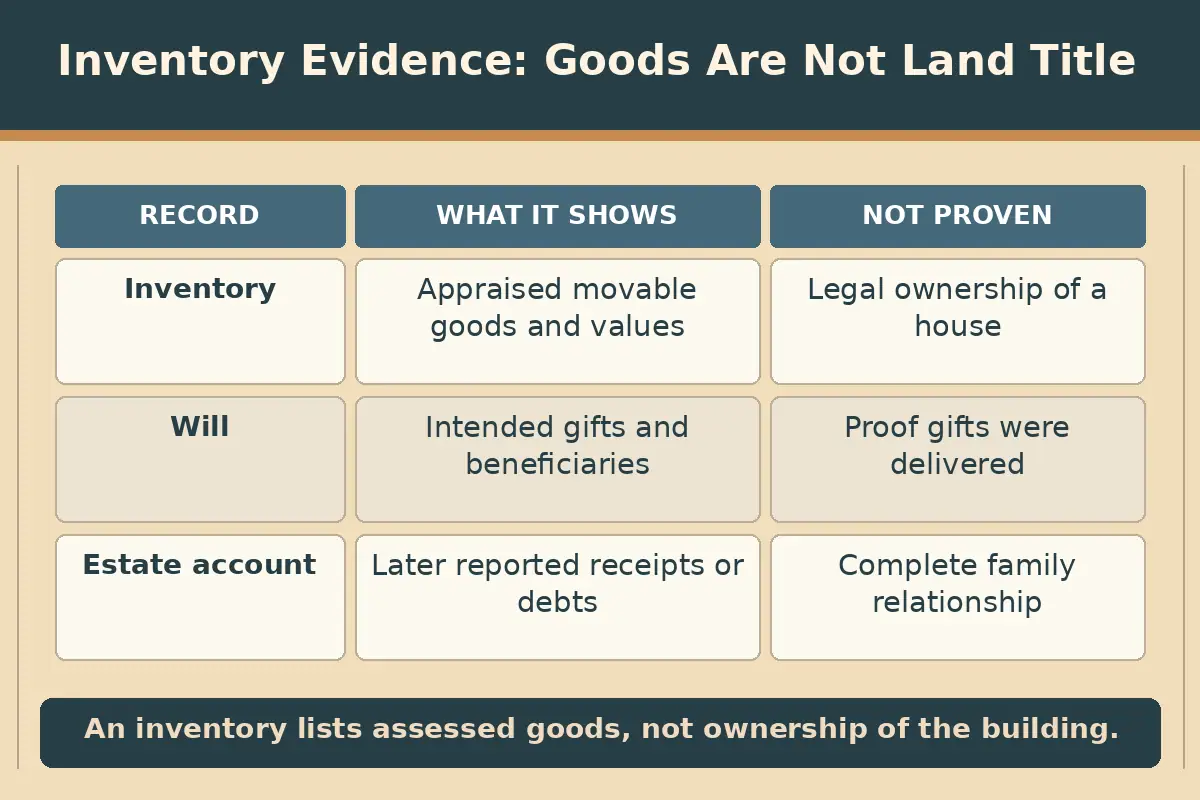
Separate personal goods from real property. Land and houses were generally not itemized in these schedules in the same way as movable goods. An expensive household entry therefore does not establish that its occupant held the building’s legal title. Conversely, an absence of a loom or livestock does not prove the person never worked as a weaver or farmer: goods could have been sold, omitted, jointly held or located elsewhere. Use a table headed ITEM / WORDING / VALUE / PROOF LIMIT, and preserve uncertain readings until compared with the physical image.
Compare the Will, Administration and Inventory
The inventory’s deceased person must be matched to the right will or administration by court, date, parish and, where available, occupation and executor or administrator. A probate record proves that a court dealt with an estate, but it does not by itself validate every family relationship later asserted by a family tree. A creditor, appraiser, executor or witness may share a surname without being related. Record each person’s role explicitly. If an inventory refers to an account or a debt, look for accompanying probate material before treating payment as completed.
An inventory total, a will’s gifts and an administrator’s later account answer different questions. The will describes intended disposition; the inventory lists assessed property at an occasion; later proceedings may reveal disputes or revised accounts. If values differ, do not choose the larger figure as “the true estate” without explaining the date and scope of each document. The National Archives also notes that inventories became less common after the eighteenth-century change in requirements. A missing nineteenth-century inventory is therefore not, on its own, suspicious or evidence of fraud.
Resolve Same-Name Estates and Property Claims
When two Thomas Browns lived in the same county, assemble a comparison of parish, trade, burial, will date, court and names of estate officers. The material goods may help distinguish a blacksmith from a merchant, but occupation clues should supplement documentary identity evidence rather than replace it. Test each candidate against independently dated parish entries and local taxation or directories where surviving. An inventory can contain a “household” set of objects without naming a spouse or children. Never assign unnamed occupants of a property to a family simply because the deceased owned furniture.
For property ownership, seek deeds, land tax, manorial papers or other title evidence in the appropriate repository. A room-by-room list does not tell whether premises were rented, leased or inherited. If a farm inventory mentions crops, distinguish ownership of crops from ownership of land. Maintain separate conclusions labeled “object recorded,” “person likely identified,” and “legal title not yet shown.” This prevents an appealing historical reconstruction from becoming a false hereditary claim. Write down conflicting details and what future original record could resolve each one.

More Records and Archives Guides
How We Research Historic Probate Inventories
We begin with a dated death and a probable court, then check the appropriate PCC series and any local-court alternatives. Every cited item is identified by its actual series and piece reference, the appraisal or filing date, the recorded parish and the status of inspection. We transcribe names and property descriptions as written, preserving currency and historical spellings, then compare the inventory with the will or administration. The resulting family-history claim is narrower than a general account of someone’s wealth: it states precisely what property the appraisers recorded.
The guidance at The National Archives and Gloucestershire Archives supports the search routes above; individual record access and survival remain record-specific. We distinguish the catalogue, original item, appraiser’s assertion and independent corroboration. A single inventory may be rich enough for a detailed domestic reconstruction while leaving kinship and title unresolved. For our editorial disclosure, see GenHis affiliate disclosure. No commercial service or affiliate relationship is assumed by this article.
No. It is one PCC series. Other PCC series overlap its dates, and many inventories were handled by lower church courts or did not survive.
No. It describes appraised movable goods; seek deeds or other title records for the building or land.
Yes. An estate might have been administered without a will, and survival differs between related document classes.
They can record different purposes, dates and types of estate property; the discrepancy must be assessed from the originals.
Record the reference and arrange to inspect the original; do not attribute unviewed property or family relationships to that name.