
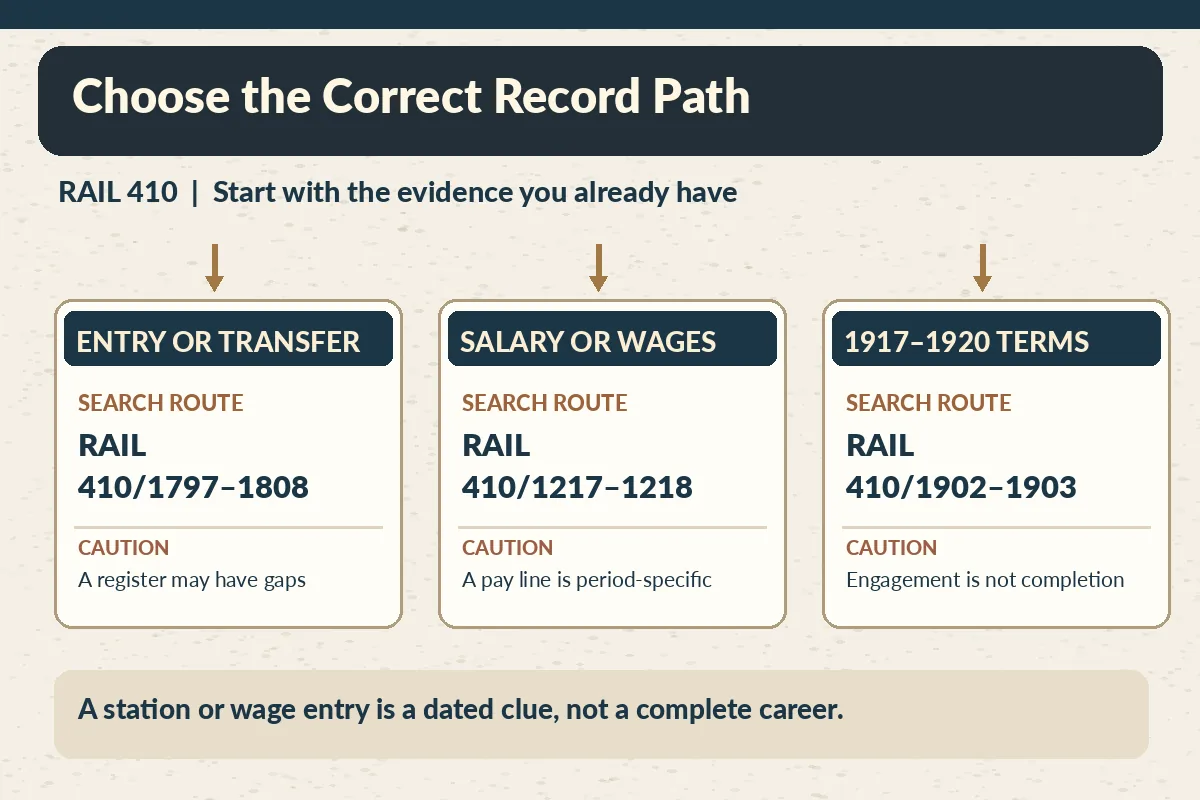
London and North Western Railway employee research is not a single surname lookup. RAIL 410 contains varied company records, including staff registers, salary lists and engagement agreements that answer different questions. The National Archives identifies RAIL 410/1797–1808 as staff registers with entry and transfer information, RAIL 410/1217–1218 as salary lists, and RAIL 410/1902–1903 as engagement records for 1917–1920. Use the station, occupation and time period to choose a ledger. A wage line does not prove that a worker stayed with the company throughout a lifetime, and a transfer entry does not by itself explain why a person moved.
Choose the Ledger by Job and Date, Not Just Surname
The official railway workers guide places London and North Western Railway material among records of multiple companies, so distinguish the employer before searching. RAIL 410 is broad: minutes, plans and accounting papers sit alongside personnel evidence. Start with an independently established station, occupation or railway department. Then inspect the National Archives’ series document, which describes specific staff register and salary piece groups. A record of the company purchasing a station is not the same as a register naming an employee at that station.
RAIL 410/1797–1808 includes registers of salaried and waged staff, with names, capacities, dates of entry and sometimes transfers or wage rates. The official document samples RAIL 410/1797 in detail, but any one volume may have different arrangements and gaps. Do not assume every register spans the whole nominal 1837–1911 date range for the same staff group. Keep department and station as distinct identifiers, especially if the same surnames appear at different offices or depots.
Compare Staff Registers With Salary Payment Books
The series summary identifies salary lists in RAIL 410/1217 for 1853–1863 and RAIL 410/1218 for 1863–1873. These can show a name, occupation, station, month and amounts due. It separately lists Northampton district salary payment books at RAIL 410/1900–1901 for September 1866 to February 1878. An amount owed or paid at a particular moment is not automatically an annual salary and may not describe a full year of service. Read the headings, units and deductions rather than extracting an isolated number.
Make a staff timeline with each entry’s exact date, piece reference, job title, station and amount. If a register records a date of joining and a salary book begins much later, do not fill the intervening years with assumed uninterrupted employment. A missing month may be an indexing or preservation problem, a change in role, or a move to another payment system. The archive must support any claim about promotion, dismissal or pension rather than the researcher silently completing a career.
Understand Engagement Agreements and Transfers
RAIL 410/1902–1903 includes engagement agreements dated 1917–1920 in the official series document. Those agreements are especially useful for testing whether an identified candidate entered a particular post, but an engagement is not proof that the contract was completed. A signature or company seal identifies a documented commitment; subsequent wage records are stronger evidence that work took place. Inspect whether the agreement names a depot, department, status and start date rather than inferring them from a file title.
The National Archives also describes RAIL 410/1911 records of men leaving, being engaged or transferred in 1883–1890. Read the specific movement word and do not treat ‘left’ as proof of retirement or death. A person might shift to another company, grade or station and later return. If a surname and initial appear in both an engagement agreement and an earlier register, compare age, occupation, address and station before merging the entries into one individual.
Resolve Similar Names and Company Boundaries
An employee named John Brown may appear at several London and North Western Railway stations. A register’s date of birth or entry can help distinguish him from another person of the same name, but it is not always present. Compare a household census entry, civil marriage or death certificate, or a relevant trade directory when a candidate’s age, occupation and district align. Even matching details require attention to changing home addresses and the difference between a workplace and a residence.
The RAIL 410 series is a company collection; some pieces refer to staff inherited from or operating on other lines and joint arrangements. Do not silently declare every entry to be a lifelong LNWR employee. The railway workers guide warns that dates in its appendix can reflect the oldest subject’s birth rather than the date a volume was created. Record actual page headings and check the ‘held by’ field before requesting a document at a different repository.

Work Through a Wage and Station Discrepancy
Imagine a family story that a relative became a station clerk in 1870. A matching surname appears in a staff register with a date of entry in 1868, and a salary list shows the same name at the target station during 1871. First transcribe both entries, including their original job titles, the distinction between salaried and waged status, and the pay period. The two documents may support a plausible identity but not the exact promotion year alleged by the family story.
Check for a transfer note in the register or a new station in a later salary book, and look for local directory or census evidence tying the person to the town. If the job title changes from porter to clerk, describe the earliest recorded clerk entry without inventing the date of promotion. A payroll amount is evidence within that pay scheme; use the contemporary book’s own terminology for bonuses and deductions. Log every unresolved ambiguity between people sharing a surname.
Publish a Career Timeline With Source-Level Confidence
Cite the RAIL 410 piece and folio or page, the ledger’s own title, date of entry and the name as written. Keep separate citations for the 1797–1808 personnel registers, 1217–1218 salary lists, and 1902–1903 engagement documents. Indicate when a source has been inspected and when only a series description has been consulted. The National Archives’ RAIL 410 information sheet is helpful for choosing material, but it is not an employee-specific transcript and cannot verify any one career for you.
A careful conclusion could say that an individual of this name appeared in a particular station’s staff register in one year and in a pay book in another; intervening service remains unverified. Do not publish payroll data as if it proves an entire biography, a residence at the station or membership of a specific family. A timeline with gaps is still useful to descendants and future researchers because it states precisely what is known and what remains to be checked.

More Records and Archives Guides
How We Research and Verify This Archive Series
Our source check starts with The National Archives research guidance and a second reference, this complementary finding aid. We record the original series, piece or item, date, creator and access method before making a personal or legal inference. Documented statements and independently corroborated outcomes are separate categories. Where a file is missing, unindexed, closed or not inspected, we say so rather than manufacturing negative evidence. A cited catalogue lead does not mean we have seen every folio. For disclosure of any commercial relationships, see our affiliate disclosure.
No. Different registers have different arrangements and the catalogue does not index every employee on every page.
The official series document identifies RAIL 410/1797–1808 among registers of salaried and waged staff.
Only if the evidence actually states or closely dates a change in grade; a wage change alone is inconclusive.
The National Archives identifies staff engagement agreements for 1917–1920.
No. Station and department identify employment context; use independent residential records.