
MAF 68 is a record series of agricultural parish summaries for England and Wales, with a broad 1866–1988 span. The records described here can answer a precise historical question only when the researcher separates what the source actually says from what a later interpretation would require. The first step is to identify a document, its original purpose, the date and place it describes, and the independent evidence needed for a larger family or local-history claim.
Start With the Parish, Year, and Statistical Question
MAF 68 is a record series of agricultural parish summaries for England and Wales, with a broad 1866–1988 span. The National Archives’ agricultural statistics guide describes returns for cultivated land and livestock. These records are valuable for a history of local farming, crop transitions or regional production. They are not lists of named individual landowners or households. Begin by writing one precise question: how did reported acreage or livestock in a named district differ between two years, and what was the area represented by the summary?
Identify the historic parish or administrative unit from the date of the return, not only its present-day name. During the twentieth century the “parish summary” label did not always mean an ancient ecclesiastical parish: the collecting area could be another local administrative unit. Keep a separate map or boundary source beside the agricultural numbers. If the area changes, the figures may move even when farming patterns did not. Never transform a statistic for the entire parish into a claim about one named family.
Put the 1917 Reporting Change on Your Timeline
The National Archives says that returns of agricultural acreage and livestock were voluntary until 1917 and compulsory from that year, with later data generally considered more accurate. That change matters when interpreting a seeming jump between annual returns. An increase can reflect better participation, a changed district or a real increase in cultivation. Do not call every difference a crop boom or livestock decline without checking how a return was collected and classified.
For a comparison, record the survey year, reporting unit, column labels, values as printed and any footnotes or qualifications. Keep the original unit of area rather than converting or combining it silently. A crop category may be grouped differently in different periods, so compare like with like. A gap in a parish sequence is a survival or retrieval problem until proven otherwise; it is not an assertion that the locality had no farms that year.

Find the Right MAF 68 Record in Discovery
The National Archives’ agricultural guide recommends searching Discovery for terms including crops, agricultural statistics, parish summaries and agricultural returns, then refining by year or searching within MAF 68. Its National Farm Survey guide adds a practical approach: put a county name in the keyword field and MAF 68 in the “Search within” field. A broad place query can miss a county-indexed item; begin with the county and dates before narrowing to the particular locality.
Check the description and covering period of each result before requesting a record. An online catalogue result may describe a county or a range of years without providing downloadable images of every parish schedule. Search failures can reflect spelling, arrangement, missing digitization or volume-level cataloguing. Note the exact piece number and place, keep unsuccessful searches in a log, and do not claim to have examined a return until you have seen the original or an authoritative reproduction.
Distinguish Aggregate Figures From Named Farms
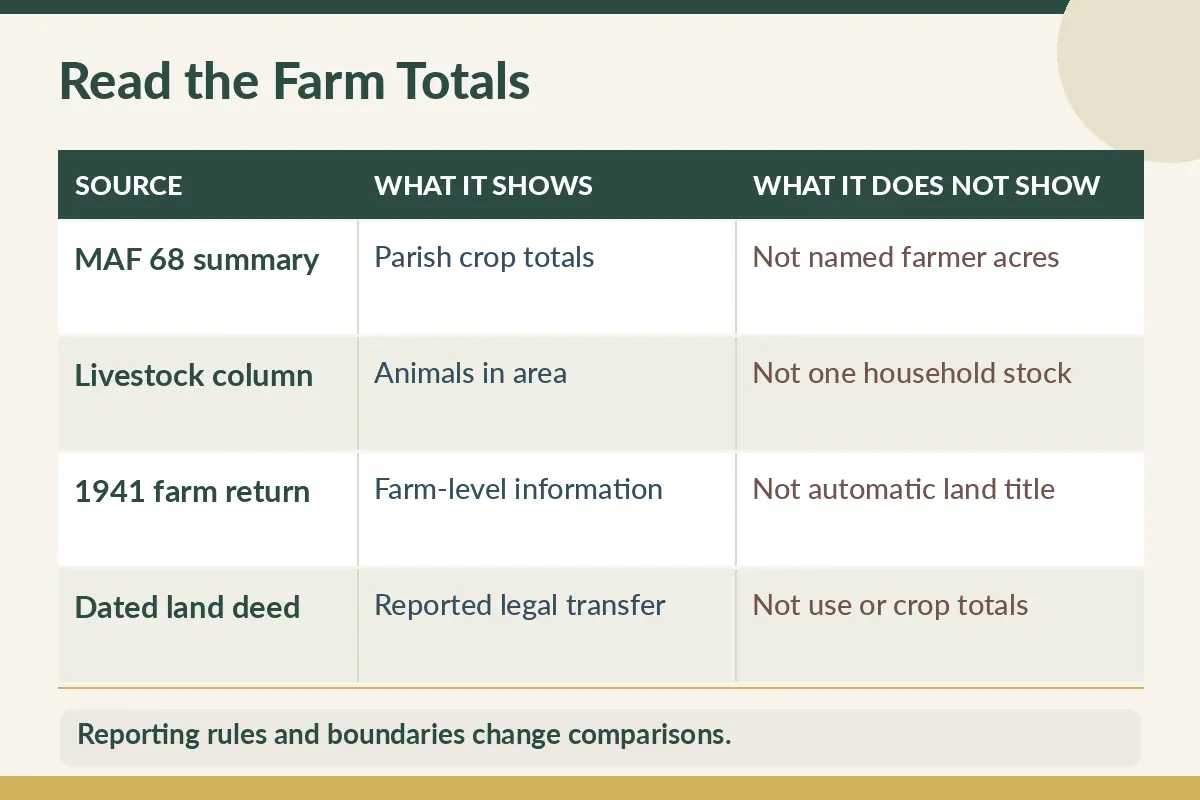
A parish summary can report total acres of particular crops or livestock counts without supplying an identity for the individual farmers who contributed. Even if an ancestor owned much of the land, a total is not a household inventory. Conversely, a tenant could cultivate land owned by somebody else. To connect a numerical pattern to an actual holding, identify the farm separately using rate books, land-tax lists, tenancy agreements, maps, directories or other dated local records. Each source answers a different question.
Label columns in the evidence worksheet “directly stated,” “suggested by the data” and “not demonstrated.” For example, MAF 68 may directly report a parish cattle total; it could suggest the prevalence of cattle farming locally but cannot say the researcher’s ancestor held 30 head. If a family farm lay across a parish boundary, the reported total could be split between reporting units. Do not use an apparent match between an acreage total and a later deed as sufficient identity evidence.
Use the 1941 Farm Survey Only for the Right Comparison
The National Archives’ National Farm Survey guide connects the system of farm identifiers used with MAF 68 to farm returns in its wartime survey holdings. It describes the 4 June 1941 returns as an exceptional survival of completed forms in the annual agricultural survey system. That is useful, but it does not mean every year in MAF 68 contains the same individual farm-level detail. Treat the 1941 documents as another record family to be located and read under its own access arrangements.
If the real question concerns a named farmer in 1941, compare the wartime survey record, farm identifiers and other holding or occupation evidence with care. Farm boundaries and operational units may differ from legal ownership and from census households. A number linking two administrative returns identifies a reporting unit or its paperwork; do not elevate it to proof of inherited title. If privacy or access conditions apply to an individual file, follow the archival rules rather than attempting to reconstruct restricted data from indirect hints.

Explain What a Local Agricultural Trend Actually Means
A transparent conclusion can say: “The surviving MAF 68 summaries report a higher total acreage in a particular crop in this district between these two dates; changes in reporting and boundaries need checking.” It should not name individual adopters without other evidence. Cite the exact MAF 68 piece, the reporting unit, survey date, column title and any footnote or transcription uncertainty. When possible, create a same-unit comparison or clearly flag where a boundary break prevents it.
To make the research reproducible, preserve a short ledger of the place name, county, year, units and sources for competing interpretations. Independent maps can establish territory; farm accounts or leases can test ownership; an agricultural return measures reported activity at the specified aggregation level. These sources can complement one another without being identical. The strongest result is a local history rooted in data, with family-specific statements supported separately and apparent survey gaps left visible.
More Place and Jurisdiction Guides
How We Research and Verify the Record Claims
The series scope, examples and record limits were checked against the original repository guidance: The National Archives; The National Archives; The National Archives. These sources explain how to locate a collection and interpret record families. They do not authenticate a particular unseen piece, individual person, building alteration or farm that a reader has not yet inspected. A catalogue description is a finding aid, not a full transcription. Preserve original wording and references, check survival and access arrangements, and make each independent source do a distinct job.
Our research standard separates source statements from reasonable inferences and from claims that remain unverified. Quotes in a petition, proposal or official letter are attributed to their authors rather than automatically accepted as established events. We have not asserted that every record is online or free. Our affiliate disclosure explains commercial relationships where applicable; no paid purchase is needed to follow this research method.
No. The series contains parish or other area summaries; aggregate crop and livestock figures should not be attributed to individuals.
The National Archives identifies parish summaries in England and Wales between 1866 and 1988; coverage and arrangement must still be checked by item.
Reporting was voluntary until 1917 and compulsory afterward, which can alter completeness and apparent trends.
No. Later administrative areas may differ despite continued use of the term “parish summary.”
The wartime survey can support farm-level questions, but it must be checked separately and does not turn all MAF 68 summaries into owner lists.