
AIR 6 contains minutes and memoranda of the Air Board and the Air Ministry’s Air Council. It is useful for studying decisions about British aviation administration, equipment and organization, not for constructing a named pilot’s flight history. The name of a type of aircraft or station on a meeting agenda can show the question officials considered. It does not establish that the type entered service, a facility opened on schedule or an airman took part in an operation. Start with the meeting, the date and the question under discussion.
Distinguish an Air Board Meeting From a Squadron Record
The Air Board emerged during the First World War as British air administration developed, while the Air Council belongs to the later Air Ministry framework. Check the body named in the archival item instead of treating those organizations as interchangeable. The catalog reference AIR 6 identifies meeting material; changes in administrative terminology matter when following a policy from 1916 into the period after the formation of the Royal Air Force in 1918.
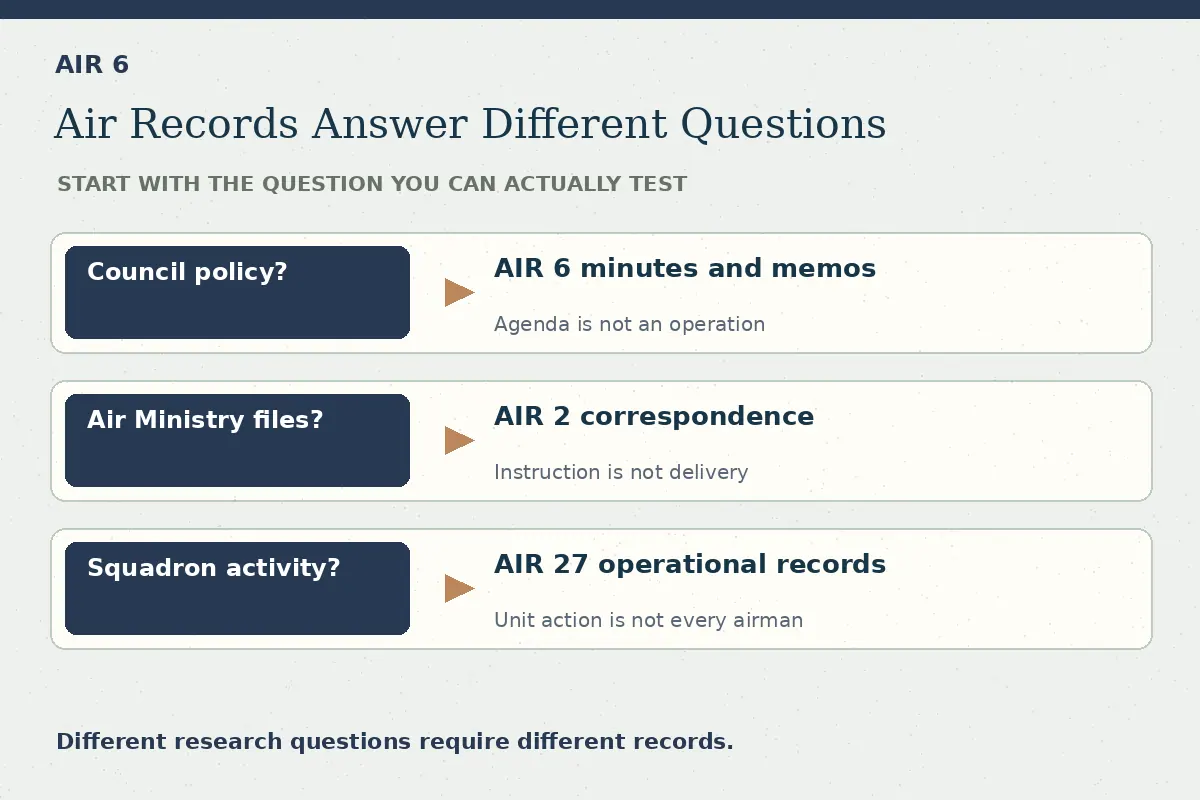
Choose between four questions before searching. For policy deliberation, look for AIR 6 minutes and memoranda. For registered Air Ministry correspondence or development work, consult the AIR 2 guide. For a squadron’s operations, the RAF operations guide points to AIR 27. For station history, examine station records such as AIR 28 where relevant. Those record groups are not interchangeable stages of a single required process: the original question decides the correct route.
Do not use a technical project title to attribute work to a specific individual. A meeting could discuss training capacity, a new type, or an expansion target without listing the people who carried out the work. An aircrew roster, service record, or squadron record is needed for an individual assertion, and a name match must still be tested against dates and service number where surviving.
Search by Meeting Date, Subject and Changing Terminology
Build a two-column list of historic and modern terms. An interwar file might describe an establishment, machine, tender, requirement or scheme rather than the modern name of a program. Search Discovery for the topic within AIR 6 and bracket the date of known policy debate. If a family story offers only “around the war,” first establish which war and whether the relevant body existed at that moment.
A meeting number or memorandum reference may be a better locator than a surname. When a citation in a history book gives an AIR 6 piece, search that exact archival reference. Then inspect the meeting title, any enclosure, and the dated minutes. A catalog description can paraphrase the matter broadly; the original pages may separate a recommendation, a question deferred, and an instruction to return with figures.
Write the actual meeting date alongside the earliest and latest document dates. Enclosures can precede a meeting and later typed copies can be filed with an earlier decision. A proposal discussed in a 1930s expansion meeting does not necessarily refer to facilities opened in that calendar year. Avoid collapsing proposal, approval, procurement and operational use into the date on the file cover.

Make an Evidence Table for Decisions and Deliveries
Use separate rows for deliberation, administrative direction, technical procurement and operational outcome. An AIR 6 minute can record an agreed policy direction if the wording says so. A subsequent AIR 2 correspondence file may document an instruction or the reasons for a change. A contractor account, production return or operational record is needed to establish physical delivery or service use. Each row requires the actual source, not a plausible link supplied by the researcher.
Pay close attention to modal verbs and status labels. “Proposed,” “recommended,” “noted,” “approved in principle” and “ordered” are not synonyms. A memorandum forwarded for comment may have no final endorsement. Even a decision to order aircraft leaves open the questions of quantity delivered, model specification and later deployment. Cite the precise words before interpreting their practical significance.
For a named squadron, an operations record may report unit activity but still omit some personnel. A site mentioned at a policy meeting may be a possible airfield rather than an existing one. Match airfield names, dates, unit codes and independent operational sources before describing a place as occupied or a flight as undertaken. The distinction is especially important where names were reused between bases.
Explain an Aviation Story Without Inventing Aircrew
Consider a hypothetical historian’s note: “The Air Council planned improved navigation training.” This could be a valid summary of an inspected minute. It does not show that an individual ancestor attended the course or that the proposed syllabus was adopted unchanged. A dated training-unit record and a personal service document would have to carry those narrower claims. Keep separate citations under each sentence.
When sources conflict, prefer the status actually expressed in the original. A later administrative report may claim that a policy was implemented while a station’s records show delays. Preserve both dated observations. Ask whether they describe different definitions of completion, an approved plan versus an operational building, or a change in location. Do not erase a discrepancy merely to produce a simple chronology.
A missing person in the meeting papers is unsurprising, not negative evidence about that person’s service. Log the series searched, the archival title, the item consulted and the question it addresses. For genealogical work, the outcome may simply be a verified account of the institutional setting in which the relative served, with individual assignments still unknown.

More Records and Archives Guides
How We Research Air Board and Air Council Papers
We verify AIR 6 against scholarly references to early Air Board minutes, then check the evidence categories against The National Archives RAF operations guide and its RAF research and development guide. The latter directs readers to AIR 2 for administrative and technical files; the former separates those records from operational logs. We read the original minute when accessible, keep the organization and date exact, and require independent records for any claimed flight or posting.
A useful citation includes the AIR 6 piece, meeting or memorandum identifier, date and wording of the disposition. Examples are methodological and do not represent authentic transcriptions of a particular meeting unless explicitly identified as such. Our affiliate disclosure explains site relationships; no partner service is assumed.
No. They primarily document aviation administration and discussion, not a comprehensive list of pilots.
No. Procurement and actual delivery require separate contract, production or technical evidence.
The National Archives directs users to AIR 27 for operations record books, with specific coverage limitations.
Yes, date and meeting or memorandum identifier can be strong locators, although item descriptions vary.
No. Plans and discussions need independent station, works or operational evidence.