
Bedfordshire parish registers can contain baptisms, marriages and burials over several centuries, but the online collection label 1538–1983 is not a promise that every parish has uninterrupted records in every year. Begin with a parish and event date, find its actual register span in the Bedfordshire Archives catalogue, then compare any FamilySearch index entry with a viewable original or an archive-held transcript. Most importantly, keep baptism separate from birth, burial separate from death and a same-name parish entry separate from a proven ancestor.
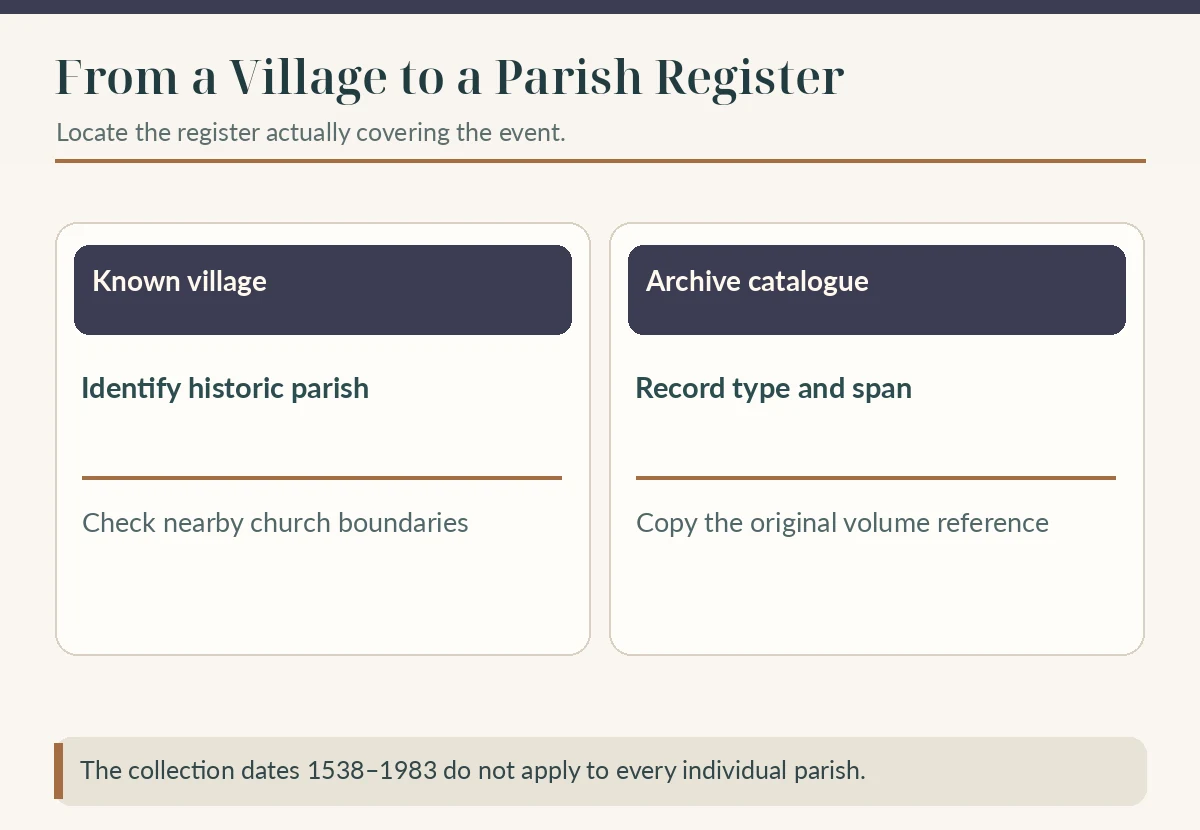
Identify the historical Bedfordshire parish before searching names
Use an address, village name, census or marriage document to fix the likely parish at the event date. Bedfordshire village boundaries, ecclesiastical parishes and registration districts are not necessarily the same. A later residence in Bedford town is not evidence that a baptism occurred in a Bedford parish. If a family lived near a county border, note neighboring parishes in Hertfordshire, Northamptonshire and Buckinghamshire instead of forcing every event into Bedfordshire.
The Bedfordshire Archives family-history guide says Church of England registers of baptisms, marriages and burials are central holdings. It also distinguishes local parish registers from General Register Office civil certificates. Build a place-and-date list first; then select register classes that could actually have recorded your event.
Treat 1538–1983 as collection coverage, not parish coverage
FamilySearch labels one indexed collection England, Bedfordshire, Parish Registers, 1538–1983. That range describes the span of the collection, not continuous registers in every parish. Many records predate the start of civil registration in 1837, but coverage can start later, end earlier or contain missing years. Search results may provide index entries without unrestricted access to the original image in every context.
Write down the parish, event type, date, original or derivative source and exact archive holding. If an indexed child appears with the expected parents, examine siblings and nearby entries but check whether the age, name forms and district agree. Do not infer that a blank period in one local book establishes the family’s departure; consult the parish-specific catalogue and other denominations. Our guide “Illogan Parish Registers” covers a related question.
Use Bedfordshire Archives transcripts without losing the original context
The county archive notes indexed transcripts to 1812 available in its search room and through the Bedfordshire Family History Society. These are helpful discovery tools and can be consulted when a scanned original is awkward to read. Record the transcript publication separately from the manuscript; spellings, omissions or interpretation of Latin abbreviations can differ. If the original is available, compare the register entry, not just the typed name hit. Our guide “Cornwall Parish Registers” covers a related question.
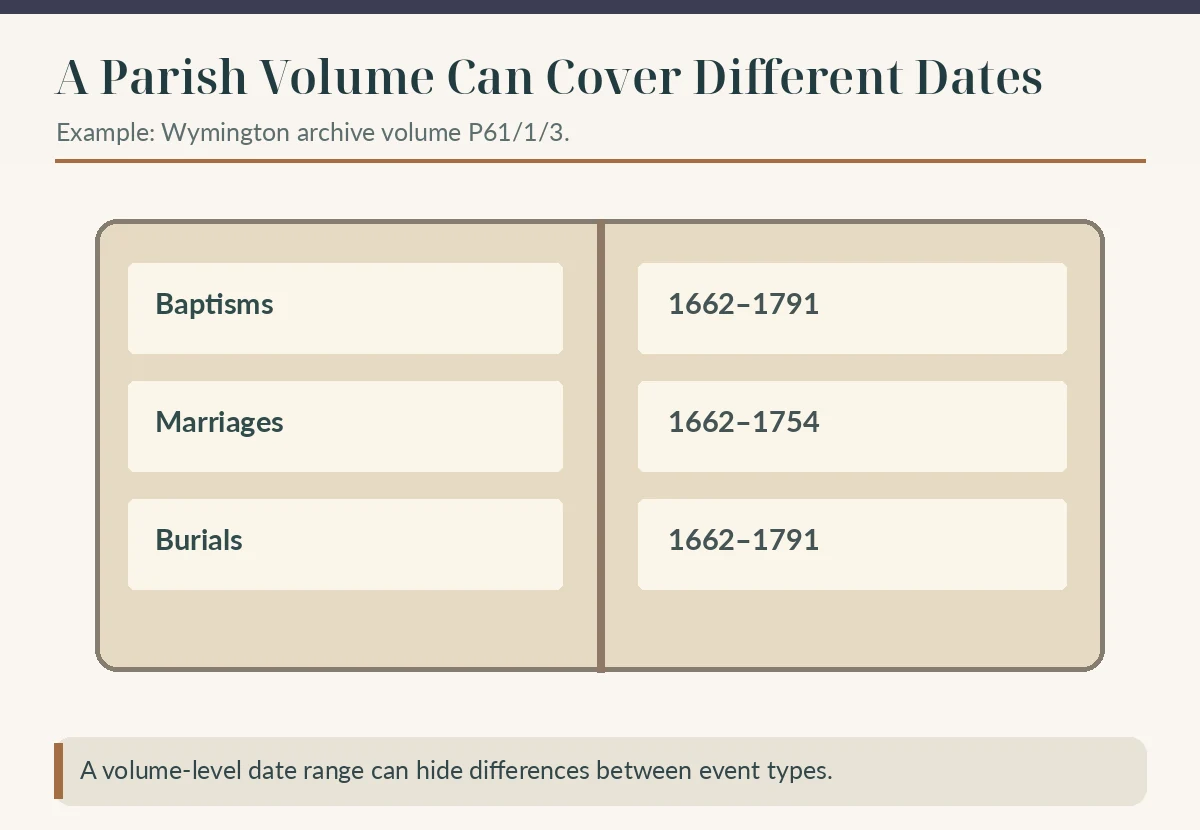
Use the archive catalogue to find the parish fonds and a specific register item. For example, the official catalogue describes a Wymington volume with baptisms, marriages and burials spanning different periods under reference P61/1/3. This is an illustrative archive reference, not a claim that your particular ancestor appears in Wymington. It shows why the correct source unit is the volume and its event-specific date span.
| Entry type | Direct question answered | Needs separate proof |
|---|---|---|
| Baptism | Who was recorded as baptized, when and where | Exact birth date or adult identity |
| Marriage | Whether a recorded ceremony occurred | Later residence; witness relationship |
| Burial | Who was recorded as buried and when | Exact death date and family link |
Read baptism, marriage and burial entries as different events
Baptism entries may identify parents and an abode but do not necessarily provide the date of birth. Marriage registers can record witnesses, signatures or marks, marital status and sometimes family identifiers, depending on the period and form. Burials document a burial event and can provide age or abode, but a burial date is not interchangeable with a death date. Do not use a single column of an online index as proof of all those claims.
For an early marriage, compare banns, licenses and a register entry if each exists; a banns entry by itself does not establish that the wedding took place. Before interpreting abbreviated Latin or damaged handwriting, transcribe the entry exactly, indicate uncertain letters and include neighboring entries for context. A later family historian should be able to see which marks belong to the record and which spellings are your interpretation.
Locate nonconformist and civil alternatives when a parish search fails
The Bedfordshire Archives guide also lists non-Anglican registers and other family-history sources. A Methodist, Baptist or other nonconformist household may not appear in the Anglican registers you searched. For births, marriages or deaths after 1837, check the relevant civil index and certificate route for England and Wales rather than assuming a church book is complete or a civil event occurred within the same parish. Our guide “Cambridgeshire Parish Registers” covers a related question.
Build a coverage table showing parish, denomination, register dates and repository. A “no baptism found” conclusion is defensible only for the precise register spans and names examined. Sometimes the next effective source is a will, tithe record, census or adjacent parish, because the event happened elsewhere or no register survives.
Compare two same-name baptisms using independent family links
Suppose two Mary Browns are baptized two years apart in neighboring villages. Make one row per baptism with parish, year, parent names, abode and original-volume reference. Then compare later marriages, siblings’ baptisms, burial ages and a parent’s occupation where recorded. Similar names and approximate years are not enough to merge the women in a single family tree. Our guide “St Matthew Bethnal Green Parish Registers” covers a related question.
The strongest case identifies a chain of independent records with no unresolved contradictions. A parental relationship stated by a contemporaneous baptism entry is relevant evidence; its reliability still depends on the entry and possible duplicate families. Record absent or contradictory links explicitly rather than smoothing them away to make the story read neatly.

Cite the parish volume, not merely a searchable website
A reproducible citation should name the parish, register type, entry date, register volume or catalogue reference, page or folio if present, Bedfordshire Archives or other original custodian, and the digital database used to see it. If only a transcript was seen, say so; do not cite an unseen manuscript as personally examined. Note access conditions without describing them as universal or permanent.
Finish with a claim table separating evidence from inference: “the register records a baptism here”; “the baptism may belong to the later census person”; “a marriage or parentage connection remains unverified.” That concise discipline gives this county-specific collection its value beyond a broad England records overview.
More Records and Archives Guides
How We Research Bedfordshire Parish Books
Our review starts with the record creator and holdings guidance rather than repeating an index description. We compared the dated archival instructions and forms above, checked which fields are genuinely present, tested the difference between an original record and a derivative index, and built the visual worksheets around one specific failure mode: treating a county-wide collection range as uninterrupted coverage for every individual parish. The examples are illustrative, not transcriptions of real individuals, and source claims should be rechecked if a custodian changes its access policy.
All recommended resources here are informational archival sources, not sponsored endorsements. We have not inserted paid links or assumed that an affiliate relationship exists; see the affiliate disclosure. Keep identifying information about living people private, and document unresolved claims rather than publishing unverified family connections.
No. These are overall collection dates; parish, denomination and register survival determine the actual available years.
Bedfordshire Archives is a primary custodian; check its catalogue for the precise parish and item reference.
No. Transcripts are useful finding aids but should be distinguished from and compared with manuscript entries when available.
Only if the entry states it. The event date often documents baptism, not the underlying birth.
Check the original parish date range, adjacent parishes, nonconformist registers and appropriate civil sources after 1837.