
Search the Petition, Then Verify the Decision
Upper Canada land petitions document requests for Crown land or leases and the administrative process around them. They are not themselves proof that an applicant eventually owned a particular tract. Begin with Library and Archives Canada’s land petitions and boards guide, identify the named person and approximate locality, and record all location fields before opening images. A plausible surname entry is an archival lead; a decision or patent needs separate examination.
The database references approximately 82,000 people in the Upper Canada petition material dated broadly 1763–1865, with most documents falling between 1783 and 1841. Ontario was known as Upper Canada only for part of that historical span. Jurisdictions changed: Ontario and Quebec were part of the Province of Quebec before 1791 and were subsequently united in the Province of Canada in 1841. Record the date and administration stated by the original file rather than assigning a modern provincial label backward without explanation.
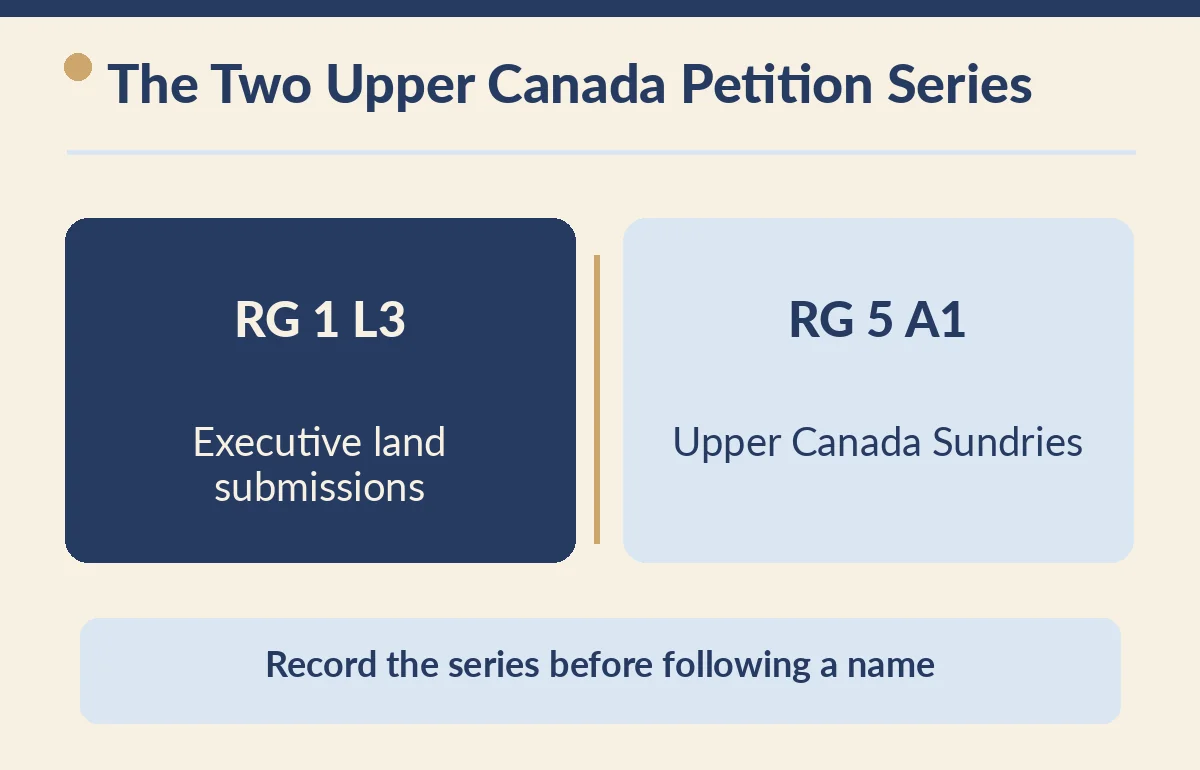
Keep RG 1 L3 Separate from RG 5 A1
The database incorporates two source streams. RG 1 L3 includes land submissions to the Executive Council. RG 5 A1 is the Upper Canada Sundries collection, within which references to land petitions were identified from finding aids. LAC explains that the RG 1 L3 index was made from names at the front of petition bundles, not from a fresh transcription of the individual petitions; spelling mistakes and omissions can therefore follow through into the searchable database.
For RG 5 A1, original name indexes were drawn from the finding aid and later entered into the database. This is why identical search terms need not produce equally complete name coverage in both series. Enter surnames alone when first names are missing or reduced to initials. Try historically attested variants, then place and topical terms for group petitions. Keep the two record groups distinct in citations. A search result’s index transcription is not an independent eyewitness record.
Preserve Every Locator Before Opening Images
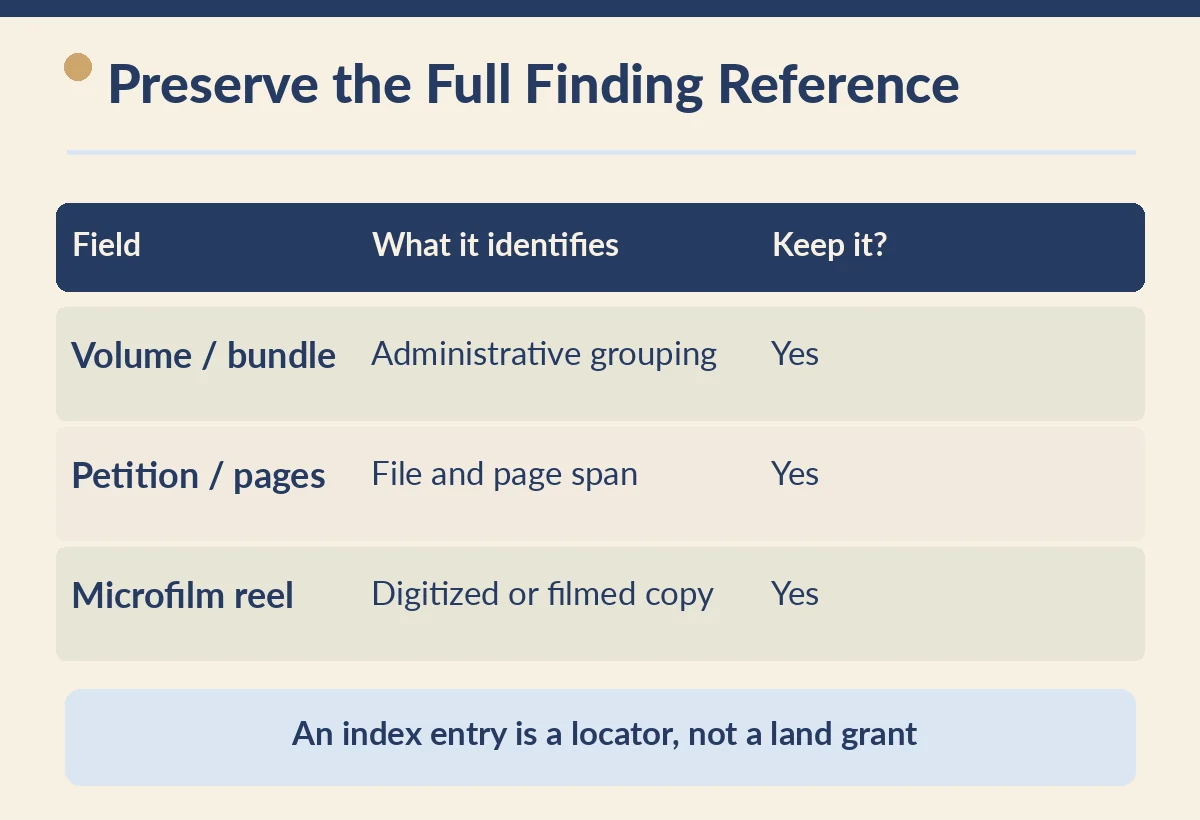
A result may show surname, given name, place, year, volume, bundle, petition, pages, archival reference, and microfilm. Record each item in a single citation line. The finding aid can identify the first and last pages of a petition file without pointing to the exact page on which a person’s name appears. Browse the entire stated document range, including attachments and neighboring pages needed to understand the submission and decision process.
The Archives of Ontario guide recommends using the index to obtain microfilm, volume, bundle and petition information, then navigating by those locators. The original papers belong to Library and Archives Canada; Ontario holds microfilm copies. Digital images are provided through LAC mass digitization and the Héritage project for relevant series. An image not directly attached to a search result may still be discoverable by reel, so a missing download button is not evidence that the original petition no longer survives.
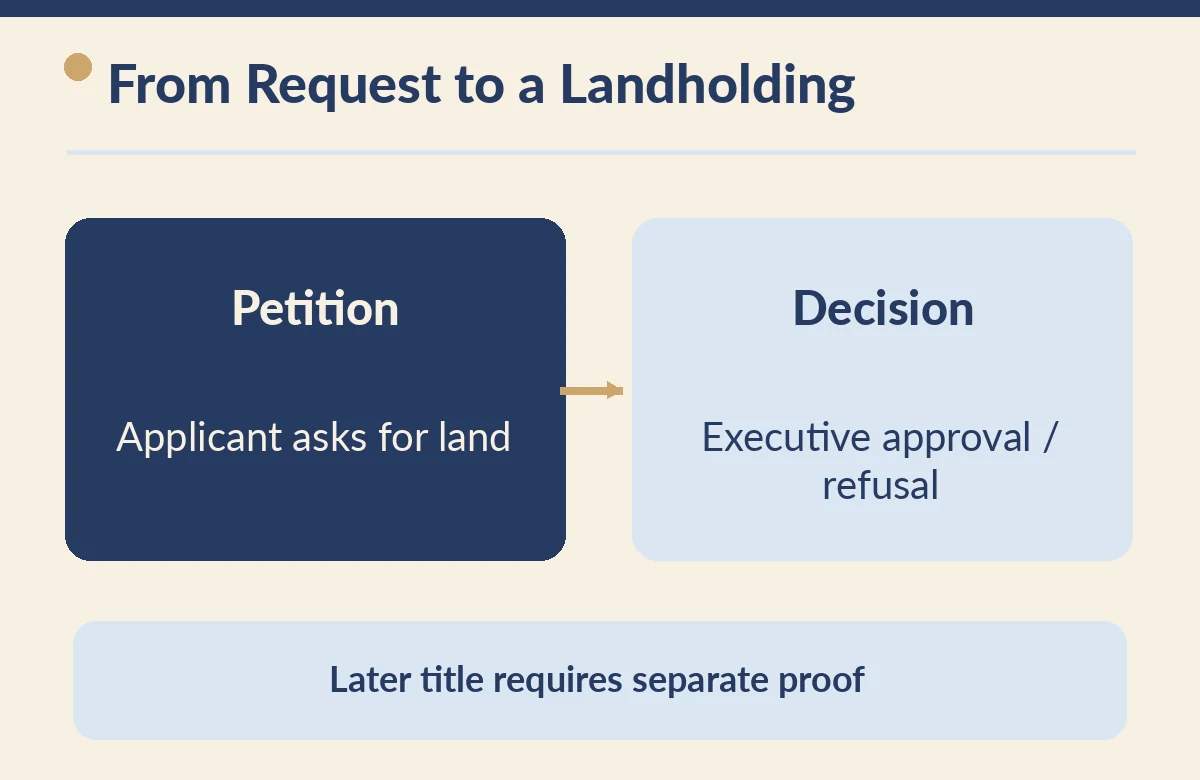
Identify the Difference Between a Claim and an Award
A petitioner might have supported a request with military discharge papers, letters of introduction, proof of alleged entitlement, service claims, settlement plans, or descriptions of wartime losses. Such statements may be rich genealogical clues, but they can be assertions by an interested applicant. LAC explains that supporting documents were sometimes returned and are not always present today. Absence of a certificate does not mean an applicant did not present one.
Where a petition was reviewed, note the exact administrative endorsement or recommendation and whose decision it represents. The term “approved” on one stage of a file may not itself identify a surveyed lot, completed grant, patent, or registered title. LAC’s separate land-record overview describes Upper Canada Land Books as documenting executive decisions after petitions. Use the land books and subsequent land records when the research question concerns the ultimate disposition of a named property.
Work Through a Two-Namesake Petition Test
Imagine a fictional John Fraser found twice in the database, once under a township name and once in a group petition. Do not assume that the two references concern a single settler. Record each petition’s year, associated place, bundle number, other named petitioners, supporting statements, and any military reference. Only then compare them with independent tax, census, church or military evidence for the target person. The same name in both indexes is not enough.
If an original document states a birthplace, prior residence, family member, or service history, identify whether the detail is the petitioner’s own assertion or an official attestation. Preserve both when they differ. For a group petition, read the document sequence for all participants and note if a name appears solely on a collective list. Your conclusion might remain “possible” despite a detailed petition; that is preferable to using an unproven land relationship to build several generations of a family tree.
Look for the Land Board and Later Parcel Trail
The separate Upper Canada Land Boards records fall broadly between 1765 and 1804, with most material from 1789–1794; these are not interchangeable with the two petition series. They include minutes, correspondence, regulations, location schedules, and oaths. LAC records about 16,400 referenced people, but frequently named officials may receive only volume-level indexing. A Land Board mention may supply context for a grant application without resolving its final status.
A land investigation may then continue to executive land books, survey records, patents, deeds, and later tax or assessment rolls. Draw a distinction between the person who asked for land, the person whose request was approved, the person who acquired legal title, and the family who actually lived there. Preserve lot and concession identifiers exactly once established. If a search concerns an area outside colonial Upper Canada, consult the custodian of that jurisdiction’s land administration rather than forcing it into this database.
More Records and Archives Guides
How We Research Upper Canada Petitions
We begin at the custodian’s guide to determine the source series and indexed scope, then search surname variants and relevant places. For each candidate we preserve microfilm, volume, bundle, petition number, pages, and year. We inspect the entire digitized submission where possible, distinguish handwritten statements from endorsements, and use land books or other surviving evidence to decide whether a requested grant progressed beyond application.
The resulting evidence ledger separates the applicant’s statement, an official recommendation, a government decision, and a later conveyance into different dated entries. We do not promote an index hit or petition into proof of ownership, kinship, or military entitlement. Citations retain the original record group and digital container for retracing. See the site’s affiliate disclosure for our editorial policy; no unverified service link is involved.
No. It documents a request or administrative step, which must be followed to a decision and later title records.
They are distinct LAC series: executive land submissions and Upper Canada Sundries references, respectively.
Preserve the microfilm reel, volume, bundle, petition, page range, year and archival reference.
RG 1 L3 indexing was derived from bundle name lists, so transcription, omission and spelling limitations apply.
Yes. LAC notes that some original supporting documents were returned to applicants and no longer accompany the file.