
Check Whether This Was an Assisted Arrival Before Searching
The Queensland State Archives provides an index to assisted immigration for 1848–1912, drawn from Series 13086, Registers of Immigrant Ships’ Arrivals. It covers people in particular government-assisted or related migrant categories, not everybody who ever entered Queensland. Start with the ship, approximate arrival year and whether the passenger’s circumstances plausibly match an assisted passage.
An ancestor who bought a private ticket or traveled first to another Australian colony may be absent from this index even if the later family history clearly places them in Queensland. Keep arrival in Australia, landing at a Queensland port, selection for assisted migration and later Queensland residence as four distinct events. A name match in the index begins the question; it does not settle those distinctions.
Search Names, Variants and the Actual Ship Entry
The government’s search-the-indexes page lists assisted immigration records, with links to original scans where available. Search the surname, then use a broader surname-only query if given names do not match. Historical initials, married names, age rounding and phonetic spellings can all complicate an apparently precise query. Identify the actual indexed ship and arrival date before comparing candidates.
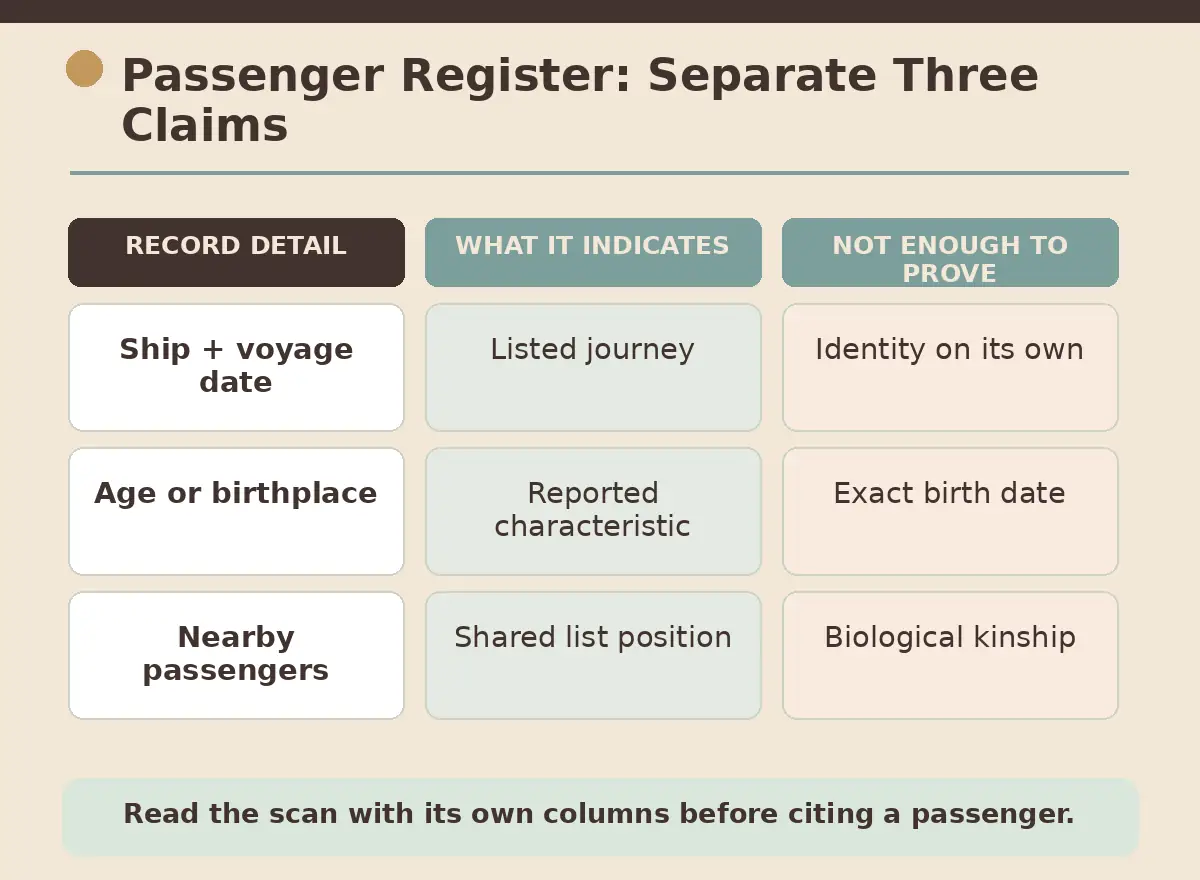
Do not stop at a search-results snippet. Open the linked scan or full archival catalogue description and find the row in context. Check the surrounding passengers because families may be grouped, but do not automatically assign kinship to people listed nearby. Save the series and item identifier shown by the repository, the page or image reference and all spellings used in the search.

Use Series 13086 as a Record Locator, Not a Family Verdict
Queensland State Archives identifies Series 13086 as the record basis for its assisted immigration index and explains that indexed names can lead to scanned passenger lists. Depending on the register and its period, you may encounter voyage, port, ship, passenger name, age or other travel details. Check the columns on the actual page rather than assuming every vessel used the same format.
The index is a derivative finding aid, while the original register provides fuller layout, annotations and adjacent entries. A passenger sharing your ancestor’s name and approximate age should be tested against the departure place, arrival chronology and later Queensland records. It is possible to identify a ship correctly but a person incorrectly, so keep these two decisions separate in the evidence table.
Account for Serious 1893 Flood Losses and Rewritten Lists
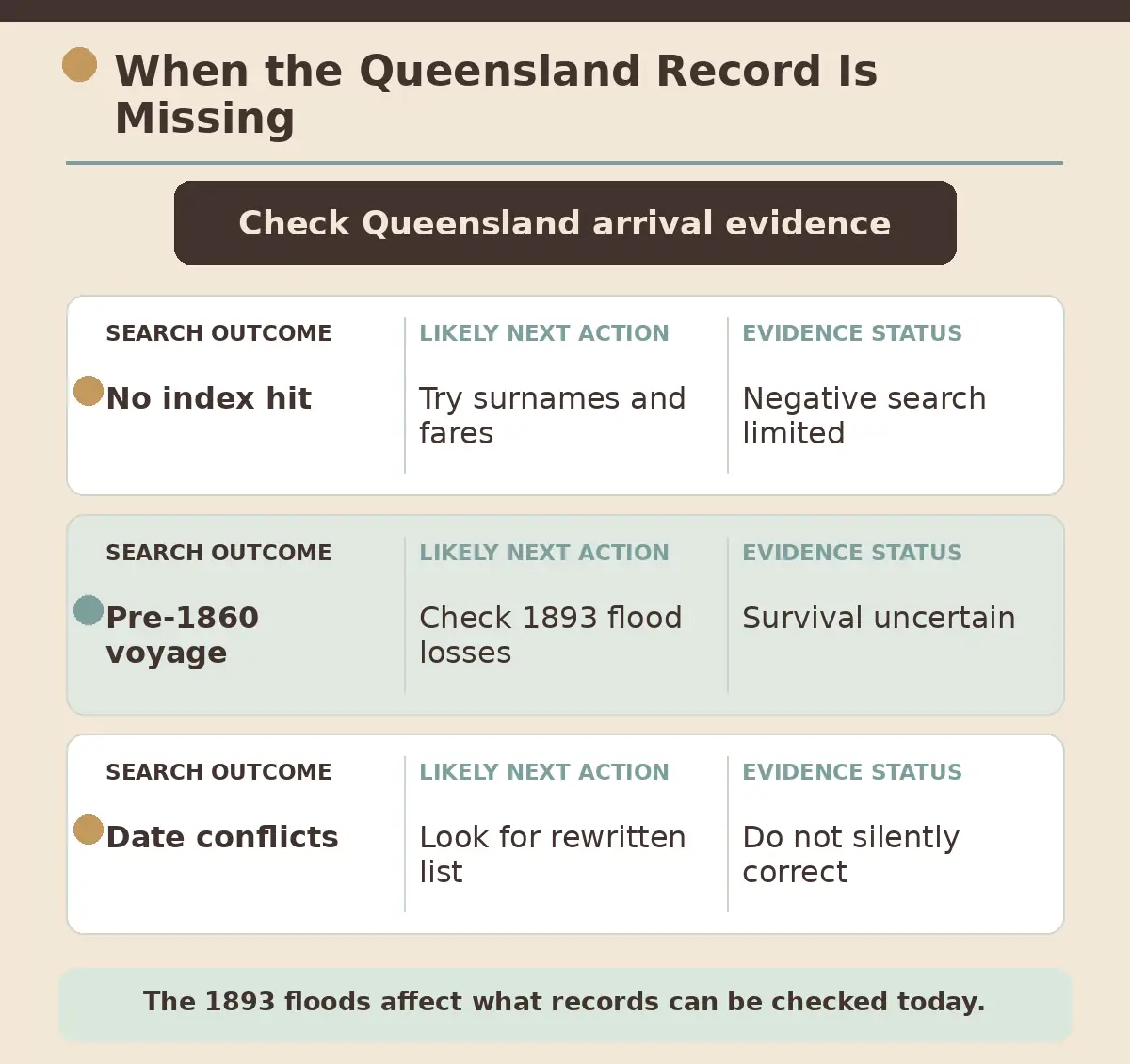
The archive warns that many early passenger lists, particularly those created before the 1860s, did not survive. Its guidance specifically identifies severe damage and destruction associated with the Queensland floods of 1893. Some damaged lists were later copied out by the Immigration Department, which can introduce transcription errors and even incorrect voyage dates. A missing or inconsistent scan may reflect the archive’s history rather than a failed migration story.
When a voyage date seems impossible, compare the listed vessel, other passengers, contemporary shipping notices and the archive’s record description. Mark whether the copy is original, later rewritten or only represented by a finding aid. Never silently correct the departure or arrival date in your working transcription: write the recorded value and explain why a separate source may contradict it.
Distinguish the Port of Arrival From a Later Queensland Home
A person could arrive in Sydney or another colonial port and later settle in Queensland by coastal vessel or overland. Queensland’s assisted-immigration registers chiefly concern the arrival routes within their specific administrative remit. Thus a Queensland marriage or land purchase does not guarantee a matching entry under a Queensland ship list, even when the family came from Europe in the right decade.
Use civil certificates, later residence records and newspapers to establish the earliest known Queensland date. Then search for a plausible port and ship in the correct colony. If the travel route was indirect, consult records held by the first-arrival jurisdiction or the National Archives of Australia as appropriate. Keep “first arrival in Australia” separate from “first recorded residence in Queensland.”
Test Passenger Age and Family Grouping Against Later Records
Passenger lists can contain age estimates, omissions or names supplied by someone other than the individual concerned. Compare the reported age with later marriage and death records without insisting on perfect arithmetic. Where a family unit appears together, note actual printed grouping and any explicit relationship language rather than assigning every same-surname passenger as a child or spouse.
A household shown twenty years later in a census substitute or electoral roll is corroboration only when chronology and identity details agree. Another passenger of the same name might arrive on a different ship. Build parallel candidate rows showing ship, year, age and destination before deciding which record belongs in the family tree. Keep conflicting records visible rather than erasing a less convenient candidate.
Move Beyond the Index When No Passenger Appears
The State Archives says its lists largely cover people classed as migrants, especially those with assisted or free passages and land-order arrangements, and may exclude self-funded travelers and arrivals through other colonies. The repository also notes that records of passengers coming from outside Europe may not be present in the collection. Missing coverage is a categorical limitation, not evidence that such people did not travel.
Search contemporary shipping reports, records from the probable port of first landing and alternative immigration indexes. If you have a confirmed arrival ship but no name in Series 13086, check whether the vessel and fare category belong to this archival series at all. Record the searched vessel, years, spelling variants and known survival limitations before writing a carefully bounded no-result statement.
Cite a Specific Voyage and the Custodian’s Image
A useful source citation identifies Queensland State Archives, Series 13086 when applicable, the ship, arrival date as recorded, register item or page, individual passenger and retrieval link. Name the government index separately if it supplied the initial lead. If an original scan is missing, do not imply it was consulted; cite the surviving finding aid and note the access limitation.
Retain the comparison between ship’s passenger details and independently dated Queensland events. When two reported dates differ, tell readers whether one came from a later departmental rewrite, a contemporary newspaper or a subsequent family certificate. That provenance can be more important than the apparent precision of an indexed day and month.
More Records and Archives Guides
How We Research Queensland Assisted Immigration
We begin with the archive’s record-class definition and test whether the hypothesized voyage was an assisted Queensland arrival. Then we search the official index with name variants, follow its reference to the surviving register, and examine nearby passenger entries and dates. We explicitly log the 1893 flood survival problem before treating any unsuccessful search as meaningful.
We corroborate passenger identity with an independent Queensland record and label the difference between first Australian arrival, arrival at a Queensland port and later Queensland residence. We do not claim a partnership with the archive or passenger websites. Our affiliate disclosure describes the website’s general policy.
Queensland State Archives lists assisted immigration records from 1848 to 1912 based on Series 13086.
No. They focus on particular migrant categories and often omit privately funded travel or arrivals through another colony.
The archive reports survival gaps and significant losses or damage in the 1893 Queensland floods.
Yes. The archive cautions that later reconstructed lists may contain transcription mistakes, including voyage-date errors.
No. Grouping is a research clue; verify the relationship against independently supported records.