
Grosse Île was a quarantine station on the St. Lawrence River downstream from Québec City, operating from 1832 to 1937. It is not a comprehensive roll of everyone who arrived in Canada. The current Library and Archives Canada collection page describes 11,612 references from its holdings concerning immigrants, sailors and employees who died at sea, died at the station or were buried there. Your goal is to identify the recorded event and follow its archival reference, rather than turn every name hit into a verified passage or family relationship.
Start with the narrower current LAC quarantine search
Search a surname with alternative spellings and then try a given name, initials or a broad year span. The official guide suggests a wildcard such as Fran* for related name forms; historical transcriptions retain original-language spellings. If you already know a ship, try comparing departure port and voyage date to narrow candidates. Do not add a precise arrival day simply because a family story gives one: establish the voyage from a passenger list or contemporary shipping report.
For every potential hit, save the record’s name as spelled, event type, event date, possible ship, any age or place details, and especially its Reference field. The current LAC page is specifically scoped to deaths and burials; an ordinary healthy passenger may never be indexed there. LAC’s older Grosse Île explanatory page describes a broader historical database. Because scopes differ, record which interface and date you used instead of merging the numerical counts or claiming the collections are identical.
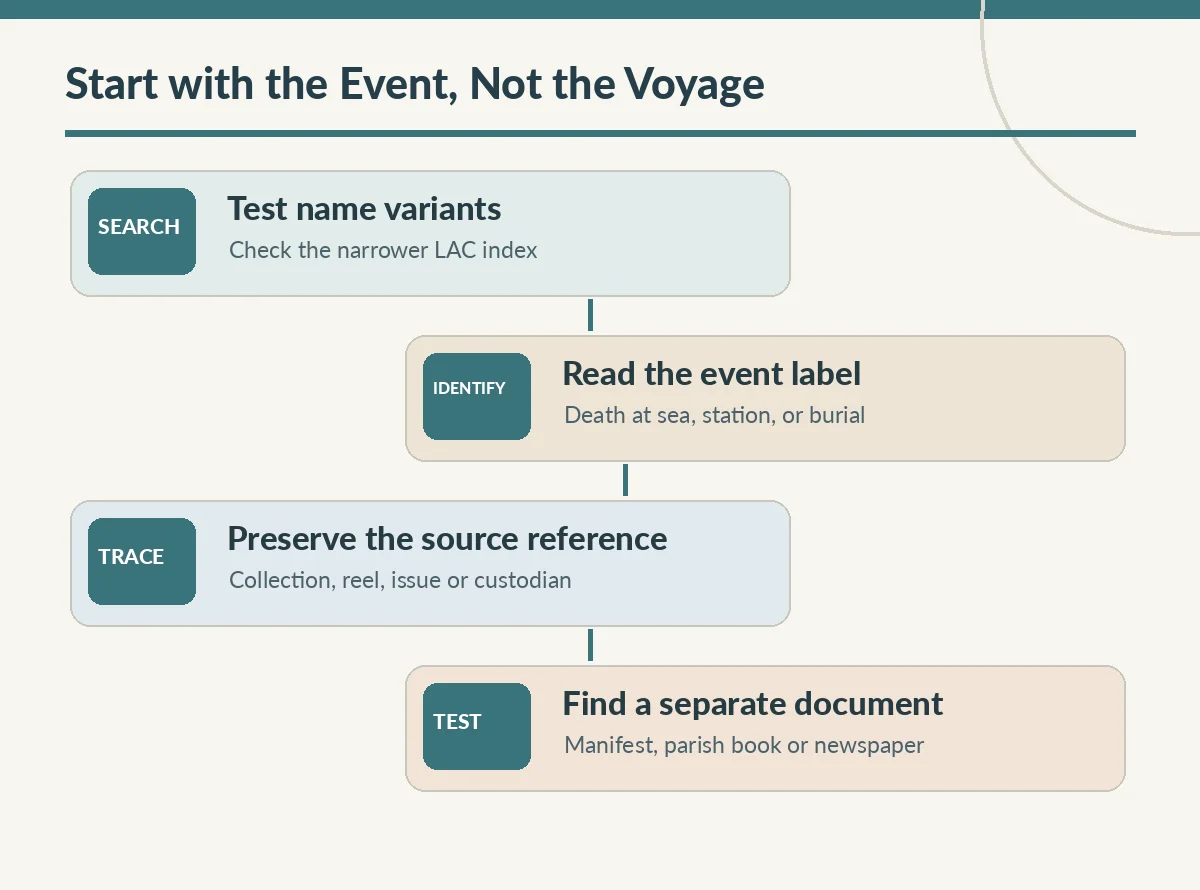
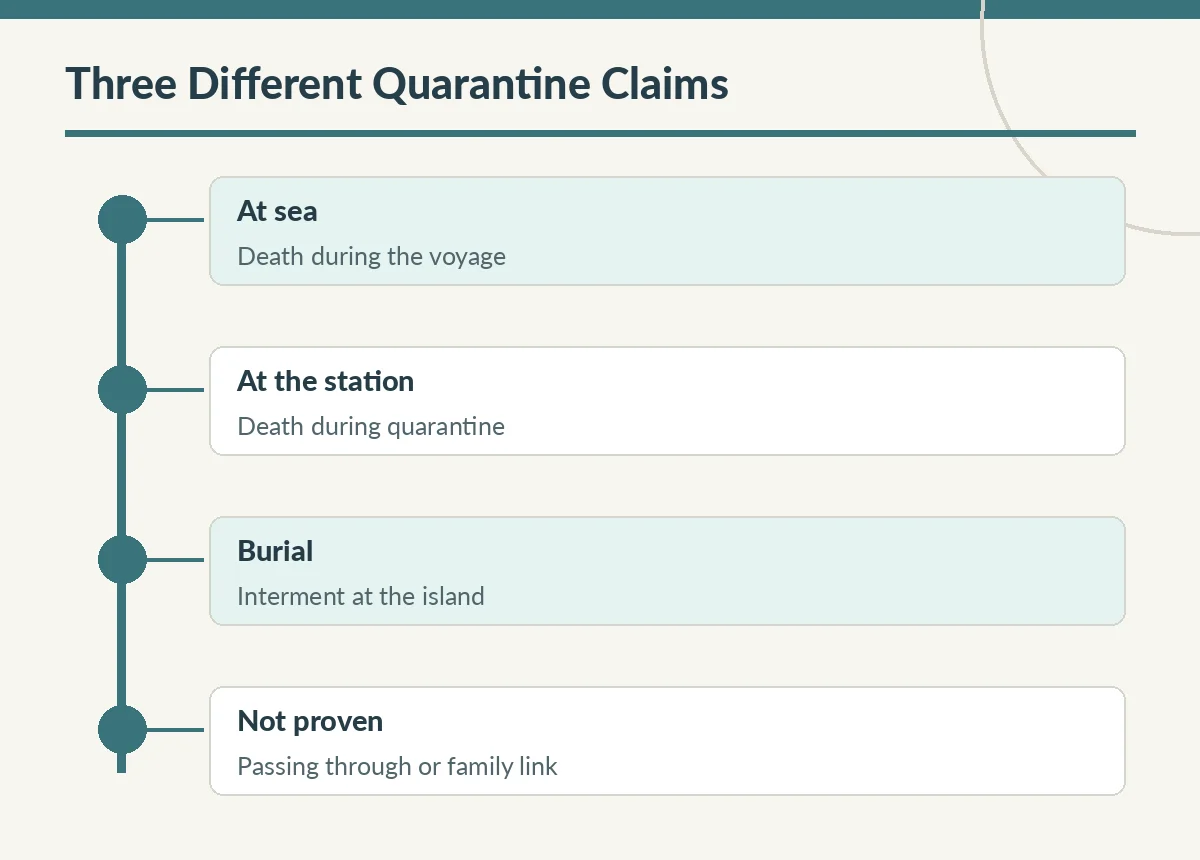
Classify death at sea, station death and burial separately
A person could die during the Atlantic crossing before reaching the island, die while under quarantine, or be buried at Grosse Île after an event recorded elsewhere. These are different claims with different dates. A newspaper death notice may supply a reporting date rather than the date of death; a memorial list may memorialize someone without giving the precise medical event. Build a four-column event row: literal source wording, interpreted event, date type and independent check.
Do not convert an entry marked ‘buried at Grosse Île’ into evidence that a person died there unless the source states both events. Conversely, a reported death at sea does not prove burial on the island. A listed disease may reflect historical diagnosis and observation; it should not be recast as a modern medical conclusion. Handling these distinctions matters especially when working with people affected by epidemic disease, forced displacement and bereavement.
| Record label | What it may support | What still needs testing |
|---|---|---|
| Died at sea | Reported death on voyage | Ship and burial location |
| Died at station | Reported island death | Registration or hospital source |
| Buried on island | Reported interment | Exact death site and date |
| Newspaper notice | Publication of an assertion | Independent event record |
Follow the Reference field to an actual document
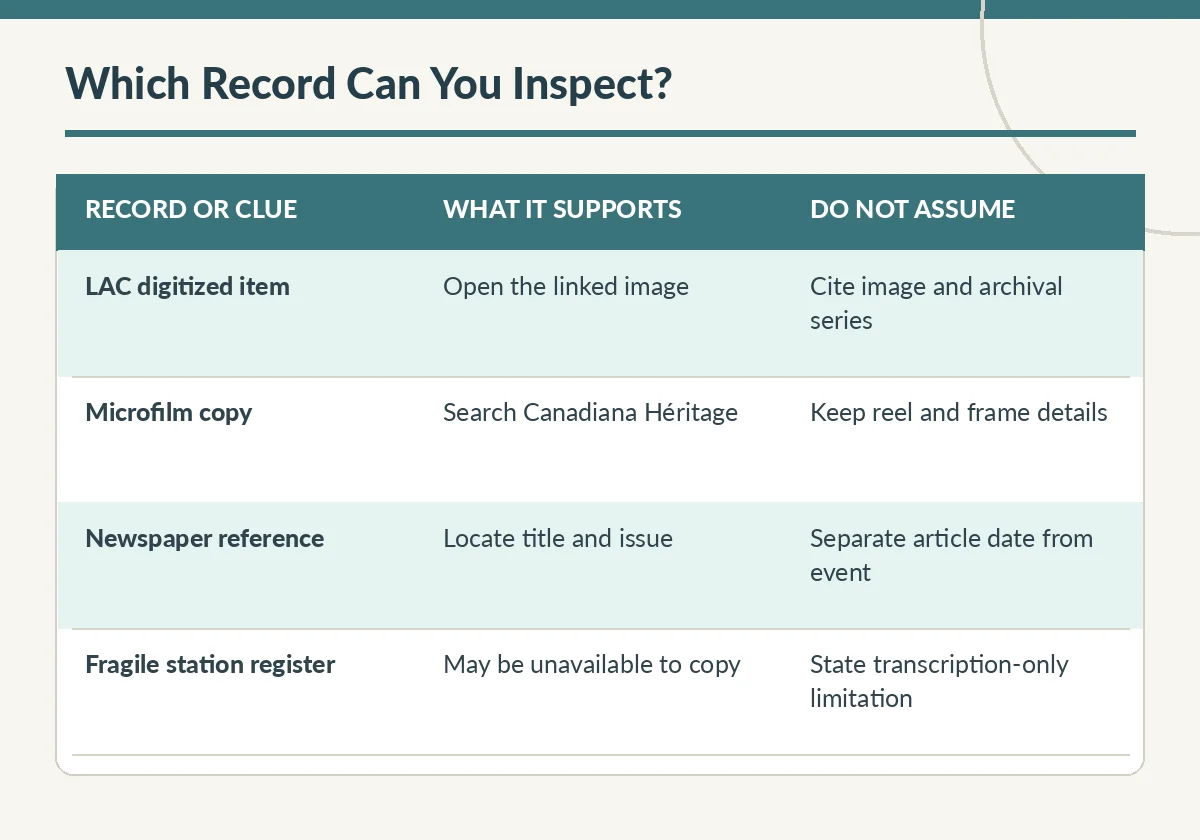
The official current LAC guide says some transcriptions connect to digitized images in Collection Search and others to digitized microfilm at Canadiana Héritage. When no image is online, use the archival Reference field to identify the collection, volume, file, page or newspaper issue. The original record might be held by LAC, a Quebec archive, a diocesan repository or Parks Canada. Write down the physical or digital custodian, not merely the website on which the name appeared.
Some Parks Canada quarantine registers are too fragile to be consulted or copied, according to LAC. That is an access limit, not a reason to invent page content. If an image cannot be inspected, state precisely what the transcription claims and which primary source has not been read. Use an independent passenger manifest, church burial entry or contemporary newspaper to test the account. Remember that evidence in a historical compilation may derive from several records rather than one original page.
Use ship details to test a named immigrant
A plausible match needs more than a name. Compare the vessel’s name, voyage timing, port of departure, traveling companions where listed, age and occupation against an independently held passenger list. If a ship name is absent, a search for that year in Quebec shipping notices may still reveal the available voyages, but it must not be treated as an individual boarding record. Keep two hypotheses where common names and similar ages cannot be separated.
For example, two people called Patrick Kelly might be reported in different sources in the same summer. One document may mention a hospital death and another an emigrant traveling onward. Do not combine these references into a single life until matching identifying information bridges them. A death record cannot show that a person later appeared in an inland Canadian census. Where records disagree, preserve both citations and test whether they describe namesakes or a transcription error. To go further, our guide “Canadian Border Entry Records, 1908–1935” shows how to find lists and Form 30 without false negatives.
Build an alternate route when Grosse Île search is blank
The quarantine station existed during the heavy transatlantic movement of the nineteenth century, but the surviving indexed items do not represent every immigrant. LAC notes that a fire in 1878 destroyed many early station records. A negative search can mean that the person was never documented in the relevant event type, that the record did not survive, or that indexing used another spelling. Do not equate it to evidence that the family never arrived through Québec.
Shift to the LAC immigration collection guide to locate passenger lists, border documents, local parish events or records for the destination community. Build a voyage window from the first proven Canadian appearance and the last proven foreign residence. Use county or city histories only as context until linked to an original person-level document.
Cite quarantine evidence with its date and provenance
A useful citation states the person and event, reported or document date, original collection reference, repository, specific index page or image locator, and the date accessed. If a report was published days after the event, record both dates separately. If your evidence comes from the older LAC database, say so, especially if newer search interfaces return fewer matches. The provenance tells readers exactly which observation they could verify.
An efficient evidence log has separate statuses: original examined, transcription only, correlated independently, and unresolved. A moving family-history story deserves a respectful account of uncertainty. Avoid showing a fictional medical register with invented patients as though it were a true archival page; any illustrative worksheet should be clearly conceptual and should carry no fabricated personal details.
More Records and Archives Guides
How We Research Grosse Île References
We relied on the current Library and Archives Canada quarantine overview for the narrower 11,612-reference scope and for image, custody and loss warnings. We separately reviewed LAC’s broader legacy collection description rather than treating the two numerical descriptions as interchangeable. The central test in this guide is an event label checked against the underlying source and then against an independent record, not a generic family-arrival search.
Our examples use invented same-name candidates and assert no historical deaths or family relationships. The article contains no paid travel, copying or records-service recommendation. Our general affiliate disclosure explains the site’s policy; any archival copying charges must be verified with the custodian.
No. The current LAC collection focuses on specific deaths and burials, and surviving records and indexing are incomplete.
They describe different collection scopes and interfaces. Save the version used; do not combine counts as if they were the same database.
Not necessarily. The place of burial and place of death are separate facts requiring specific evidence.
Cite the indexed transcription as such, preserve the original archival reference and seek independent records; some fragile Parks Canada registers cannot be copied.
No. The station lost early records in a fire and the current name index covers particular event types, not all passengers.