
MH 52 contains correspondence between central health authorities and local authorities, covering 1913–1973, and is arranged by county council, topic and date according to The National Archives. It can explain how a sanitation scheme, clinic proposal or public-health concern was discussed and supervised. It does not provide an automatic patient index or proof that a particular household used a service.
For local and family historians, the useful result is an evidence-based account of a public decision. First identify the responsible historical authority and subject; then follow a letter or proposal to local council minutes, budgets, reports or other records of action. A correspondence file may be rich in place names but silent about individual patients.
Choose the correct historic county and authority
Write down the place, approximate year and whether the question concerns a county council, county borough, municipal authority or another local body. Administrative responsibilities and boundaries changed during the period 1913–1973. A modern council name may not identify the authority that created the correspondence. Search contemporary directories, council reports or dated boundary descriptions before choosing a county series.
The National Archives recommends looking in MH 52 by county council, topic and date. Treat those as three separate search dimensions. A district sanitation project might have appeared in county-wide correspondence even though the site was a specific village. If several authorities shared responsibility, record each as a candidate rather than assuming the nearest present-day council held every file.

Search MH 52 by the problem, not a patient name
Start with an administrative keyword such as water supply, health inspection, clinic, isolation, housing conditions or a historically used program name, and combine it with the correct county and approximate dates. A record’s catalogue title may describe the whole subject rather than a named individual. Use broader synonyms and track which series years were checked. Do not treat a missing name hit as proof that the person had no contact with the health system.
Read the catalogue description to determine whether the item consists of a single exchange or an assembled file. Look for incoming letters, drafts, minutes, enclosures and references to local reports. Record document creation date separately from the event, reported condition or proposed deadline. An enclosure might have been written years before a file was closed.
Distinguish central advice from local implementation
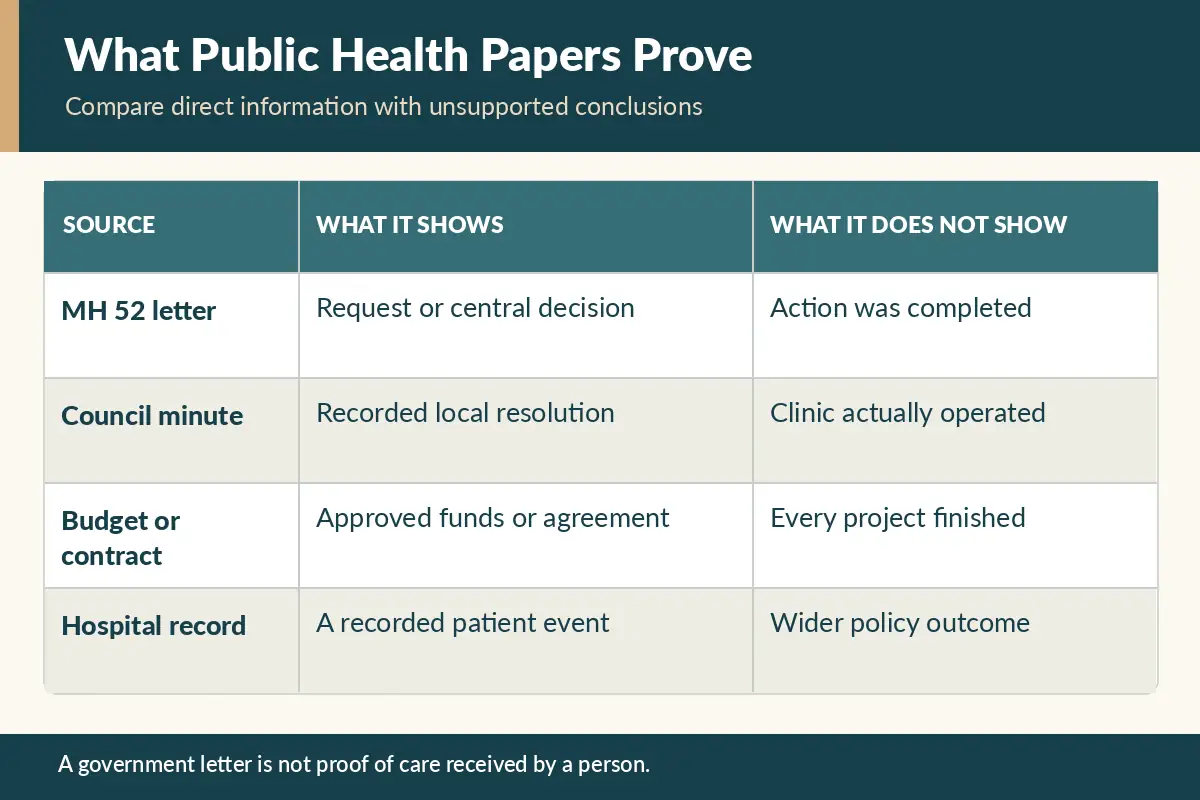
A Ministry letter might recommend a measure, request statistics, approve a budget or respond to a complaint. Those functions are not interchangeable. Create a decision trail: proposal, response, any approval, local allocation and evidence of completed work. A letter saying that a council “should” build a facility is not a building completion notice; permission to spend money does not establish that all funds were used.
To confirm the outcome, seek surviving council committee minutes, annual medical officer reports, contracts, building plans or local newspaper notices. Compare the dates and organizations named. A later central summary might claim success, while local records describe delays or altered plans. Preserve both accounts and state the exact action that each document supports.
Read numbers and geography with caution
Public health correspondence may contain aggregate counts, estimates or rates drawn from locally collected information. Check the population base, geographic coverage, period and definitions before comparing figures across counties or years. One table may count cases reported to officials while another counts admissions to a facility. Such figures are not a list of identifiable patients and cannot establish whether a particular relative was treated.
If place names recur, determine whether each refers to a district served, an administrative headquarters or the actual location of a clinic. Mark them separately on a dated map. A health authority’s region could be larger than the town where an office stood. A historical map is useful for showing jurisdiction but does not identify a household or medical event.
Where personal treatment records may survive
The National Archives explains that, with limited exceptions, it does not hold hospital patient files. Older local NHS or hospital records may survive with local archive services, but retention and access vary and identifiable patient material may be restricted. MH 52 central correspondence should not be presented as a substitute for a clinical record, admission register or birth or death certificate.
If the family question concerns a named patient, identify the institution, dates and legal grounds for access before contacting its successor or holding archive. Respect confidentiality and never attempt to infer private diagnoses from a town-wide public health response. An ordinary family death certificate may help establish an event but does not prove a connection to an MH 52 administrative decision.

Publish a documented local-health case study
A strong local history can report that the Ministry corresponded with a named council about a stated subject on a documented date, and then show what the council later did. Include an MH 52 piece reference, page or folio when available, named sender and recipient roles, historic jurisdiction, quotation context and separate local corroboration. If the final outcome is unknown, show that gap in a short timeline.
Separate public policy, local implementation and individual experience in your conclusion. A clinic’s proposed opening does not prove that it opened; an operational clinic does not prove a family member visited it. The evidence ledger is most useful when it records what remains uncertain and the next council, property or patient-record source that could resolve the question.
More House and Local History Guides
How We Research and Verify These Records
Our archive-first review began by identifying the holding repository, creator and series rather than searching a family name in isolation. We compared the series description with subject-specific guidance, separated original documents from catalog descriptions and compiled indexes, and checked how dates, jurisdictions, omissions and access conditions affect each conclusion. The examples in these diagrams are editorial illustrations of evidence logic, not reproductions of documents or identified historical people.
We consulted this archive research resource on 2026-11-03. The National Archives describes MH 52 as 1913–1973 Ministry of Health correspondence with local authorities, arranged by county council, topic and date. The next step for a real family claim is to examine the identified source item and test that one finding with independently created evidence.
We consulted this archive research resource on 2026-11-03. The National Archives distinguishes local historic health-service records from patient files, which are generally held elsewhere and may be restricted. The next step for a real family claim is to examine the identified source item and test that one finding with independently created evidence.
We consulted this archive research resource on 2026-11-03. A National Archives specialist article explains how central government hospital correspondence differs from records created by individual medical institutions. The next step for a real family claim is to examine the identified source item and test that one finding with independently created evidence.
Our record descriptions and illustrated methods are informational, not advice that a specific commercial provider owns every relevant document. Some archival copies require a fee or a visit, and access restrictions must be respected. We have not assumed any paid relationship. Read the affiliate disclosure before following any recommendations.
MH 52 is central health correspondence with local authorities, described by The National Archives as 1913–1973 and grouped by county, topic and date.
It is primarily an administrative correspondence series, not a comprehensive named-patient index.
No. Local council minutes, contracts or operational records must confirm what happened.
Start with the historical county or authority, the public health subject and the time period.
No. They are often held by local or medical repositories and may remain subject to access restrictions.