
MH 82 contains minutes and papers of the Central Council for Health Education dating broadly from 1927 to 1969. It is valuable for tracing public-health messages and administrative intentions, but a surviving poster or committee discussion does not demonstrate that a particular family saw, believed or followed the advice. This guide gives a precise source route, identifies what the archive can and cannot show, and names the independent documents needed before a personal or geographic conclusion becomes defensible.
Locate the Central Council and Its Historical Role
The Central Council for Health Education supported local authorities by offering advice, educational materials and expertise. The National Archives public-health guide identifies its surviving minutes and papers as MH 82, with the date range 1927–1969. These are institutional records: they reveal what the council discussed, endorsed or circulated, not a clinical record for every person affected by a disease. Begin with a well-defined topic—such as tuberculosis publicity, child health education or the treatment of public anxiety—and a historical time window before searching the catalogue.
The story of a household during an outbreak may involve several different institutions. Central bodies formulated messaging and provided materials; local councils and health officers might have implemented or adapted them; hospitals and doctors documented care. Separate those roles in the research plan. A central poster is evidence of the advertised message in its historical context, but a claim about a neighborhood requires more local evidence. Avoid using a graphic from the 1930s to describe a community in a different decade without showing it was then in circulation.
Read the 1935–1939 Tuberculosis Poster With Its Reference
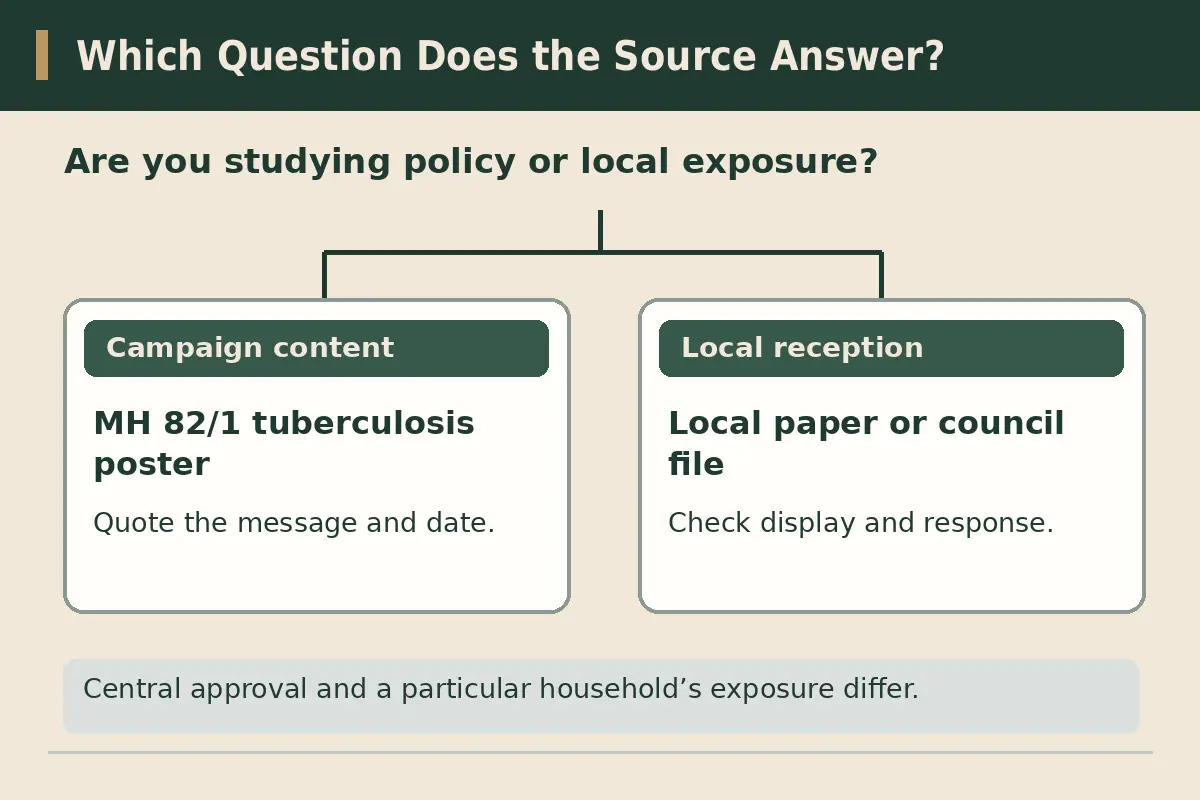
The National Archives collection feature identifies a tuberculosis-awareness poster as MH 82/1 and dates it to 1935–1939. It describes a campaign intended to spread knowledge and reduce unnecessary fears, encouraging people to seek early medical help. This is a concrete archival starting point because a reader can capture the catalogue reference, published date interval, sponsoring organization and historical message. Treat the quoted dates as the poster’s identified range, not as the single exact day it reached a particular street.
Examine the original image or reliable institutional reproduction for its heading, audience, imagery, medical vocabulary and any printing or distribution detail actually visible. Distinguish literal text from a modern interpretation of visual persuasion. A statement such as “the council advertised early tuberculosis diagnosis” can be supported by the item, whereas “my ancestor was aware of this warning in 1936” cannot be established from the poster alone. Even a plausible location and year do not bridge that person-level evidence gap.
An illustration reproduced by a trustworthy archive can be the best way to establish how a campaign represented illness, yet the reproduction is not a comprehensive list of campaign materials. Trace it back to its catalogue reference and original date description. If a later exhibition labels an image with broad years, do not silently turn the range into an exact event date. For derivative images, cite both the repository holding and the page where you inspected the reproduction.

Search Minutes for Decisions Without Inventing Distribution
Use Discovery within MH 82 to look for minutes or papers covering the campaign and the period in question. Record meeting date, item description and precise piece references. Different documents may contain proposed wording, committee discussion, a printing arrangement or retrospective evaluation; the series title does not guarantee any particular piece includes all of these. A recommendation in committee minutes is an action of deliberation unless later material demonstrates adoption. A plan to issue a leaflet is not an audited count of leaflets displayed.
Build a two-stage log. The first records what the central source actually states: approval, printing, proposed destinations or educational goal. The second asks what independent materials could establish distribution or public response. A council minute may explain why a campaign existed while a local medical officer’s report, council agenda or dated newspaper advertisement might show that materials reached a town. Avoid treating one such local notice as proof that every household encountered it, and preserve uncertainties about missing correspondence or fragmentary local archives.
Find Local Reception Without Diagnosing Individuals
To test whether a campaign reached a particular place, search county and borough health committee records, local newspapers, municipal annual reports, libraries or surviving health-department files. Specify date, locality and institutional creator in each search. A newspaper carrying campaign material may establish publication of a message to its readership, but circulation figures and household reading habits are different claims. When a local report says “posters displayed,” transcribe the locations and dates only if the report actually identifies them.
Family testimony may recall a poster at a clinic or school, which is useful oral-history evidence when attributed to a particular informant and date. Record the memory alongside contemporary sources, not as their direct substitute. A historic tuberculosis campaign did not diagnose the people who saw the material; neither did public-health publicity guarantee that every resident received a medical examination. Avoid making medical claims about named ancestors, especially from suggestive symbols, general statistics or historical images not tied to them.

Create an Evidentiary Timeline for One Campaign
A hypothetical local case begins with a 1937 newspaper notice mentioning a tuberculosis awareness event and the MH 82/1 poster. Write three rows: the poster’s documented date range, the notice’s publication date and any surviving municipal minute about local display. If the notice mentions a venue, cite it. If it merely announces a meeting, label attendance unproved. This simple alignment makes the difference between central publicity and documented local activity visible, and prevents a familiar family name from being placed in the room without evidence.
For publication, cite MH 82/1 by full reference and the National Archives description, then give independent local source citations with date and page. Describe the council’s historical language respectfully and note where it reflects its own period. Preserve alternative explanations for an absent newspaper report—lost issues, a different local newspaper, no event, or ineffective searching. The strongest local-history result may be a carefully delimited account of what was promoted, where, and when, with family-level exposure left explicitly unresolved.
When a local archive holds public-health files under a council name that changed later, use the creator’s name in force at the time. A county medical officer’s return may summarize aggregate conditions but not provide names of all patients. Preserve any figures in their original reporting units. Comparing a council campaign with individual family sickness requires a separate personal medical source, and access restrictions may apply.
More Research Method Guides
How We Research This Archive Series
This guide starts with the official description in The National Archives’ research guidance, not a claim that we have inspected a particular person’s private file or a specific original piece. The archival statements here concern the series or research method. A hypothetical example is labelled as such; it is not a newly discovered historical event. We use the Discovery search guidance to distinguish keyword matches from archive holdings and document contents, because catalogue descriptions do not transcribe every word of an original.
For every real candidate, record its historical place or person’s name, the creator, document type, date, full MH 82 piece or item reference, access restrictions, and the exact claim being tested. The official citation guide explains how to document those references so another researcher can retrace them. An unread document remains a catalogue lead, never proof of imagined details. If a record is missing, preserve the searched terms and dates and examine survival and alternate custodians before interpreting the gap.
Before sharing a conclusion, audit the difference between original source wording and your interpretation. Require independent evidence for any further claim about an individual, property owner, legal effect, or completed action. Respect archival access limits and living people’s privacy. This website also provides an affiliate disclosure; no paid partnership or commercial access is implied by these archival references.
It contains Central Council for Health Education minutes and papers, broadly 1927–1969.
Yes. The National Archives identifies a 1935–1939 tuberculosis awareness poster as MH 82/1.
No. Search local authority records, dated newspapers or other locality-specific evidence.
Not from central publicity papers. Individual health claims require appropriately accessible personal evidence.
No. Look for approval, distribution and independent local implementation evidence.