
AIR 60 includes monthly Air Ministry Directorate of Research reports from 1919–1925 with photographs of research into aircraft, airships, balloons, engines and equipment. The National Archives notes that many photographs in those reports are printed copies of originals. An image of a test component shows what was pictured, not necessarily a completed aircraft, successful trial or actual flight. Begin with the report month and exact reference, then separate image content from a dated operational claim.
Use the Research Month as a Finding Aid
The National Archives describes AIR 60 photographs in monthly reports associated with the Air Ministry’s Directorate of Research and later Directorate of Research and Technical Development. Search by the research subject, such as aircraft structures, engines, equipment or airships, with the series reference. If the catalogue provides only a broad report description, do not assume every experiment appears as an individually indexed image. Establish the report month, the precise piece and any internal figure or plate number before citing a result.
Compare report dates with the date of the photographed test, if it is actually stated. An image may have been taken before its inclusion in a monthly compilation, and an image reprinted from an original negative may lack a reliable shutter date. Make separate fields for report date, photograph date, test date and any later compilation date. This basic separation is crucial for any claim that a machine or apparatus had reached a particular development stage by a certain day.
Identify the Apparatus Without Claiming Performance
A research photograph may depict an engine under examination, an airship component, a balloon, a test fixture or a completed aircraft. First write a literal visual description: what shape, equipment or setting appears, and which labels are legible. Then record what the accompanying report actually says about the research question and observations. Do not infer a successful powered flight, certified aircraft type or adopted design merely because a piece of equipment looks finished or bears an official departmental stamp.
Where diagrams and photographs appear together, decide whether a line drawing represents a proposed assembly, a measured test setup or an explanatory figure. Only a report explicitly describing test results can support a claim about its recorded test findings; it does not automatically establish later operational performance. Technical vocabulary may evolve, so retain the author’s labels rather than replacing them with modern interpretations. The goal is source-faithful engineering history, not reconstruction of unreported experiments.

Tell Original Photography From Printed Reproductions
The archival guide explicitly cautions that most AIR 60 photographs are printed copies of original photographs. A reproduced picture can be useful for identifying a historical experiment, but cropping, halftone printing and contrast loss may conceal small annotations or equipment details. Record whether you examined a printed plate inside a report, a separate original print or a digital reproduction. Do not imply you have consulted an original negative if you viewed a scanned report page.
Check the plate caption, figure number, document page and neighboring discussion. A photograph without its test-report context can invite overconfident identifications, particularly when two experimental prototypes resemble one another. If a number cannot be read clearly, write “unreadable” rather than inventing an engineering designation. Capture the whole page where permitted, because the surrounding text may contain the limits, dates or conditions that govern the photograph’s meaning.
Separate Ground Testing, Flight and Service Use
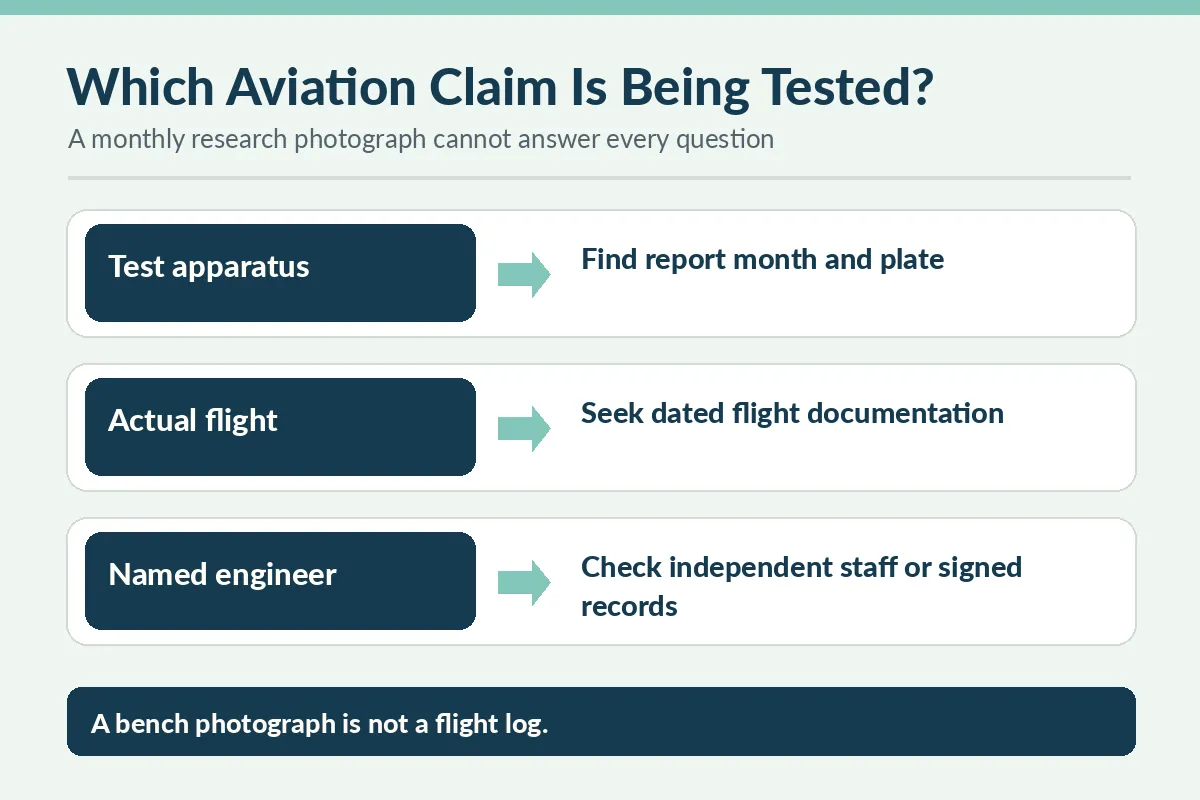
For a historical aircraft claim, construct three independent questions: Was an apparatus assembled or tested? Did a documented aircraft flight take place? Was the design adopted in operational service? AIR 60 can be particularly informative on the first question, but the other two may require dated test-flight logs, correspondence or service records not preserved within the monthly research report. A picture of a model or engine in a workshop cannot answer all three.
Consider a hypothetical family recollection that an engineer helped develop an experimental motor in 1923. An AIR 60 plate may depict the correct apparatus and an accompanying report may describe its test. That cannot by itself name the engineer who worked on it, or say they piloted an aircraft. A named employment record, signed report or contemporary attribution would be needed for the person-level link. If missing, describe the technology and acknowledge that the contributor remains unverified.

Write a Piece-Level Citation for Each Test Plate
For a retraceable source record, give The National Archives, AIR 60, full piece number, monthly report title and date, plate or figure number, page, caption and whether the examined image was a printed copy. Quote the report’s own wording for the particular test claim. The broader series dates 1919–1925 are the dates described for this research-photo material, not confirmation of comprehensive photographic coverage of every interwar aeronautical project.
End with a claim ledger: directly visible equipment, statements in the report, proposed interpretation and next independent source. A research photograph can illuminate the laboratory environment and development sequence without proving a flight, service adoption or a relative’s engineering role. Do not label an editorial illustration as an original AIR 60 scan. This separation makes the article useful to aviation historians and family researchers alike.
An especially helpful research log has a row for each plate, containing its figure number, equipment label, report month, image medium and claimed experiment. A second row records any later account of the same apparatus. This makes it possible to distinguish a test documented in a monthly report from an author’s later retrospective statement. When the later story introduces a new aircraft model or flight date, test those details against their own contemporary records rather than silently transferring them back to the earlier photograph.
More Research Method Guides
How We Research This Historical Collection
For this article we checked The National Archives subject guide and additional official guidance on November 8, 2026. Those guides establish the described archive series and research limitations; they do not prove the contents of a piece that has not been personally examined. Dates and examples identified as collection-level are treated as such. The procedures above are original evidence-audit methods, not claims that an undocumented ancestor or person has been discovered.
Our workflow records catalogue wording, original creator, full piece reference, format of the photograph or drawing, date of record creation when known, and the exact independent source that could test a proposed conclusion. We preserve unanswered questions rather than converting missing search results into negative proof. Editorial illustrations are not historical facsimiles. Read the affiliate disclosure; links here identify research resources and do not assert an affiliate partnership.
Monthly Directorate of Research reports with photographs of aircraft, airships, balloons, engines and equipment, described for 1919–1925.
No. The National Archives says most are printed copies of original photographs.
No. Ground tests, powered flight and service adoption need separate supporting documentation.
Give the full AIR 60 piece, monthly report date, caption, page or plate and image-copy status.
Not without a named record or direct attribution independently connecting the person to the project.