
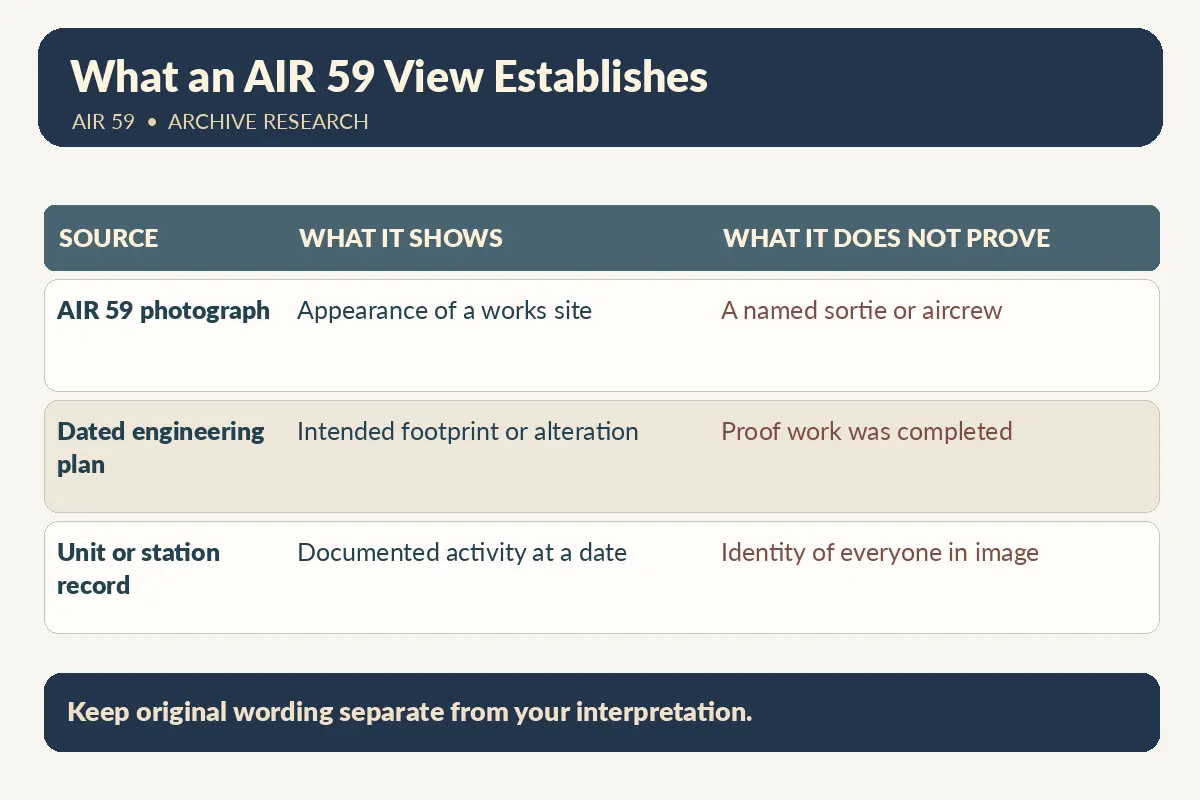
AIR 59 contains a photographic collection linked to Admiralty and Air Ministry works and buildings, with dates listed broadly as 1914–1932 in The National Archives photographic guide. Other official guidance directs researchers to AIR 59 for photographs of airship sheds. These photographs can support identification of a hangar, shed or construction site, but a pictured structure does not prove that a particular airship flew from it, that an RAF unit was stationed there on that day, or that a proposed facility was completed. Start with the physical building and its location, then consult a dated plan and independent operational documents before moving from architecture to aviation history.
Find AIR 59 by Structure, Site and Archived Piece
Search the AIR 59 series using the airfield or naval works name, neighboring town and alternative terms such as hangar, airship shed, works, aerodrome or construction. The photographic guidance presents AIR 59 as a discrete collection, not as a universal register of every airfield. A site’s modern name can be misleading: naval, army and air administration may have used different designations. Record the full AIR 59 piece reference and original wording before standardizing a location or building name.
Another reference guide to Royal Air Force research specifically notes photographs of airship sheds in AIR 59, which is a stronger route for those structures than a broad search for all aviation photographs. The appearance of a shed may be distinctive, but comparison still requires dimensions, roof shape, doors, surrounding roads or another measured feature. Do not label an unidentified curved-roof structure a specific station merely from a general resemblance to a known airship hangar.

Date the Photograph Separately from the Building Project
The series date span 1914–1932 is coverage for archived material, not the exposure date of every image. A construction photo may have been printed, mounted or captioned later. Enter the camera date, report date, plan date and known work milestones as separate fields when sources supply them. A photograph may depict scaffolding around an addition to an already-operating site, so do not treat it as evidence that the entire airfield was being built from scratch.
When a date is uncertain, compare site features with a sequence of dated drawings, construction contracts or local maps. A missing wall, roof panel or apron can establish a relative phase only if you are confident that the same building appears in both records. Clouds, seasonal vegetation and worker clothing generally provide weak precision. A later technical report may reproduce an older image to illustrate a defect. Report an interval when that is all the evidence permits.
Separate Airship Sheds, Aircraft Hangars and Workshops
Different aviation structures served different purposes. A large shed can be associated with airships, while a smaller hangar or workshop may support aircraft storage, repair, fabrication or testing. The exact classification needs a source-supported label, measurable structure or reliable comparison. On each print note roof type, door aperture, internal trusses, ventilation, track or apron, but do not assume operational status from equipment visible nearby. A ground photo has a restricted field of view and may omit other buildings.
A large building appearing in an architectural plan is not proof that it was built as drawn. A construction photograph can show that some portion existed at a particular stage, while acceptance records or a dated later image are needed to claim completion. If a structure was later repurposed, this must be dated separately. Do not make the common jump from “airship shed planned” to “airship operated here”; building suitability, station activity and individual flights are distinct evidentiary questions.
Match an Image with a Plan Without Faking Precision
For each candidate, record the photo reference, camera viewpoint, visible corners or entrances and any identifying sign. Compare those details with a plan showing north direction, building number, scale and project revision. A revised drawing may differ from what was built; the revision date is a date of design, not necessarily construction. This is especially important when a station was developed in successive phases or when adjoining sheds shared a similar outline.
Make an uncertainty column for each match: “confirmed by numbered building,” “probable by two features,” or “unresolved.” A single roof line is weak evidence; a distinctive doorway and position relative to a road are stronger. If a photo is uncataloged at image level, request the containing volume or group of prints and keep the album order. Do not manufacture coordinates or a site survey from an undimensioned oblique view.
Find Operational History Outside the Construction Album
A station record or unit operational book can document an aviation activity that a construction image cannot. Keep the question precise: when did the site open, which unit was there, what aircraft type used it, or who was assigned? Each may require a different record class and time period. The official guides distinguish building photographs from surviving airship logbooks in AIR 3 and from design papers in AIR 11 and AIR 12. Those are separate evidentiary routes, not sequential pages of AIR 59.
Even a photograph of an aircraft near a shed would not prove that a named airman piloted it or that a flight occurred at the moment pictured. Read any aircraft serial only when genuinely visible, then correlate date and location with independent records. A construction worker in an image might belong to a private contractor or government department rather than an RAF squadron. The safest family-history use of an AIR 59 image may simply be to show what a verified workplace or base looked like.

Publish a Site Finding with a Real Evidence Boundary
A defensible conclusion names the specific AIR 59 photograph, an identified structure, the evidence for its location and the best-supported date or range. Add independent records for later alterations and operations only where they exist. Preserve the original caption and explain any reinterpretation or spelling change. This is often more valuable than a confident but fragile claim about the first aircraft to use a structure.
The National Archives warns that not every photograph is available as a searchable individual item or online image. A catalog hit may be a container description rather than proof of what an unseen print depicts. Mark your access level explicitly. Include unsuccessful searches and alternate station names so another researcher can avoid the same blind alleys and still reconstruct the project timeline from the sources that truly survive.
More House and Local History Guides
How We Research This Archive Collection
The starting point is The National Archives photographic collections guide, which specifically identifies AIR 59 and describes the collection at series level. We checked the series scope and any additional official guidance cited below, not every item or original image. This distinction is essential: an archive summary is not a substitute for viewing an individual photograph, its caption or related paper records. Use the archive’s Discovery search guidance to check the series, search terms, historic names and filters, then browse the full piece if descriptions are incomplete.
Our three research aids separate a starting-point decision, a source-by-source evidence limit and a route to independent verification. We distinguish visible details, archival caption claims, later comparisons and remaining uncertainty. The National Archives citation guidance explains the importance of a complete department, series and piece reference with an item or page identifier where applicable. The illustrative artwork and example workflows here are explanatory designs, not facsimiles or reports of an undocumented discovery.
The examples do not identify unnamed people or establish operational, legal or household outcomes merely by association with an image. If the paper original or verso was not accessible, retain that limitation, request access as needed and avoid fabricated details. Additional source: official archival guidance confirms official RAF research guidance specifically directs readers to AIR 59 for airship shed photos and AIR 3 for airship logbooks. Our affiliate disclosure explains site transparency; archival citations do not assert commercial partnerships.
The National Archives identifies photographs connected with Admiralty and Air Ministry works and buildings, including airship sheds.
No. The series spans broadly 1914–1932; each image and construction phase requires separate dating.
No. Operational use and individual flights must be checked in independent station, unit or aircraft records.
Official RAF research guidance points to AIR 3 for surviving airship logbooks.
Not unless a reliable name or independent personnel record supports the identification.