
The Royal Navy’s daily returns to the First Lord, identified as ADM 7/502–538 for 1812–1830 by The National Archives, offer a way to check naval administrative information for a known date and ship or station. They are not crew agreements and cannot, by themselves, identify a relative as a sailor aboard a named vessel. Start with a ship identity and narrow date, inspect the correct volume, and then move to ship logs and personnel evidence for different questions.
The National Archives lists daily returns to the First Lord in ADM 7/502–538 separately from ADM 7 abstracts of ships’ journals, board-room journals and later board minutes. That classification matters: a return is produced for Admiralty administration, while a master’s or captain’s log has a different purpose. Even when the same ship appears in both, the documents should not be treated as interchangeable.
Identify the correct ship rather than a repeated name
Begin with the ship’s full contemporary name, any designation such as HMS, approximate year and naval station. Ship names could be reused, so a family account calling a vessel simply “HMS Victory” or another common name needs a chronological identity test. A ship commissioned decades after the event cannot supply the required record even if a modern catalogue search returns it.
Record known evidence for ship identity separately from the family claim: date, captain where available, type of vessel, station and other distinguishing details. An uncertain spelling is a search variant, not license to combine records of two vessels. Find the date range of the relevant volume in ADM 7/502–538 before assuming it contains every daily return in that year.
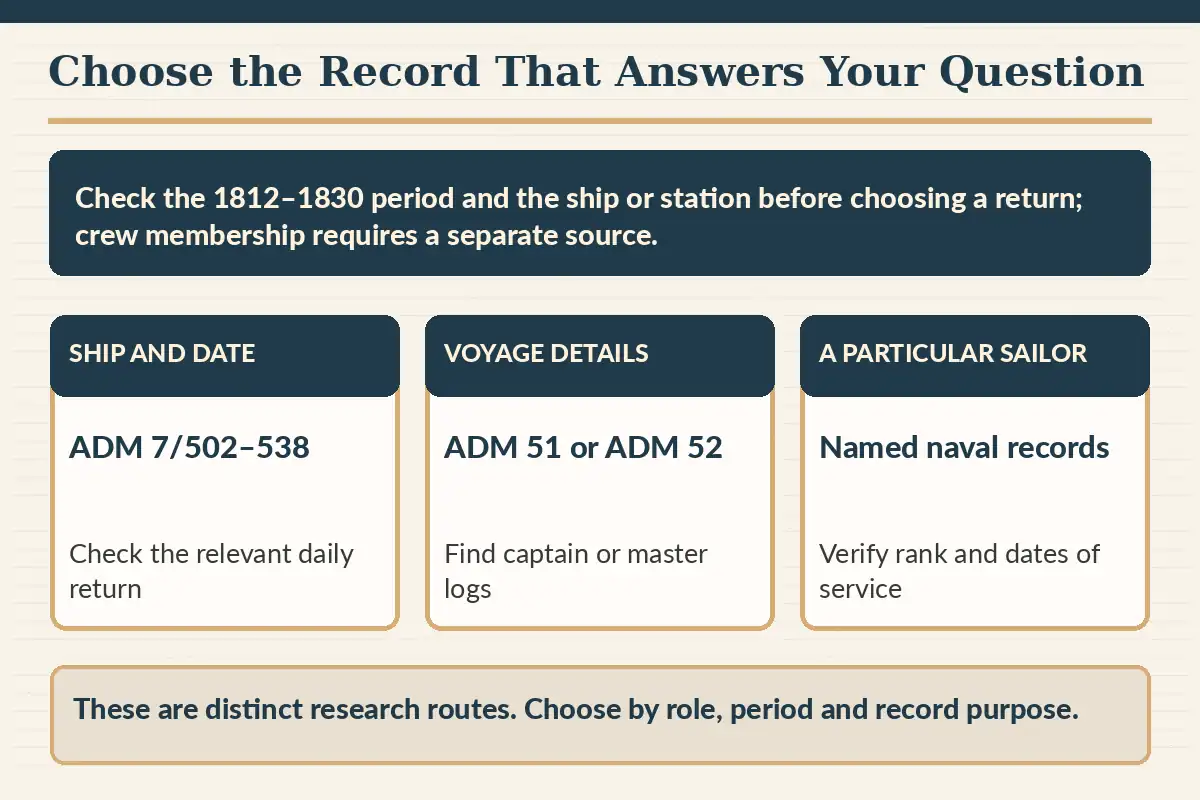
Treat the return as a report to naval administration
The National Archives identifies these records as daily returns to the First Lord. That is the correct documentary purpose to cite. Inspect headings and notes of the particular entry before describing its fields; not every dated return should be assumed to have an identical template. Transcribe dates, ships, locations or administrative notes exactly as recorded and retain the original piece reference.
A reported station can differ in precision from a location established in a navigation log, and a headquarters report may contain information compiled from multiple sources. Do not translate an administrative category into a confirmed port arrival, departure or personal posting without corroboration. The phrase “reported in the return” preserves what was actually observed.
Select a ship log for a voyage-level question
If the research asks where the ship sailed, consult the separate log series and the coverage dates identified in the official logs guide. The captain’s logs in ADM 51 and masters’ logs in ADM 52 are different documentary routes, with their own date ranges. Search by ship and year, then compare relevant dates against the daily return.
A log may contain bearings, weather and operations, but it is not necessarily a complete nominal crew list. A ship might be at sea, in port or undergoing other activity; the evidence available for a specific date must determine the wording. Treat a discrepancy between a log and a return as a question about timing, reporting or ship identity, rather than silently discarding either.

Prove a seaman’s connection independently
A separate named record is necessary to establish that a specific sailor served on the vessel at the date in question. Begin with any known name, rating or rank, date of birth and service number if available, then select appropriate muster or individual service evidence for the historical period. A return mentioning a ship never proves an individual was aboard it.
If a person is recorded in a service series as entering the ship on a particular date, check whether the later date claimed by the family falls inside the supported interval. Dates of transfer, absence, discharge or death need their own evidence. Two people with the same name can have different ranks and service paths; compare identifying details before merging them.
Handle uncertain cataloguing and access
Use the full ADM 7 series and piece number in a research log. Record which dates you inspected, whether you viewed the original or an image, and whether the entry has uncertain handwriting. Some older naval documentation requires consultation or copying rather than a keyword search of the text. A catalogue description cannot tell you every ship in an unindexed bound volume.
When a search is negative, check period coverage, variant names and another appropriate series. Do not interpret the lack of a name inside a ship-level administrative record as absence of service. If a ship is not listed on one day, a reasonable next search is nearby dates and alternative returns, not an invented explanation for the omission.

Make a three-layer ship evidence table
Create separate columns for the ship’s verified identity, the administrative daily return, the voyage log and the named sailor’s record. The date of each document and the date of the event being described belong in distinct fields. If a log records the ship off a coast while a return names its station, quote both accurately.
The strongest conclusion might be: a named vessel was reported at an Admiralty station in a particular return, and independent logs place it in a particular area. Add a sailor to that conclusion only when independent service evidence supports the connection for the same interval. This workflow makes naval family research testable without inventing crew biographies.
Make the evidence traceable and reproducible
For the next search, open a source ledger with separate columns for the exact reference, creator, document type, original date, event date, names and roles, location, original wording, inference and the record still needed. Check the 1812–1830 period and the ship or station before choosing a return; crew membership requires a separate source. Save searches that fail with the terms and actual series coverage; a failed name search in an administrative series is not negative evidence about a person. Only cite an image as inspected when you saw it rather than a catalogue abstract.
When independent sources disagree, preserve the different dates and wording and identify their creators. Two Royal Navy vessels can share a name across different years; check identity and period before linking records. Two websites presenting the same archival description are not two independent records. A useful final conclusion names the exact documented fact, the inference left unresolved and a practicable next archive or local collection to consult. Avoid converting administrative context into an imagined family biography.
More Records and Archives Guides
How We Research and Verify These Archives
We checked archival source guidance on 2026-11-03. The National Archives gives the precise run ADM 7/502–538 for daily returns to the First Lord, 1812–1830, alongside different series for ship movements. The source supports a record-search route, not the presence of an invented ancestor in an unexamined file.
We checked archival source guidance on 2026-11-03. The official ships’ logs guide distinguishes ADM 51 captains’ logs and ADM 52 masters’ logs from administrative records and explains their purposes. The source supports a record-search route, not the presence of an invented ancestor in an unexamined file.
We checked archival source guidance on 2026-11-03. The official citation guide requires the full reference down to piece or item where the catalogue makes that level available. The source supports a record-search route, not the presence of an invented ancestor in an unexamined file.
The accompanying illustrations are newly drawn explanatory artwork, not images of particular surviving archival originals. No paid partner or purchase is suggested. Read the affiliate disclosure.
The National Archives identifies ADM 7/502–538 for daily returns to the First Lord dated 1812–1830.
No. They are naval administrative records, not substitutes for crew musters or named service files.
Consult the appropriate captain’s or master’s log, such as those in ADM 51 and ADM 52, checking the dates covered.
Only if the actual entry supports that precision; an administrative station is not necessarily a dated port call.
Use the year, ship type, captain or station to establish the vessel’s identity before connecting records.