
MUN 7 is a useful route into First World War Ministry of Munitions contracts, especially when you know a manufacturer or the type of industrial supply. This guide shows how to find the right original record, distinguish the observation it contains from a later claim, and decide what independent evidence must be checked next.
Start with a Contractor and an Order, Not a Worker
MUN 7 is a useful route into First World War Ministry of Munitions contracts, especially when you know a manufacturer or the type of industrial supply. The National Archives identifies this record series in its guide to research and development in the British Army. Its guidance places the creation of the ministry in 1915, when responsibilities for making and supplying war material shifted into a central organization. That change is a search boundary, not proof that all wartime orders sit in MUN 7 or that every business had a ministry contract.
Write the question at company level first: which named firm may have accepted an order, for what category of product, and during which interval? An ancestor said to work at that company creates a separate employment question. A government contract can establish a business relationship without listing a single shop-floor worker. Search company variants, former trading names, sites and the exact terminology used by officials rather than assuming a modern product name appears in a First World War index.
Choose the Correct Government and Record Family
Before 1915, relevant work may be found among War Office, Admiralty or private company records; thereafter MUN is important, but departmental files continued to overlap. The National Archives recommends searching MUN for wartime contractors and expressly highlights MUN 7. It also points to other records for technical trials, industrial statistics and factory plans. This means an apparent gap in one contract series is not evidence that a firm never supplied the state. A contract made by another government body may leave a trail somewhere else.
Use a branching list for the claim you need to test. For an official award or contract negotiation, begin with MUN 7 and the creator or firm. For output actually manufactured, search production returns, inspections or correspondence relevant to the product. For a factory site, maps and plans are a different record family. For a particular relative, seek personnel records, wage evidence, directories or union documentation rather than relying on a contract in the company name.

Build a Contract-to-Delivery Ledger
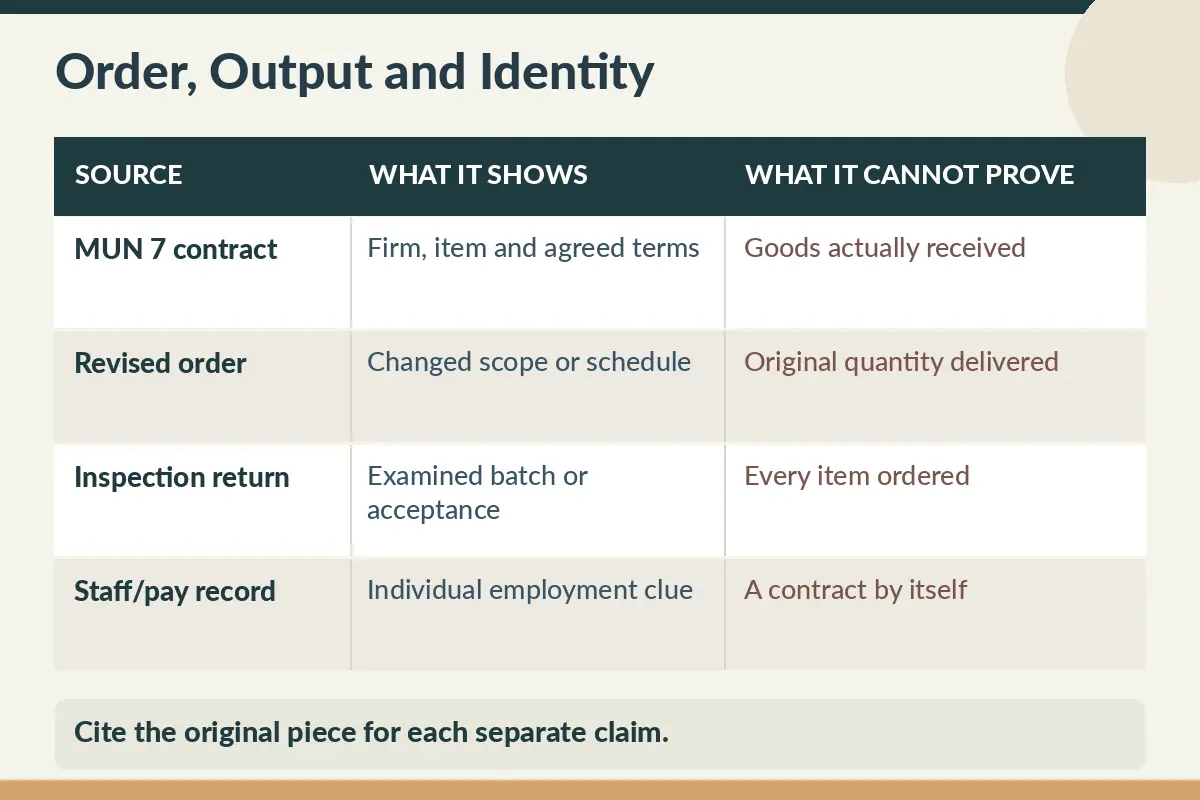
Make separate columns for catalogue reference, original document date, firm or contractor, product description, ordered or estimated quantity, price, scheduled date, amendments and signs of acceptance. Only enter a field when it actually appears in the piece. The Archives’ guide explains that government contract entry books can identify goods, a producer, quantities, money and completion details, but their forms and coverage vary. A search result with only the title “contracts” does not tell you which of those facts is present in that particular record.
The distinction between an order and completed work matters. A signed agreement might be canceled, amended or fulfilled in stages, while an invoice might have been contested. Even a payment entry may refer to an advance or a partial transaction. Do not convert a promised 2,000 items into “2,000 delivered” without dated dispatch, receipt, inspection or acceptance evidence. If different ledgers disagree, keep the two values and their dates rather than silently choosing the larger total.
Follow the Firm Through Name and Site Changes
Companies may trade under a family name, partnership style or incorporated identity that changes over the years. Look for the trading address, registered office, works location, the person signing for the company and any later successor business. Two manufacturers with similar names may have different works and different contracts. Write down enough identifiers to prevent a false link. A contract name alone does not prove that an ancestor’s small workshop was the supplier described.
Factory locations need special care. The order may be administered from an office far from the place of production. A branch company can be an agent rather than the actual maker. Use dated commercial directories, company registration papers, local rates or maps to connect the named contractor with a particular site. Then seek a named employment source to test a family story about a machinist, clerk or inspector. A factory’s contract is evidence for the firm, not an employee roster.
Read Technical Notes Without Confusing Trials with Supply
The National Archives separates development, experimental testing and manufacture into different documentary functions. A prototype may appear in research papers, but it is not necessarily a mass-produced article. Similarly, an approved design can precede a production order by months or never lead to one. Record every stage as its own assertion: proposal, test, order, manufacture, inspection, shipment and receipt. Treat an arrow between stages as conditional until a specific record supplies the connection.
A contractor’s correspondence might describe shortages, labor disputes or the difficulty of meeting specifications. Such a letter is evidence of what its author reported, not automatic verification of actual output. If the government’s own returns differ, look for a change in dates, product definitions or which factory made the goods. Include the original units and avoid transforming “cases” into individual items without knowing how many each contained. The same caution applies to money paid and wage claims.
Write a Finding that Names the Limit
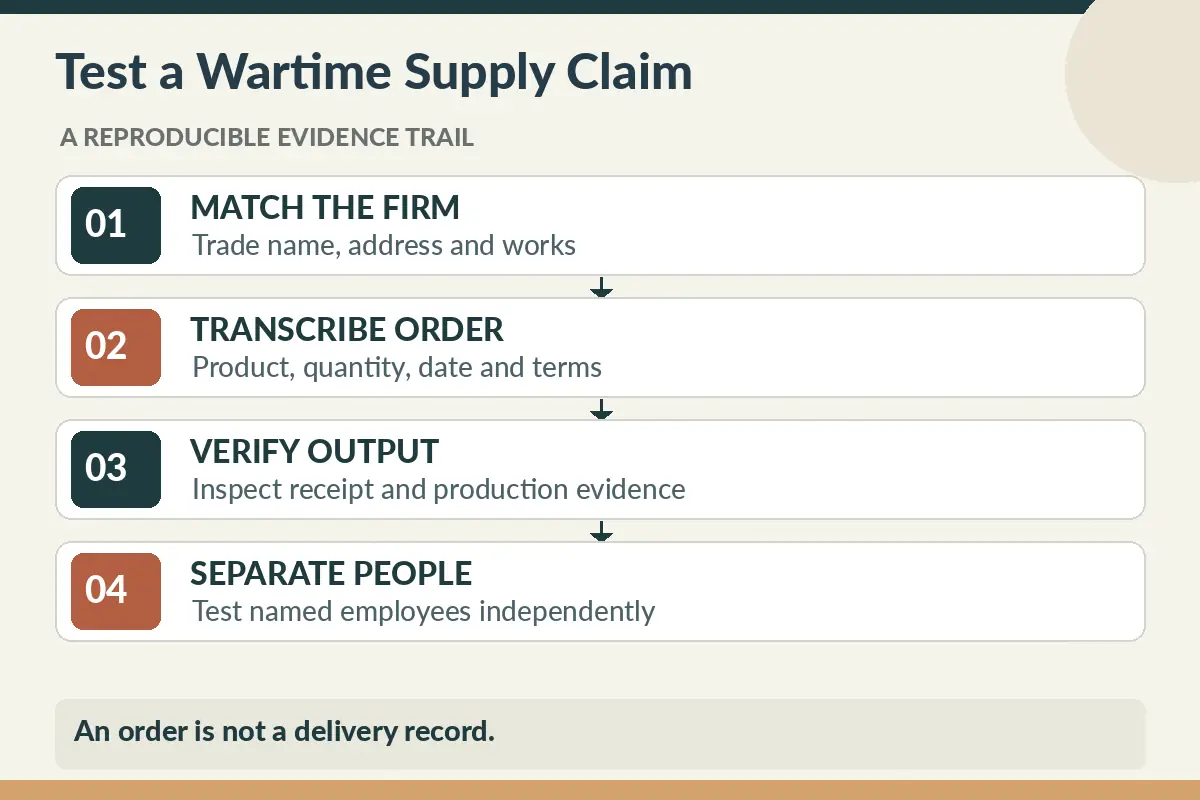
A useful conclusion identifies a firm, document, date and transaction status: “A Ministry of Munitions file records an order placed with this contractor; delivery remains unverified.” If a later inspector’s return documents completion, cite that record separately and specify what was received. For company family history, the distinction protects a story from being built around a contract that changed or never progressed beyond negotiation.
Preserve a research log for all MUN 7 searches, including empty results, alternative spellings and records requested but not examined. Note where the original is held and whether it must be consulted in a reading room. A catalogue hit is not the same thing as an image of a signed contract. The strongest result is a short, reproducible chain that tells the next researcher which company, order, works and independent source to inspect next.
More Records and Archives Guides
How We Research, Cite Sources, and Test Limits
We checked the named series, record purpose, broad period and repository guidance in these source descriptions: The National Archives; The National Archives. Collection-level guidance establishes which kinds of papers, maps or photographs may be found and how they should be searched. It does not certify a particular unseen item, a specific ancestor, or an uninspected case. Exact claims must be supported by the original document, its piece-level description and any independent evidence appropriate to the historical question.
Our evidence worksheet distinguishes what the original says, what can reasonably be inferred, and what remains unproved. Dates and categories are transcribed before conversion or comparison. Search absences are reported as gaps in available evidence, not proof that an event never happened. Individual access and reuse rules must be checked against the record’s repository. Read our affiliate disclosure; no paid service or commercial relationship is required to apply this method.
No. It primarily helps locate government contract records, not a comprehensive factory payroll. Named employment needs independent records.
No. Other departments, MUN series and private company archives may hold related evidence; 1915 marks an important administrative change.
No. Check amendments, inspection, shipping and receipt records for evidence of completed performance.
Not on its own. Match company identity, trading address, dates and the actual factory before inferring a relationship.
Do not assume so. Read the individual Discovery entry and its access instructions before planning a visit or copy request.