
Home Office HO 43 Entry Books can answer a narrow historical question, but it cannot carry a larger family-history claim by itself. The starting point is the record’s creator, date and function; the next step is independent evidence for an individual, place or event. The examples and routing method below separate what the archive actually documents from an interpretation that still needs to be tested. In particular, distinguish a name present in official paperwork from confirmed identity, kinship, employment, judgment or completed action. The archive references and access routes used here are from the named official guides, not an invented case file.
Start With the Difference Between Incoming and Outgoing Letters
HO 43 is a Home Office entry-book route for outgoing domestic correspondence. In archival practice, an entry book records copies of letters sent or intended to be sent by an office; it is not a modern inbox containing every letter received. The National Archives specifically groups HO 43 with out-letters and entry books arranged by date. If a family story concerns a petition to the Home Office, looking only for its original in an outgoing book risks overlooking the actual incoming document.
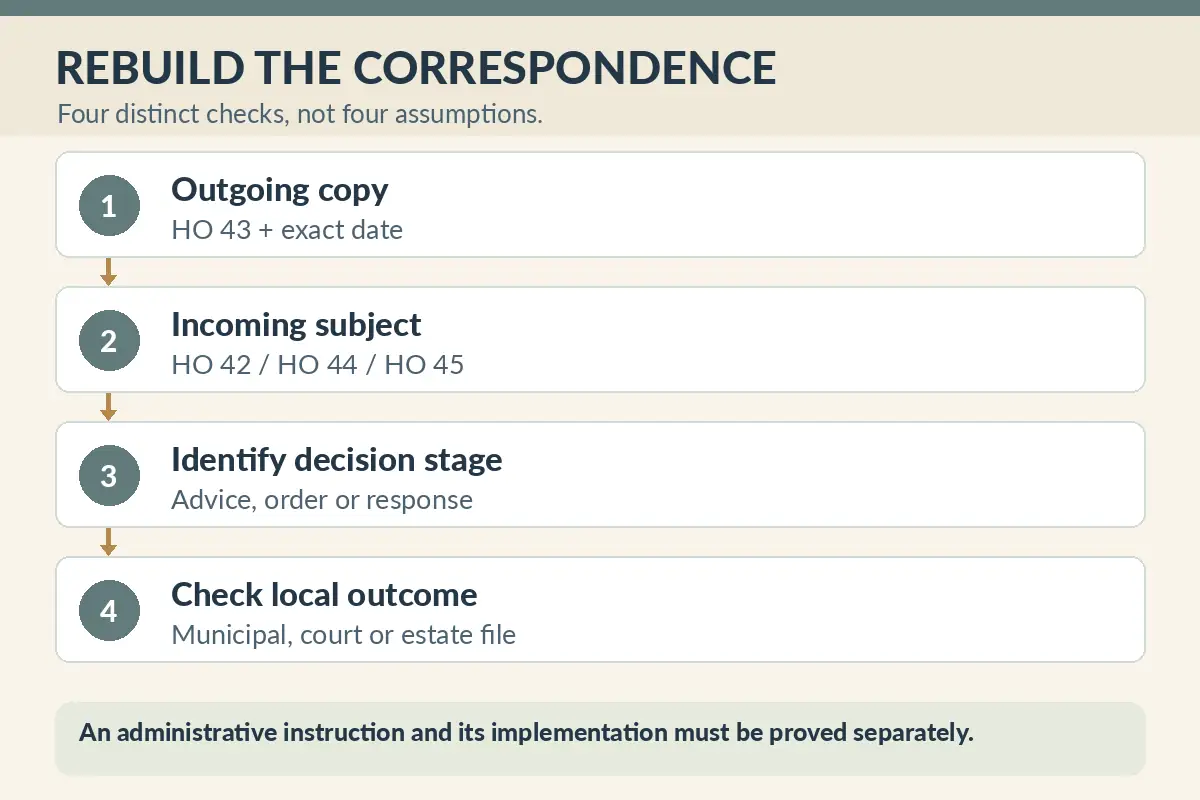
Set up two parallel searches: a possible letter received by the Home Office, and the outgoing reply or administrative instruction. Copy any dates and recipients in the family source without rounding them to a year unless necessary. Keep the person requesting an action distinct from the office replying to it. A transcript of the reply may summarize a petition selectively and does not prove that the Home Office preserved or approved every assertion in that petition.

Route an Old Petition Into the Right Home Office Class
The National Archives’ patent research guide gives a useful model: petitions for patents after 1782 can appear among incoming papers in HO 42, HO 44 and HO 45, with relevant entries in HO 43. This does not mean all domestic correspondence was about patents; it demonstrates how a copied reply and an incoming application can survive separately. Determine the subject and period before selecting a catalogue series, and avoid forcing an unrelated local issue into the wrong correspondence category.
Registered papers in HO 45, beginning in the nineteenth century, may offer a different search route from earlier volumes. Some dates or subjects cannot be keyword searched effectively. Use the official catalogue and record series descriptions to understand arrangement, then work from dates and named correspondents when full-text searching fails. If an entry book has no matching reply, consider misdated papers, a different department or an unpreserved exchange before inferring that no request existed.

Extract the Wording of an Entry Without Overreading It
For a candidate entry, capture its date, addressee, office, summary and full archival reference. Note whether the text says a request was acknowledged, considered, referred elsewhere, refused or approved. These are different administrative states. A stock phrase such as directions having been given may record an instruction rather than its subsequent enforcement. If the letter mentions an enclosure or a previous communication, write that lead in a separate note rather than presuming the related document survives.
Entry books were working instruments, and copies can contain abbreviations, marginal notations or references to office procedures unfamiliar to modern readers. Do not silently supply words missing from a damaged page. Preserve questionable readings and page context. Where one entry crosses a page boundary, obtain both sides. Record distinctions among the date of the copied letter, the date of an earlier request, and the much later date on which a family historian accessed the record.
Verify the Recipient and the Administrative Result Elsewhere
A letter addressed to a local magistrate or municipal official may speak to a public matter rather than the recipient’s personal circumstances. The fact that an individual received correspondence cannot establish residence at a particular private address, political allegiance or a family relationship. If the recipient is the subject of a biographical investigation, locate contemporary appointment records, directories or local government papers to identify the right person and office.
To investigate whether an official direction had an effect, search the receiving institution’s files: minutes, legal proceedings, local registers, estate correspondence or subsequent letters. A second independent document reporting implementation has stronger evidentiary force than a draft instruction. Keep a timeline with separate rows for complaint, outgoing instruction and recorded outcome. If the final action is missing, stop at the supported conclusion that a particular office sent or drafted an administrative response.
Resolve the Two-Namesake Problem With a Correspondence Grid
Imagine two nineteenth-century clerks named John Brown in neighboring towns. HO 43 might mention one by title and date, but neither the surname nor title proves his identity. Use a correspondence grid with office, appointing authority, town, address if stated, date, and independent records. An office title can change through promotions or transfers; a letter may be addressed to the office rather than the same named incumbent throughout the year.
The most valuable finding may be a procedural trail: a petition reached the central department, an outgoing letter answered it, and the local office later produced a minute. Explain which documents carry each step rather than merging them into a single narrative voice. Archive research is stronger when it preserves open questions—such as what was actually received or carried out—than when it substitutes a plausible story for a missing source.
More Research Method Guides
How We Research This Archival Record and Its Limits
We check the series against the original government or archive custodian descriptions, then compare the purpose and date coverage with the exact claim a reader wants to make. Sources consulted on 2026-11-08: Primary repository guidance 1; Official guide 2. A series-level catalogue is a map of the collection, not evidence that a particular named person appears in a document. Catalogue availability and online access can change; always verify the individual piece and its current access conditions before traveling or paying for a copy.
Our editorial method separates four evidence levels: the collection description, the specific original document, an independently created corroborating source and a written conclusion with stated uncertainty. Any hypothetical person or example in this article is illustrative, not a transcription of an identified historic individual. For clarity about commercial relationships, read our affiliate disclosure. We do not infer an affiliate arrangement or recommend paid access unless its practical benefit is established for the exact record sought.
No. It is an entry-book series for outgoing domestic Home Office correspondence, arranged by date.
Depending on period and subject, related incoming or registered material may be sought in HO 42, HO 44 or HO 45.
No. Use independent local or departmental records to show that a direction was actually carried out.
No. The National Archives notes that date-arranged entry books may not be keyword searchable.
No. Identify the correspondent independently; the administrative address or title is not a family relationship.