
The National Archives identifies ED 56 as a route to local education authority papers on community centers, playing fields, swimming baths, recreation centers and courses during 1937–1940. These files are most useful for learning what an authority proposed or administered. A reference to a swimming bath or club is not a register of its users, and a proposed facility is not proof of construction.
The Physical Training and Recreation Act 1937 shaped this work, but the archive also describes earlier education legislation and changes during the Second World War. Readers need to separate the date of a policy, the date of an application or grant, the facility’s actual opening, and a particular family member’s attendance. Those are four different claims with potentially different repositories.
Identify the local education authority and facility type
Begin with an address or parish and identify the local education authority responsible at the date of the proposed scheme. Historical local government boundaries are not interchangeable with modern council names; record both names separately. Specify whether you are seeking a community center, a playing field, a swimming bath, a recreation center or organized training courses, because the archive guide explicitly covers several kinds of provision.
Search Discovery for the historic locality together with ED 56 and the facility type, then inspect nearby results in the series hierarchy. A title may describe a countywide project rather than the one building remembered in a family account. Preserve the date range and exact reference before making a connection to a named street or institution.

Use the 1937 Act as a date gate, not an attendance record
The Physical Training and Recreation Act 1937 expanded recreational provision beyond children in full-time education. The National Archives points readers researching authority provision in 1937–1940 to ED 56. This legislative fact helps explain why a file was created, but does not tell you whether an individual attended a class, joined a club, or played on a field.
For earlier legislation concerning education and related services, the archive guide cites ED 11, including references connected with the 1918 and 1921 Acts. Do not blend an earlier policy file into a 1937 project simply because both use the word recreation. Put statutory basis, application year, approval date and actual use on separate rows of the worksheet.
Recognize the difference between proposal and operation
A scheme can generate drawings, correspondence, financial estimates and negotiations without producing a completed building. Read verbs with care: proposed, approved, acquired, leased, constructed and opened are not synonyms. If a document supports only a proposed field or grant, the article’s claim should remain at that level even if the site exists today.
To test implementation, look for local council minutes, construction accounts, building-control files, inspection reports, local newspapers and contemporary directories. Search the relevant local archive before assuming national policy correspondence preserves the everyday life of a facility. Mark a later photograph as a later source, not evidence that the original 1937 design was built unchanged.

Follow the wartime break and postwar administrative shift
The archive explains that wartime circumstances suspended the extension of the 1937 recreation provisions and that the Education Act 1944 limited use of facilities under the education framework to people attending educational institutions. Do not present a 1941–1945 gap in ED 56 as proof that a local group ceased activity. A different authority or wartime arrangement may have generated the surviving records.
Responsibility for post-school recreational and social training moved to the Further Education Branch of the Ministry of Education in 1945. For later youth welfare, the guide directs researchers toward ED 124 and ED 126; for adult welfare, ED 169. This is a provenance shift, not a simple annual extension of ED 56.
Find individual participation only in person-level sources
A file describing a community center can help place a building, date a policy change or explain a municipal ambition. It usually cannot establish who used a swimming bath or attended a class. If your objective is a family-history claim, search contemporaneous membership lists, school records, letters, photographs with original identification, or newspapers documenting a named participant, subject to access and privacy restrictions.
Compare an individual’s identity against address and date rather than simply attaching the center to everyone who lived nearby. A facility open to the public is not an attendance roll. Even an event announcement shows an invitation or schedule, not that a particular person attended the event.
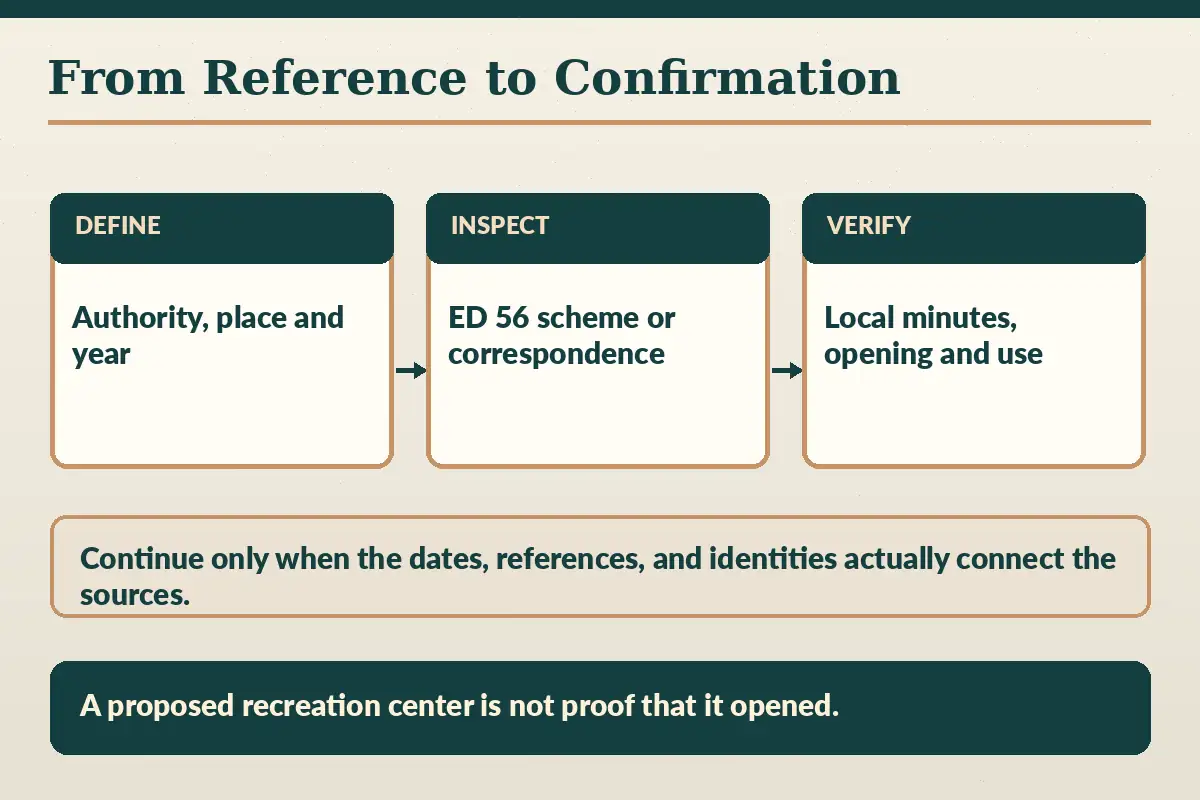
Write a site history that clearly marks its evidence
Prepare three timeline columns: administrative proposal, physical works, and local use. Enter a precise dated citation for each claim. Where no item is found, log the search terms, authority, date span, and online or on-site limits. Printed guides and catalog descriptions are starting points, and many maps or plans cannot be viewed online.
A useful final paragraph might say that the local authority considered the scheme in 1938, a later council minute records completion, and no surviving membership evidence has yet identified a particular family. That is a richer and more defensible history than treating a proposal as proof that the family visited the premises.
Create a claim-by-claim evidence worksheet
Use a research table with columns for the person or place, creator of the record, original archival reference, date described, date of the surviving item, direct statement, inference, and outstanding corroboration. This subject-specific choice matters: Local authority recreation provision, 1937–1940: ED 56. Earlier education-act legislation: ED 11. Later youth or adult welfare: ED 124 / ED 126 / ED 169. Keep index hits distinct from originals and place-related records distinct from named-person evidence. A negative catalogue search is a log of what you searched, not proof that no event occurred.
On the first pass, write the narrowest sentence that the evidence supports: authority proposal or provision. Do not silently upgrade it into a claim about opening or attendance. If several records are compared, explain the linking name, location, chronology or official reference; never assume that every nearby document refers to the same household. Note all access limits and inspect the original where the conclusion matters.
More House and Local History Guides
How We Research and Verify the Sources
We reviewed The National Archives source guidance on 2026-11-03. The National Archives identifies ED 56 for LEA recreational provision, 1937–1940, and distinguishes ED 11, ED 124, ED 126 and ED 169. This supports a research route and its limits, not an unverified personal identity.
We reviewed The National Archives source guidance on 2026-11-03. TNA explains how plans and drawings may accompany administrative files, and why a plan must be read with its parent records. This supports a research route and its limits, not an unverified personal identity.
Our diagrams distinguish administrative records, primary documents and independent proof. If the original has not been inspected, cite the guide or catalogue rather than claiming firsthand review. This article includes no presumed commercial arrangement with the archive; see the GenHis affiliate disclosure.
No. The series concerns authority provision and administration, not a comprehensive list of participants.
It specifically directs readers to 1937–1940 for local authority centers, playing fields and related schemes.
The archive guide identifies relevant Education Act records in ED 11.
Not without checking provenance. The guide suggests ED 124 and ED 126 for youth welfare and ED 169 for adult welfare.
Seek dated local minutes, construction evidence, newspaper reports or another independent record of opening and operation.