
Start With the Center, Not an Assumed Student
A National Youth Administration drawing can answer a precise local-history question: where was a workshop planned, how were rooms arranged, and which agency created the plan? It cannot, by itself, establish that a particular teenager or young adult trained in that building. The NYA began in 1935 within the Works Progress Administration and operated work and student programs. If a family recollection mentions a training center, first collect the town, approximate year, school or workshop name, and any surviving address. Treat a remembered affiliation as a hypothesis, not a proven enrollment.
Build two columns before searching: one for the place and its history, the other for the individual. A site drawing might depict carpentry rooms, machine shops or utilities without naming apprentices. An administrative report might name a project but not list the people who attended. Even when a trainee appears in separate correspondence, an exact course cannot be assumed from the nearby building. Keep the historical site name, present address and date of each claim distinct. A name shared by two centers is a reason to compare jurisdictions, not to merge them.
Separate Construction Plans From Training Blueprints

NARA lists three different architectural groups inside RG 119. Under §119.4.4 it identifies 3,700 Construction Projects Section plans for NYA buildings dated 1937–1943; another 100 maps and plans concern construction, installation and repair of training centers in 1941–1943. The same subsection also lists 3,200 training blueprints maintained by the Shop Operations Section, 1940–1943. Those blueprints concern training activity and should not automatically be read as blueprints for the permanent building that housed the class.
Use the drawing title rather than the word “blueprint” alone. A shop exercise may specify how to fabricate an object, whereas a construction sheet may show walls, foundations, plumbing or electrical service. NARA also describes 100 chief-architect tracings and processed copies of NYA building plans in §119.5.6, dated 1937–1941. These separate creators and date ranges let a researcher write a better request. When the center is poorly identified, ask first for the regional or project arrangement; do not assume all three groups contain a file for every state.
Read Titles, Revisions, Scales and Place Names
When you receive an architectural sheet, begin with its title block. Transcribe any NYA project name, date, revision, sheet number, architect or responsible section, and stated scale. A date on a drawing may refer to a revision rather than the date a building opened. If the project has several sheets, record the entire sequence before treating one plan as definitive. A small building in the corner of a site drawing may be an alternate proposal, future addition or outbuilding, not a separate completed training center.
Compare the sheet with historic maps, aerial imagery or locally dated photographs to determine what was actually constructed. The drawing may use coordinates, lot references or street names that changed later. Do not force a modern street number onto a 1938 plan without a documented link. A technical label such as “proposed” is essential evidence and belongs in the citation. If no final construction record survives, describe the document as a plan and leave the operational status unproved rather than turning architectural intent into an asserted historical fact.
Cross-Check Photographs and Project Reports
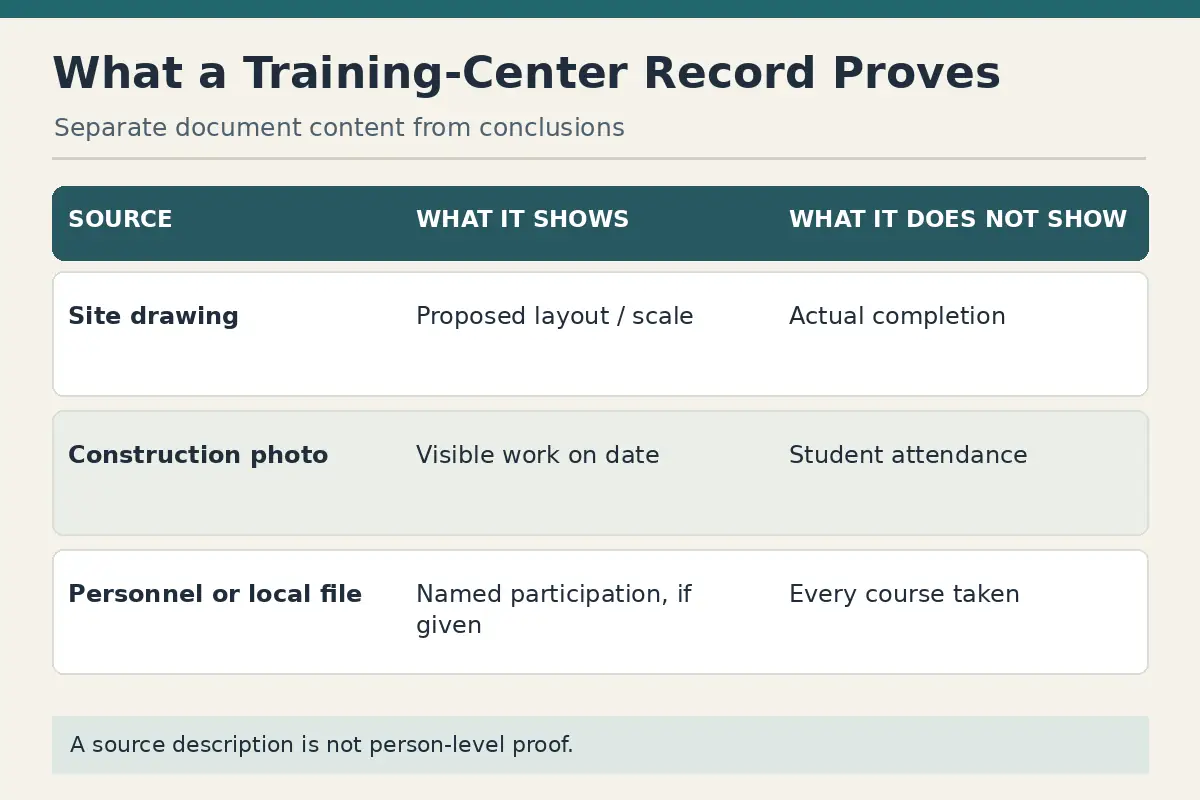
RG 119 §119.4.4 separately lists 200 photographs of the construction, installation and repair of NYA training centers from 1941–1943. An image can corroborate that work took place at a location, especially where a project name, equipment or building frontage can be tied to the plan. Yet a photograph may be a publicity image, show only one stage of work or carry a later catalog caption. Compare visual landmarks and the original caption with the plan rather than identifying an entire workshop from one image.
For opening dates, operations or course activity, search administrative correspondence and regional records described elsewhere in RG 119. A report naming a completed center answers a different question from a sheet titled for a proposed facility. If a newspaper announces an opening, verify its publication date and whether the announcement reports completion or anticipation. Use an evidence log with separate rows for planned location, documented construction, operation and named trainees. Missing photographs do not prove the center never existed; NARA describes selected holdings, not a complete camera record of every NYA project.
Trace an Individual Without Confusing Programs
NYA records were created for multiple purposes: out-of-school work projects, student aid, training and administration. A relative who received student support need not have attended a resident trade center. The records of the Division of Youth Personnel in §119.4.3 relate to recruitment, assignment, transfer and separation policies, with some reports and correspondence. The records described in §119.5.1 include job vacancy notices, interviews and job descriptions. Their presence in the guide is not a promise of a surviving name-indexed file for every trainee.
Look for individual evidence in dated letters, school records, employer documents, oral histories with named informants or local center records when they survive. If a family photograph shows a workshop, record who identified the people and when that identification was made. An NYA center might be associated with several programs over time; the program title matters. Confirm the person’s age, locality and dates against independent evidence. When the source supports only a plausible connection, say “possible trainee at this center” rather than converting a family tradition into an exact enrollment date.
Request and Cite the Exact Record Series

A workable NARA request specifies Record Group 119, the appropriate subsection, center or project name, state, approximate year and the type of plan needed. For example, a request for a 1942 training-center installation sheet points toward §119.4.4, while one for a 1938 chief-architect tracing points toward §119.5.6. Do not invent a box, drawing or Catalog identifier. Ask whether the relevant record series has an item-level description or whether staff must consult physical plans and separate photographic holdings.
In the resulting citation, name the original drawing or photograph, date, revision where present, creating unit, record group and NARA holding location. Note whether you saw an original, a reproduction or only a catalog entry. If you later find a local attendance roster, cite it separately and explain how the roster connects to the particular site. The strongest result may be a carefully documented building history even when no individual training record can be verified. Preserve that distinction for future researchers who revisit the family story.
More House and Local History Guides
How We Research This Archival Question
We checked the archival description for RG 119 and its relevant series, then distinguished what the official source explicitly documents from what a researcher might infer. The date spans on this page describe the listed holdings or survey, not a claim of complete digitization or coverage for every locality. We assessed each map, report, directory or inventory at the level of the individual item needed for the research question, rather than treating a series heading as a personal record.
We also compared this route with the relevant repository access guidance and use the National Archives Catalog guidance when a particular file unit or digitized image remains to be located. Evidence limits, alternative explanations and missing dates are named rather than silently filled. Our informational articles contain no confirmed affiliate offer; our affiliate disclosure explains the site policy.
NARA lists Construction Projects Section plans and training-center installation plans in §119.4.4.
They are training blueprints maintained by the Shop Operations Section, not necessarily plans of completed buildings.
RG 119 §119.5.6 lists 100 chief-architect plans dated 1937–1941.
No. A photo can show construction or a building, but an individual link requires other evidence.
No. The archival guide describes holdings; consult the Catalog and NARA for actual item access.