
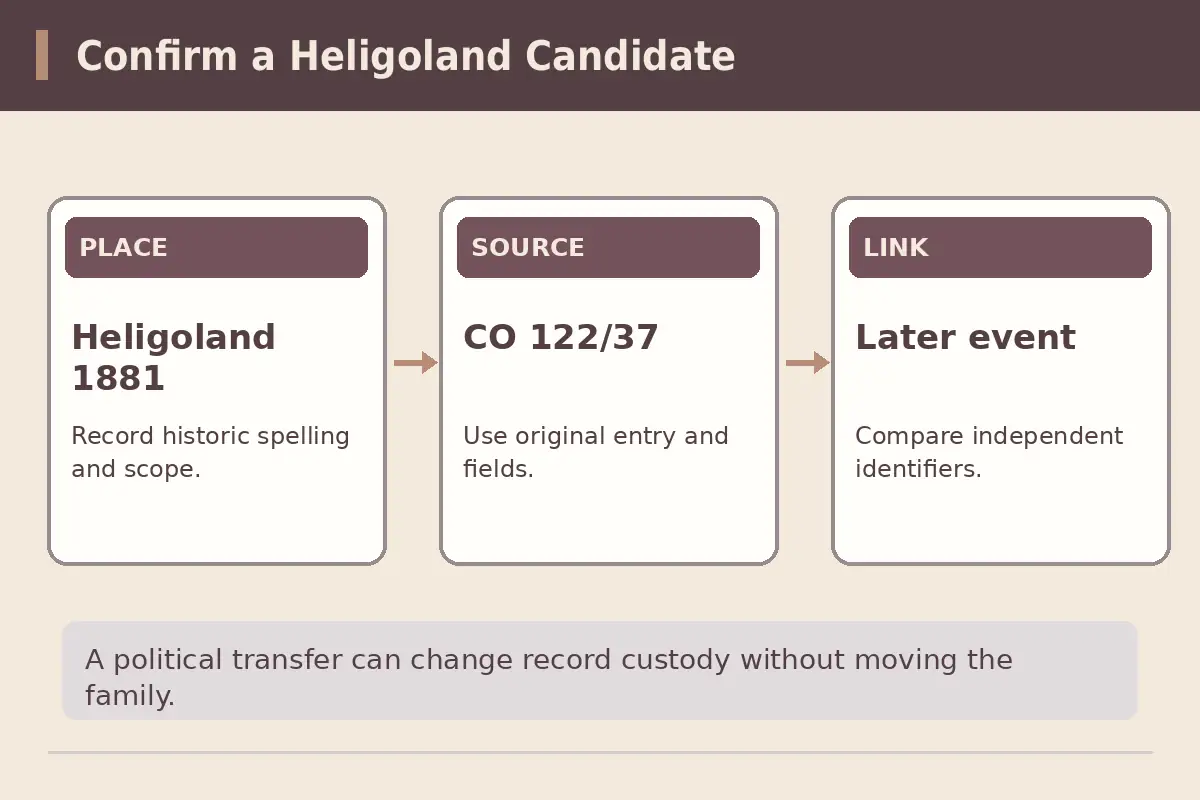
The 1881 census of Heligoland survives in CO 122/37, and its location in British Colonial Office records reflects the island’s 1881 administration, not its present-day German jurisdiction. This guide gives a precise source route, identifies what the archive can and cannot show, and names the independent documents needed before a personal or geographic conclusion becomes defensible.
Begin With the British-Era 1881 Reference
The National Archives specifically identifies the 1881 census of Heligoland in CO 122/37. An ancestor associated with the island in that year should not be rejected because a search in a modern German census collection produces no result. The record sits in a British Colonial Office series for a historical reason. The island municipality dates British control to 1807 and transfer to Germany to 1890. The 1881 snapshot therefore belongs to a different administrative setting from later vital and residence records. Record the date of the event before choosing a repository.
Search the precise CO 122/37 reference, inspect the catalogue description and note the document’s own title, language, coverage and access conditions. The official census guide establishes that the return exists, not that every household can be searched by name online. A reference found in a guide is a starting point, not an automatic match to a person in your family. Copy a full page, including headings, before using isolated names or ages.

Inspect the Island Return Before Importing a Household
An 1881 English census schedule has recognizable questions, but Heligoland was a different jurisdiction and should not be assumed to use exactly the same template. Read the Heligoland original for the fields it actually provides; do not copy relationship, birthplace or occupation categories from an English sample unless they are present. If you find a named row, capture its spelling, stated age, occupation if shown, locality if shown, and nearby context. A family tree assembled from adjacent lines alone may be wrong.
The population could include people whose names are recorded in more than one language or spelling tradition. Keep the manuscript spelling and a modern normalized search form in different columns. If an indexed rendition supplies a place of birth missing from the manuscript, mark that as an editorial addition rather than a source fact. A count of island inhabitants is useful for local history but does not by itself establish any named individual’s presence.
Build an event table with four columns: date, actual jurisdiction, archival custodian and documented person. The first three columns may change even when the fourth remains the same individual. Do not use the modern name “Helgoland” alone to predict the language of an 1881 entry.

Handle the 1890 Jurisdiction Change Correctly
Heligoland passed to Germany in 1890, as confirmed by the island’s own history. That political event is not a migration event for every resident. A family can remain in the same physical location while the official language, legal context, archive and record arrangements change. Draw two timelines: geographic location and creating authority. Do not automatically describe a person listed in 1881 as having “moved to Germany” in 1890. That phrase confuses sovereignty with personal movement.
For an event after 1890, look for the relevant German civil, church, local administrative or historical record custodian as appropriate. Determine the contemporary date and place name before choosing a source. The pre-transfer census may provide one point of identity; a later marriage or death entry may provide another. They should only be merged if additional details make the match convincing. A similarly spelled island surname or a recorded occupation is rarely enough on its own.
Distinguish Local Regulations From Personal Status
The Institute of Advanced Legal Studies catalogs British-era Heligoland legislation from the nineteenth century. Those official law materials provide contextual evidence about the government’s rules, but should not be treated as individual civil registrations or as a census index. An ordinance may explain a local practice, official language or reporting framework without naming a particular family. If a legal change is relevant to your ancestor, first establish its exact date and whether it applied to the event you are examining.
As an example, imagine a fictional fisherman recorded in an 1881 list and a later German-language notice with the same surname. The first step is to compare original names and dates; the second is to seek matching kin, address or other identifiers. A history of fishing on the island cannot supply the missing link. Preserve alternative candidates when the evidence is thin, and do not change an age recorded in 1881 to make a preferred later match work.
Create a Reusable Island Research Ledger
For the 1881 evidence, cite The National Archives, CO 122/37, plus the actual page, entry or folio after inspection. Record whether the page is a name list, an aggregate schedule or a copied return. For later German material, cite its own creator, archive and reference. A two-century search can cross languages and governments, so a bare URL or a modern place name is not enough to make the trail reproducible.
Summarize only what the documents say. State, for instance, that a specifically identified entry appears in the 1881 British-era census, and that a later independent record possibly corresponds to the same person if the match remains unresolved. Include the historic custody explanation so a reader understands why an island now in Germany has an 1881 return in British papers. That is the central research advantage of CO 122/37, and a sound safeguard against false negative searches.
On a historic map, annotate the map’s survey and publication years rather than treating its labels as timeless. Island coastlines and buildings may have changed, and a modern street is not necessarily a precise locator for a household in 1881. Use descriptions and other dated records to corroborate addresses, where available.
More Place and Jurisdiction Guides
How We Research This Archive Series
This guide starts with the official description in The National Archives’ research guidance, not a claim that we have inspected a particular person’s private file or a specific original piece. The archival statements here concern the series or research method. A hypothetical example is labelled as such; it is not a newly discovered historical event. We use the Discovery search guidance to distinguish keyword matches from archive holdings and document contents, because catalogue descriptions do not transcribe every word of an original.
For every real candidate, record its historical place or person’s name, the creator, document type, date, full CO 122/37 piece or item reference, access restrictions, and the exact claim being tested. The official citation guide explains how to document those references so another researcher can retrace them. An unread document remains a catalogue lead, never proof of imagined details. If a record is missing, preserve the searched terms and dates and examine survival and alternate custodians before interpreting the gap.
Before sharing a conclusion, audit the difference between original source wording and your interpretation. Require independent evidence for any further claim about an individual, property owner, legal effect, or completed action. Respect archival access limits and living people’s privacy. This website also provides an affiliate disclosure; no paid partnership or commercial access is implied by these archival references.
The National Archives identifies CO 122/37.
Heligoland was under British administration in 1881; the transfer to Germany occurred in 1890.
Do not assume so. Inspect the fields on the original Heligoland return.
No. The change of sovereignty does not itself prove a personal move.
Compare original names, dates, places and independent identifiers before combining two entries.