
The Barbados return of 1715 in CO 28/16 concerns the white population only; using it as a census of everyone on the island would erase people deliberately excluded from its scope. This guide gives a precise source route, identifies what the archive can and cannot show, and names the independent documents needed before a personal or geographic conclusion becomes defensible.
Start With the White-Only Warning
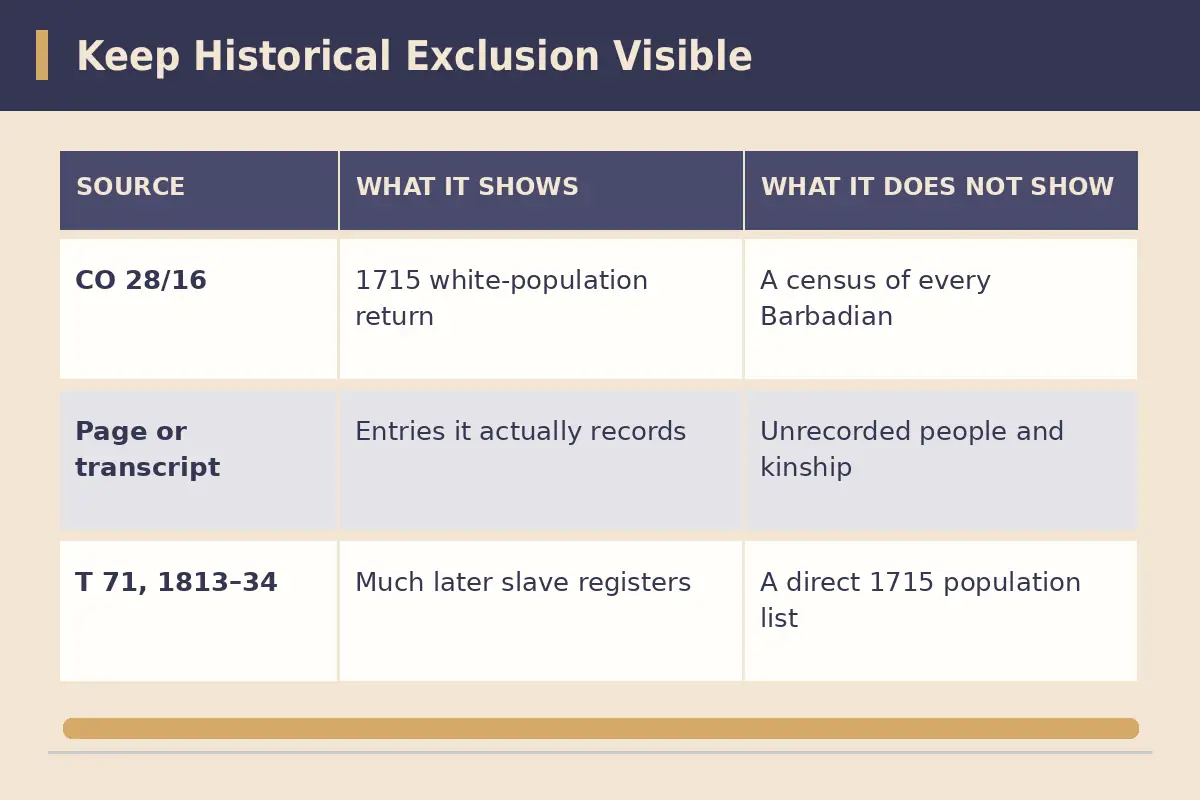
The National Archives calls the Barbados document a census of the white population only, dating from 1715, in CO 28/16. Those four details—place, date, coverage and archival reference—belong in the first line of every research note. It would be false to describe the return as a complete island census. Under British colonial rule, many residents, especially enslaved Africans and their descendants, were excluded from a category defined by whiteness. The limitations are not a small footnote: they determine whether the source can possibly answer your family or local-history question.
Start by writing the person or community you hope to investigate, followed by the historic category the return actually covers. If your question concerns someone who could not have appeared within that category, do not spend time interpreting a failed search as evidence of migration or death. Instead, identify other contemporary types of evidence, while recognizing that survival is uneven and colonial record-making was selective. Avoid treating the identities and relationships of excluded people as knowable from a numerical margin alone.

Find the Correct Item Rather Than a Similar Census
Search the precise reference CO 28/16 in The National Archives catalogue and review the piece description and access arrangements. A secondary transcription or published extract may be useful for finding a parish or surname, but should be cited as a derivative until you have checked the underlying record. The early eighteenth century produced multiple population returns in Caribbean colonies, often for different purposes and groups. A total from another year or colony must not be silently blended into the 1715 source.
When you encounter a possible entry, capture the manuscript heading and the complete line or row. Determine whether the record gives individuals, household heads, categories, totals or some mixture. Do not infer detailed family relationships from adjacent names. If a parish label appears, preserve its historical wording and check any boundary changes before converting it to a modern address. A record about a district can establish the context of an entry without proving residence at a precise house.
A useful worksheet has one field for who compiled the source, one for whom the source intended to count, one for the fields actually present, and a prominent “excluded or unknown” field. The last field cannot be erased because a later published index lists a convenient ancestor. It should guide which independent archives to consult next.
Do Not Treat the Colonial Categories as Natural Facts
Historical categories used in colonial records reflected power and law, not neutral descriptions of a whole society. In the Barbados case the guide explicitly flags the white-only scope, so any chart made from the return must carry that qualifier. If the page provides headcounts, label them as counts within the return rather than figures for the island population. A graph titled simply “Barbados in 1715” would invite a serious misreading. The people excluded from a record still existed; their omission says something about the document’s design.
Transcribe status terms cautiously and quote offensive historic language only when needed to explain what the source actually said. Do not assign an unnamed enslaved worker to an estate merely because a white owner or occupier is shown in a related document. Separate documentary evidence of ownership, labor, residence and kinship. Even a named person in one legal category may not be the same person who appears under a similar name in a tax or parish source.
Choose Separate Records for People the Return Misses
The National Archives offers a guide to researching enslaved people and slave owners, including T 71 registers dating chiefly from 1813 to 1834. These are much later than 1715 and are not a replacement census for the early eighteenth century. The time gap is vital: an owner named a century later cannot be assigned to a plantation in 1715 without independent proof. Where records exist, investigate local parish material, estate papers, wills, legal cases, shipping evidence and historical correspondence as separate potential source types.
Build one evidence sheet per claim. If you are testing that an ancestor lived in a Barbados parish in 1715, identify the exact source that names the person and the place. If you are tracing someone excluded from the white-only return, the honest outcome might be that this particular census is unusable for identification. That is a positive research decision: you have rejected a source that cannot support the question instead of inventing an answer from its silence.

Write the Narrowest Defensible Conclusion
For a possible individual in CO 28/16, use a three-part conclusion: the verbatim entry, your interpretation of its fields, and the independent evidence still needed. Cite the full reference and page or folio if inspected. If you have only seen a name index, distinguish the index from its manuscript basis. For tabulated historical statistics, keep the heading “white population in the 1715 return,” never “total population.” Do not reuse a later tally as though it measures 1715.
For an excluded person or group, explain that the surviving return provides no direct individual evidence, not that the people were absent. Your source list should make the date mismatch clear when introducing T 71 or later records. This careful approach makes the work more accurate and more respectful: it preserves what colonial administrators recorded while refusing to reproduce the mistaken idea that everyone outside their chosen category was invisible in history.
When a family has multiple possible branches, keep the 1715 census as one contemporaneous observation rather than a master list. Compare dates, parish boundaries, parish registers, deeds and estate transactions only if their contents actually support the connection. If these sources are unavailable, describe the missing link explicitly instead of substituting assumptions about household structure.
More Place and Jurisdiction Guides
How We Research This Archive Series
This guide starts with the official description in The National Archives’ research guidance, not a claim that we have inspected a particular person’s private file or a specific original piece. The archival statements here concern the series or research method. A hypothetical example is labelled as such; it is not a newly discovered historical event. We use the Discovery search guidance to distinguish keyword matches from archive holdings and document contents, because catalogue descriptions do not transcribe every word of an original.
For every real candidate, record its historical place or person’s name, the creator, document type, date, full CO 28/16 piece or item reference, access restrictions, and the exact claim being tested. The official citation guide explains how to document those references so another researcher can retrace them. An unread document remains a catalogue lead, never proof of imagined details. If a record is missing, preserve the searched terms and dates and examine survival and alternate custodians before interpreting the gap.
Before sharing a conclusion, audit the difference between original source wording and your interpretation. Require independent evidence for any further claim about an individual, property owner, legal effect, or completed action. Respect archival access limits and living people’s privacy. This website also provides an affiliate disclosure; no paid partnership or commercial access is implied by these archival references.
No. The National Archives explicitly describes it as covering the white population only.
Start with CO 28/16 and identify the precise item or page.
Not from a return restricted to the white population; seek different contemporary evidence.
No. The cited T 71 material is much later, mainly 1813–1834.
Very little without checking who was eligible for inclusion and how the record was compiled.