
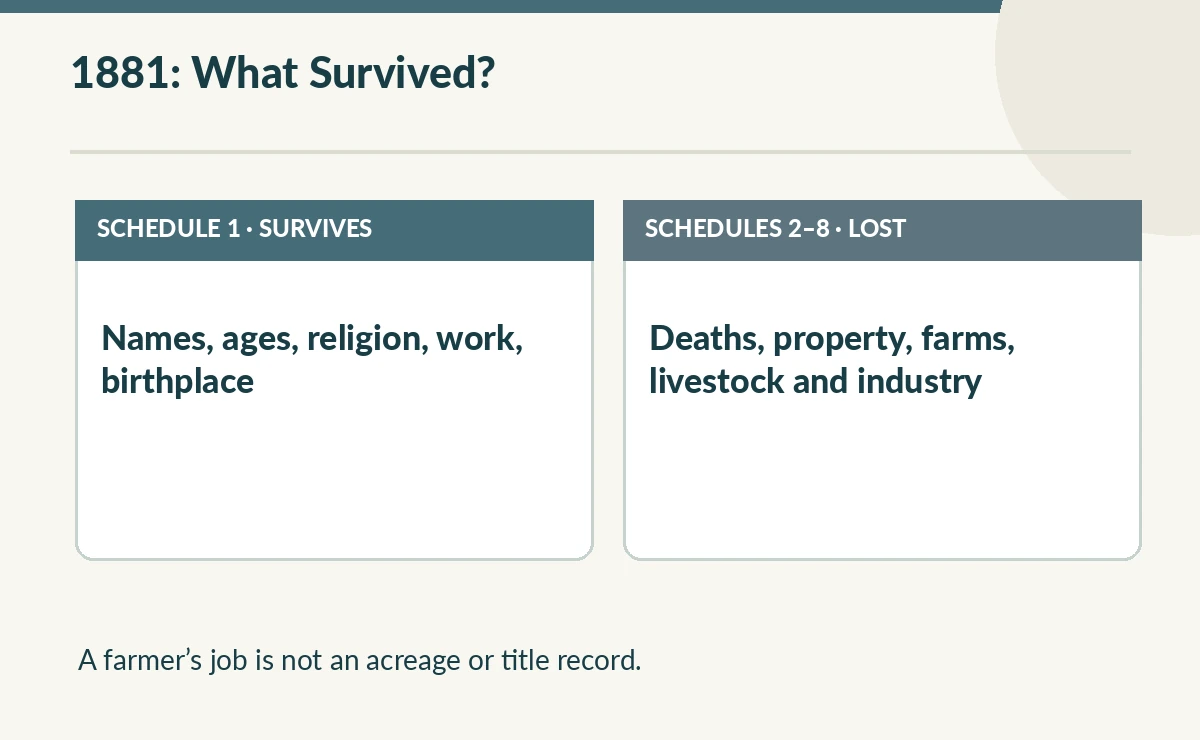
The 1881 Canada census can identify a person, family group, occupation, religion, reported origin and birthplace. It cannot supply the family’s exact landholding from a surviving property schedule. Although enumerators used eight schedules, Library and Archives Canada (LAC) reports that only Schedule 1, the nominal return of living people, was preserved. Begin with the name index, inspect the actual image, and build the identity case from names and neighboring entries—not from a field that no longer exists.
What April 4, 1881 means for the family you find
LAC identifies April 4, 1881 as the census reference date. An enumerator may have reached a particular street or rural area later, so do not treat the date written at the page margin as a second birth or migration event. Record the person’s reported age at last birthday and compare it as an approximate birth-year range with independent records. Infants could be entered using fractions of a year; do not silently turn those fractions into a precise birthday. A child born after the reference date might not belong in the count even if a family later lived nearby.
Find the provincial district before deciding a namesake is yours
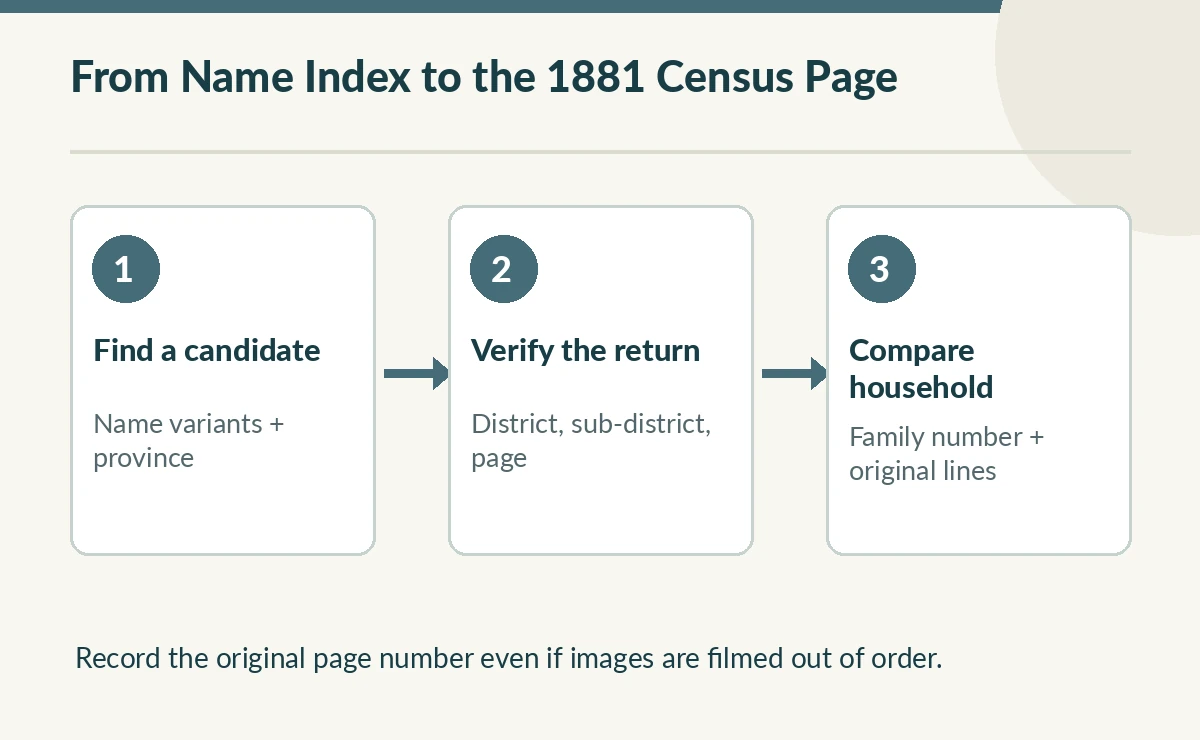
Search the LAC census collection with a plausible surname and its common spelling variants. Use the province, census district and sub-district to narrow a broad family-name search. An indexed name may be misread from handwriting, and an apparently blank result can reflect indexing rather than the absence of the family. Switch to images for a known parish, village or neighboring household when the text index fails. Capture the page header and complete district information, not merely the person’s name and a search-result URL; that context is the key to reproducing a finding.
Read the 1881 family and house numbers as separate units
Schedule 1 numbered inhabited houses and families separately. Two related or unrelated family groups could occupy one dwelling, so identical house numbers do not prove a single nuclear family. A list of adjacent names also does not automatically establish every kinship relation: the 1881 form is not a modern pedigree chart. Transcribe each line with age, sex, occupation, marital status, religion, birthplace and recorded origin. Compare those details across rows, then seek a marriage, baptism or later census that independently supports any claimed parent-child relationship.
Interpret birthplace, origin and religion without collapsing them
The birthplace column gives a province or foreign country as reported to the enumerator; the origin column is a separate period classification. They can differ. Neither column by itself proves citizenship, genetic ancestry or a specific ancestral village. Religion is also a reported affiliation, not proof of baptism in a particular congregation. The census included historically imposed categories and language that do not map cleanly to modern identities. Quote a necessary original term accurately in research notes while explaining the category rather than adopting it as a verified personal identity.
Check the unexpected microfilm page order before declaring a gap
LAC warns that original pages were sometimes filmed out of sequence—for example, pages 1, 2, 5, 6, 3, 4. When one family member appears to disappear between two page images, inspect the page numbers printed on the sheets, not just the film viewer’s next-arrow order. Search nearby images for missing folios and repeated or skipped page numbers. Copy the district, sub-district, image identifier and actual page number into your log. A recording-order problem is different from a missing original return, and the two should not be coded alike.
The seven missing schedules cannot identify an 1881 farm
The eight planned schedules included deaths, real estate and industry, agriculture, livestock, forests, shipping and fisheries, and mines. LAC says Schedule 1 alone survives. In particular, the precise household property location was recorded on Schedule 3, which is no longer available. A farmer’s occupation on Schedule 1 is evidence that this occupation was reported, not a surveyed acreage, legal owner, parcel number or livestock inventory. For land ownership, change record class entirely: identify the jurisdiction and seek deeds, grants, assessment rolls or later cadastral materials.
Use a three-record identity comparison for a difficult surname
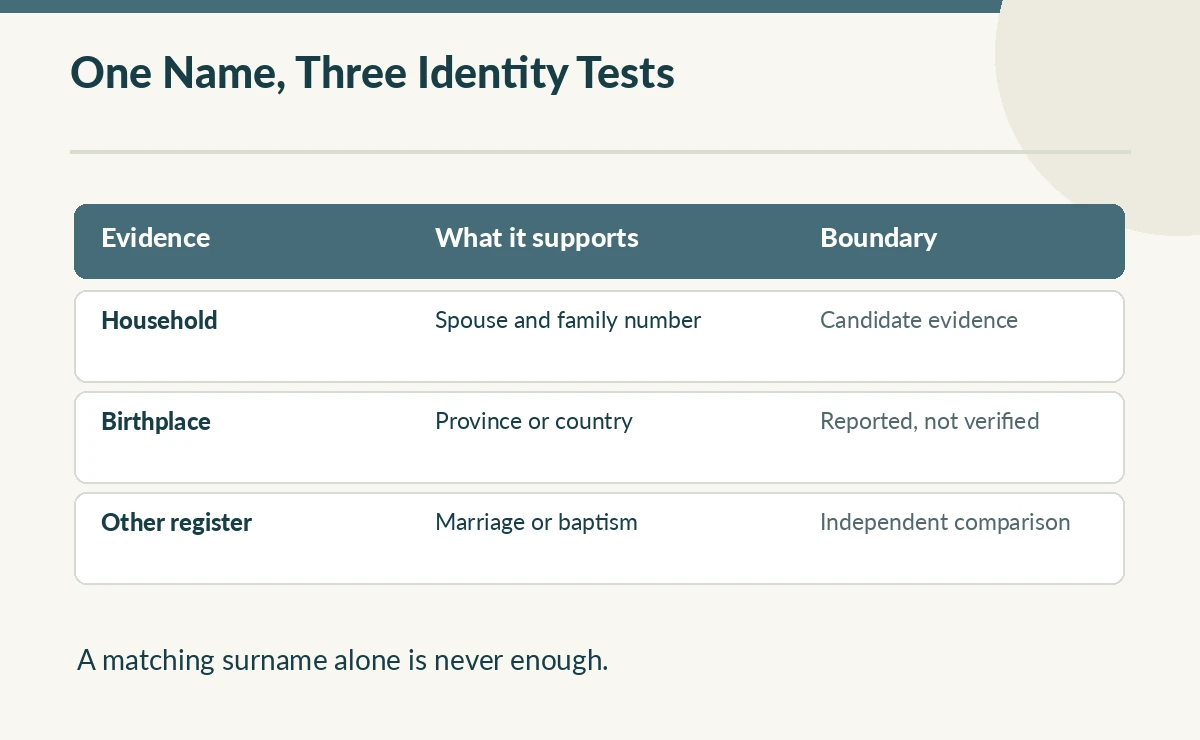
Imagine two historical residents named Mary McDonald in the same province. The 1881 age, household companions, religion and reported birthplace can rank candidate matches, but no one clue should decide identity alone. Ask whether a separate marriage record has a spouse consistent with the census; whether an 1891 household reports compatible children; and whether an earlier parish entry explains a name variation. Record the conflicting details alongside the consistent ones. Use hypothetical names only as a practice exercise and do not invent actual census citations for your example. To go further, our guide “1891 Canada Census” shows how to verify parents’ birthplaces and household clues.
| Question | Evidence to check | Do not assume |
|---|---|---|
| Identity | Name plus independent family clues | Every namesake is the same person |
| Date | Original field and its event label | A later record gives the exact date |
| Coverage | Place, years and document type | A failed index search proves absence |
| Access | Custodian and current restrictions | All original pages are downloadable |
Cite the page rather than the search engine result
A useful citation preserves the repository (LAC), census year, province, district/sub-district, nominal Schedule 1, the page and any microfilm or image identifier displayed by the service, together with an access date. If FamilySearch supplies the index and LAC supplies the image, name both roles in the research log. Store a short transcription separately from the source citation. A database may change its URL or index rendering, but the recorded district and original page can still let another researcher recover the document. For a related choice, see our guide “German Census Records”.
Choose the next original based on the missing claim
If the unanswered question is parentage, look for a religious or civil birth/marriage record. If it is place of residence, seek a directory or local tax roll for the same period. Also, if it is land ownership, use provincial land records rather than reconstructing missing Schedule 3 from an occupation label. For a person who appears in 1871 and 1891 but not in 1881, review spelling, neighboring households, microfilm page order and province boundaries before interpreting an unsuccessful search as migration or death.
When comparing rural neighbors, remember that enumeration order is not a measured property boundary. A nearby entry can supply a useful locality clue while leaving the legal parcel and actual distance unknown. Keep the two propositions separate in the worksheet. A local tax or grant record is needed to establish a parcel, and even that alone will not prove an entire census family lived on it. Our guide “1921 Canada Census” shows how to find households and separate surviving schedules.
More Records and Archives Guides
How We Research Canada’s 1881 Returns
We checked the current LAC 1881 census guide against its general census access instructions and the FamilySearch 1881 index description. We separated statements supported by the original Schedule 1 fields from the seven lost schedules and from our own proposed correlation method. No example here purports to be a verified named historical household. Check the primary references directly: Official archive guide. Original collection or archive information. Additional access guidance.
This article offers research methods, not guaranteed records or paid recommendations. We do not claim an affiliate relationship with the listed archives or services. Read our affiliate disclosure for site-wide information.
Yes. Schedule 1 includes a profession, occupation or trade field, but that answer does not establish land ownership.
LAC states that only Schedule 1 survives; do not expect original 1881 agricultural entries from the lost schedules.
Some pages were filmed out of sequence. Compare the original page numbers and nearby images rather than only viewer order.
No. They are different columns, and neither alone establishes a family’s specific ancestral town.
No. Compare the family number and seek independent birth, marriage and other evidence for exact relationships.