
Start With an Institution, Place and Historical Date
A government school inspection report can describe teaching, buildings and official judgments about a school, but it is not an enrollment record for a named child. For family history, its best use is to reconstruct the educational environment near a documented residence or to check the history of an institution. Start with the historical school name, parish or town, county and target year. A familiar modern school name may conceal a merger, relocation or change of administrative category.
The National Archives inspectorate guide covers school inspection records from 1839 to 1993. Inspection became a condition of educational grants in 1839, and the reports varied greatly in frequency and detail. Do not promise an annual report for a named school just because the series date range overlaps its existence. An inspector could report on an entire district, a school category or a particular institution.
Write down what you are looking for before searching. A district report may answer whether educational provision was discussed in a county; a school abstract can supply a more focused assessment; an admission register may document an actual pupil. These are different kinds of evidence. If you are investigating a child, identify the child through independent household and school material before using inspection findings as background context.
Use the Date Gate Before Searching a Name
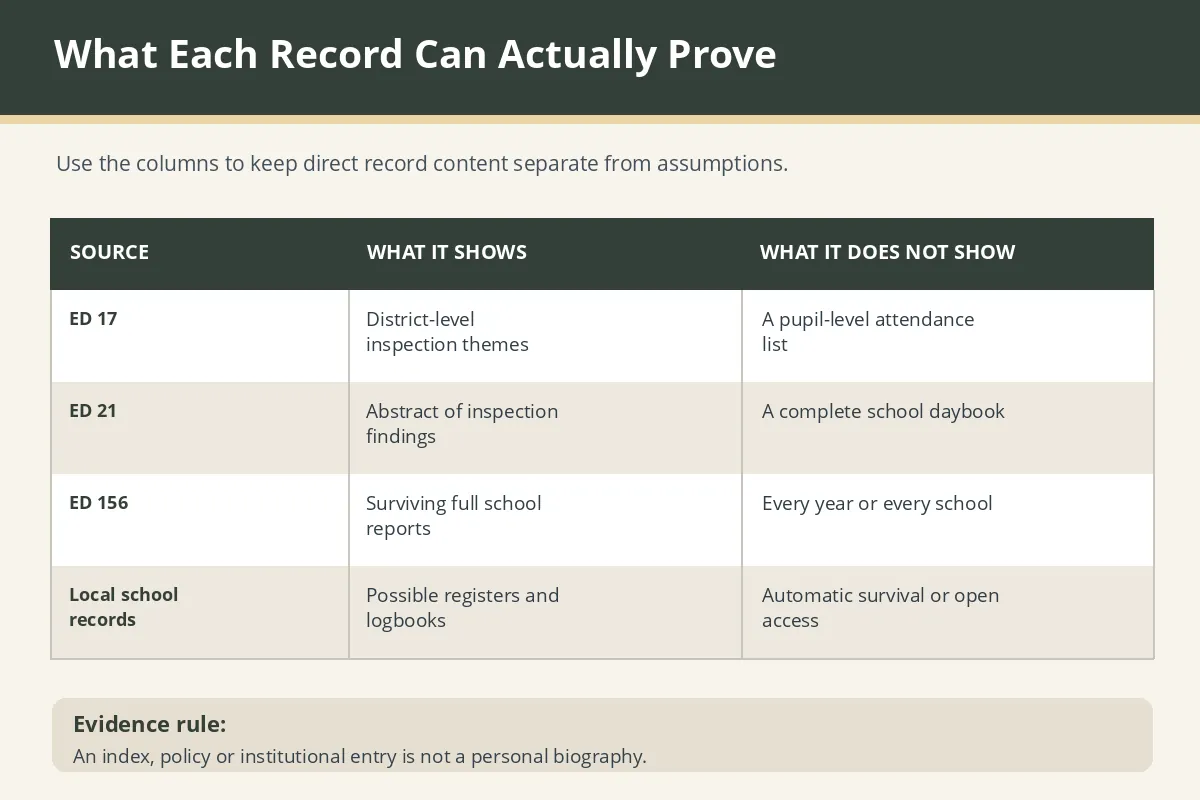
The official inspection route for early elementary education begins with printed district reports in ED 17, covering 1840–1899 as part of parliamentary annual reporting. Before 1870, districts were organized by religious denomination as well as locality. Consequently, modern administrative boundaries are a poor substitute for the recorded historical district. The National Archives says it does not hold the original manuscripts of these early district reports; a printed report should be cited as such.
For 1899–1944, ED 21 holds abstracts of inspectors’ reports, searchable by school. That does not mean each school has a surviving abstract for every year. From 1946–1993, ED 156 holds full reports, arranged for searching by county and county borough. A search restricted to one school name may therefore miss an entry in a county-level sequence. Change the search strategy when crossing these dates rather than treating one catalogue search as exhaustive.
There are period-specific exceptions. The official guide states that HMI did not inspect London elementary schools before 1943; general subject reports based on samples instead appear in ED 23/269. A missing London school report before that date does not establish poor performance, closure or nonattendance. It indicates that you need to check the relevant inspection practice and other local or departmental sources.

Inspect the Administrative Label on Every Finding
Catalogue records may refer to the same building under an elementary school, a secondary institution or a later primary school. The National Archives schools guide explains that ED 21, ED 35 and ED 161 often contain institutional correspondence and reports rather than records created by the school itself. An inspection abstract attached to a school file should not be recast as a pupil census. Examine the creator, filing title and coverage of the whole piece.
In your evidence worksheet record whether the report concerns staff, accommodation, religious instruction, educational standards or administration. Distinguish direct observations by an inspector from information the school supplied or a later departmental summary. If a report criticizes teaching in a year when an ancestor may have attended, that is context, not evidence of the individual child’s ability or experience. Avoid converting broad institutional language into private biographical claims.
A useful minimum citation includes the department and piece reference, the school or district name as actually printed, the report date, relevant page, archive and form consulted. If using a published parliamentary report, note the publication year as well as the inspection year when both exist. Differences between these dates can explain apparent chronological inconsistencies without requiring an invented additional inspection.
Use Independent School Registers for Pupil Questions
If the research question is whether a specific child attended, look for an admission register, attendance register, school logbook or school board record held locally. Inspection reports are not replacements. The National Archives advises that copies of full inspections should have gone to the school and, after 1902, to the local education authority; surviving copies may now be at a county record office. Check the catalogue’s “Held by” information before assuming every result is housed at Kew.
When a child lived near several schools, do not choose a school solely because the surname appears in a later alumni publication. Use a dated address and age, the school’s actual catchment or denomination where documented, and a direct record of enrollment if one survives. Keep schools that were plausible but unproven in a separate research column. A negative catalogue search is only a report on the material and search terms you examined.
Do not infer continuous school attendance from a single dated admission or from a school inspection that happened during the same decade. An admission proves its own recorded event, while a later absence, transfer or leaving date requires separate evidence. For institutional history, it may be enough to reconstruct changes of premises, inspections and funding without naming any individual pupils.

Handle Missing Years and School Renaming Carefully
Create a three-column timeline: contemporary school name and locality, inspection or administrative record, and the institution’s later identity. Mark every merger or reclassification as a hypothesis until a local education authority minute, foundation document or school archive confirms it. School files can outlast the institution’s original form, so the catalogue date of a file does not automatically equal the building’s opening or closing date.
The National Archives notes that the reports are generally not available to view online; researchers may need a visit or copy order after finding the exact piece. Do not describe a bare web catalogue entry as if you read the full report. Where there is no surviving record for an expected year, preserve the search scope and move to local holdings rather than treating the missing report as negative evidence about schooling.
More Place and Jurisdiction Guides
How We Research This Record Series
We begin with the institutional purpose and dated scope of each archival series, then trace the claims to the original record rather than relying on a search-result snippet. This guide was prepared using the linked custodian research guides, and catalogue descriptions should always be rechecked before a research visit. A series date range describes a group of surviving records, not guaranteed person-by-person coverage. We distinguish a named entry, an administrative statement, a corroborated identity and an unresolved inference; none should be silently substituted for another.
For this topic the custodian references are the primary National Archives guide and the complementary research guide. Access and reproduction arrangements may change; check the archive before ordering a copy. Read the affiliate disclosure for the site’s general relationships. No recommendation here requires a paid partner or presumes a commercial endorsement.
They are primarily early printed district reports, not routine pupil registers.
ED 21 holds inspection abstracts for 1899–1944; first confirm the school and locality.
HMI did not inspect London elementary schools before 1943, according to the official guide; investigate other relevant sources.
No. The National Archives states the reports covered by its guide are generally not viewable online.
Find a specific school admission, attendance or similar record and corroborate the child’s identity independently.