
First Identify the Department, Office and Date
A named royal servant in an appointment book is a useful lead, but a court title cannot by itself establish where the person lived, how long the appointment continued, or whether every payment was collected. The Lord Chamberlain’s department employed housekeepers, watermen, musicians, messengers, physicians and many other specialists. Start with a dated office, not the glamour of the institution. Make a research question such as: was this named musician appointed in a particular reign?
The National Archives guide to Royal Household and Wardrobe records places the Lord Chamberlain material under department code LC. This is not a single indexed staff roll. It is a family of books made for different administrative purposes. Record the exact spelling, office, date, repository and reference of any catalogue hit. A modern summary can merge unlike posts that were separately administered in the historical household.
Do not start by assuming that a royal warrant to a supplier is the same thing as a staff appointment. LC 3 appointment volumes may include some warrants for tradespeople. Likewise, the residence of a palace workplace should not be copied into a servant’s family tree as a home address. The same surname might belong to a successive officeholder, an assistant or an unrelated contractor. Build an identity hypothesis that remains open to competing candidates.
Route the Search by the Book’s Actual Purpose
For a question about an appointment, the principal early sequence is LC 3/61–71, covering 1660–1851; another appointment sequence is LC 3/56–60 for 1685–1838, with acknowledged incompleteness. An establishment question starts elsewhere: LC 3/1–23 covers 1641–1849. The overlapping years are not duplicates to collapse. Search the series whose administrative purpose matches the fact you are trying to prove, and then compare the other sequence when its coverage warrants it.
Salary, livery and pension books in LC 3/37–52 cover 1667–1857. Their presence matters when an appointment is recorded but its practical consequences remain unknown. A salary entry may show an allowance for a stated period, although you still need to inspect the page to understand the payee, timing and any arrears. A missing entry in one surviving volume should be written down as a search result, not described as evidence that the person was never employed.
Use the diagram to distinguish three different questions: was an appointment entered, did the office appear on an establishment, and was money or livery recorded? Preserve the volume reference and folio or page numbers for all three. Check the chronological scope before ordering, since the boundaries of the catalogued sequence may not align exactly with a monarch’s accession or a household reorganization.

Read Names as Roles Rather Than Automatic Identity Matches
Transcribe the wording around the personal name: appointment, reappointment, vacancy, salary, livery or pension may describe different events. An appointment dated one year followed by an allowance years later is not necessarily proof of continuous service between them. A list that names the office but omits the individual cannot identify a person. Separate each assertion into a record quotation or paraphrase, its date and the question it actually answers.
A practical evidence table should have columns for record reference, name form, office title, event date, payment date, named associates and uncertainties. For a difficult surname, compare a second person of the same name explicitly. Do not treat an occupation in a marriage register as proof that the groom was the same court employee; compare residence, relatives, age and other independent details. The court’s own paperwork and local records can refer to different people.
Correspondence in LC 1 can explain a dispute or request that is not apparent in an appointment book. The National Archives civil and crown servants guide also points to LC 9, LC 10 and LC 11 household accounts. Those records are valuable cross-checks but not guaranteed individual service files. They should be searched by office, account date and departmental context rather than treated as a universal name index.
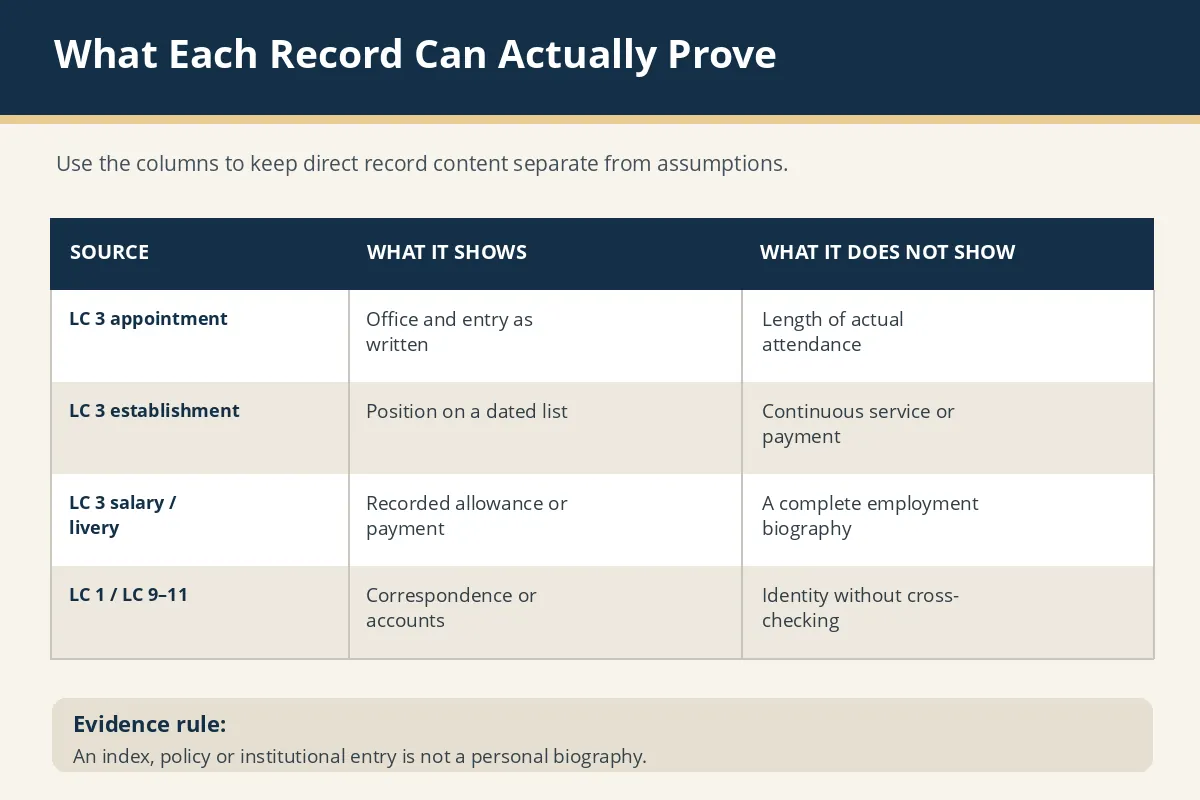
Follow an Entry Into Accounts Without Overclaiming
Suppose an appointment entry names a messenger in 1790. First verify the particular volume and the exact wording. Next look for an establishment entry near 1790 and a relevant salary or livery entry, allowing for administrative delays and different book dates. A payment to an officeholder might have been made through an agent; do not change the identity claim until the name and context can be matched. If the books disagree, preserve both entries and investigate rather than smoothing the dates.
The supporting record may concern a royal household department rather than the individual’s daily work. An office could be ceremonial, temporary, shared or held by succession. Do not infer that an officer attended a particular palace, accompanied a monarch on a journey or performed a particular duty unless a separate record says so. For a genealogical conclusion, link the named official to another independently identified person through a defensible cluster of facts.
When an index gives an office without a full name, inspect the original volume if access allows. Note whether marginal alterations are contemporary or later. Photograph or cite the entire relevant opening when permitted, including headings that explain the status of the list. A bare cropped name is poor evidence because it can conceal whether the entry is an appointment, proposed warrant or retrospective accounting note.

Record the Negative Searches and the Alternative Offices
Plan searches on both sides of a likely appointment year, but never assume the sequences were continuously kept. The official date ranges describe surviving series, not guaranteed annual coverage for every kind of office. A negative result can arise from an alternate title, a name variant, a missing book, a later payment year or a record held by another branch of the Royal Household. Put each unsuccessful query in a log with the reference and date span actually examined.
Keep the Lord Chamberlain’s department distinct from the Lord Steward’s department. The latter has separate LS references, including appointment warrants in LS 13/246–267, as the civil and crown servants guide explains. A cook or pantry employee should not automatically be routed through the same books as a musician or court messenger. Determining the employing department is often the most important first finding, even before identifying an individual.
More Records and Archives Guides
How We Research This Record Series
We begin with the institutional purpose and dated scope of each archival series, then trace the claims to the original record rather than relying on a search-result snippet. This guide was prepared using the linked custodian research guides, and catalogue descriptions should always be rechecked before a research visit. A series date range describes a group of surviving records, not guaranteed person-by-person coverage. We distinguish a named entry, an administrative statement, a corroborated identity and an unresolved inference; none should be silently substituted for another.
For this topic the custodian references are the primary National Archives guide and the complementary research guide. Access and reproduction arrangements may change; check the archive before ordering a copy. Read the affiliate disclosure for the site’s general relationships. No recommendation here requires a paid partner or presumes a commercial endorsement.
No. LC 3 concerns Lord Chamberlain records and the surviving series vary by office and period; other household departments used other records.
No. It supports an allowance or payment entry as recorded, not necessarily the whole service period.
Check LC 3/61–71 and the relevant parts of LC 3/56–60, then compare the establishment and accounts.
No. A workplace or department cannot establish a private residential address.
Transcribe both dates and their purposes, then seek accounts, correspondence and independent identity evidence.