
Identify the Railway Company Before the Police Officer
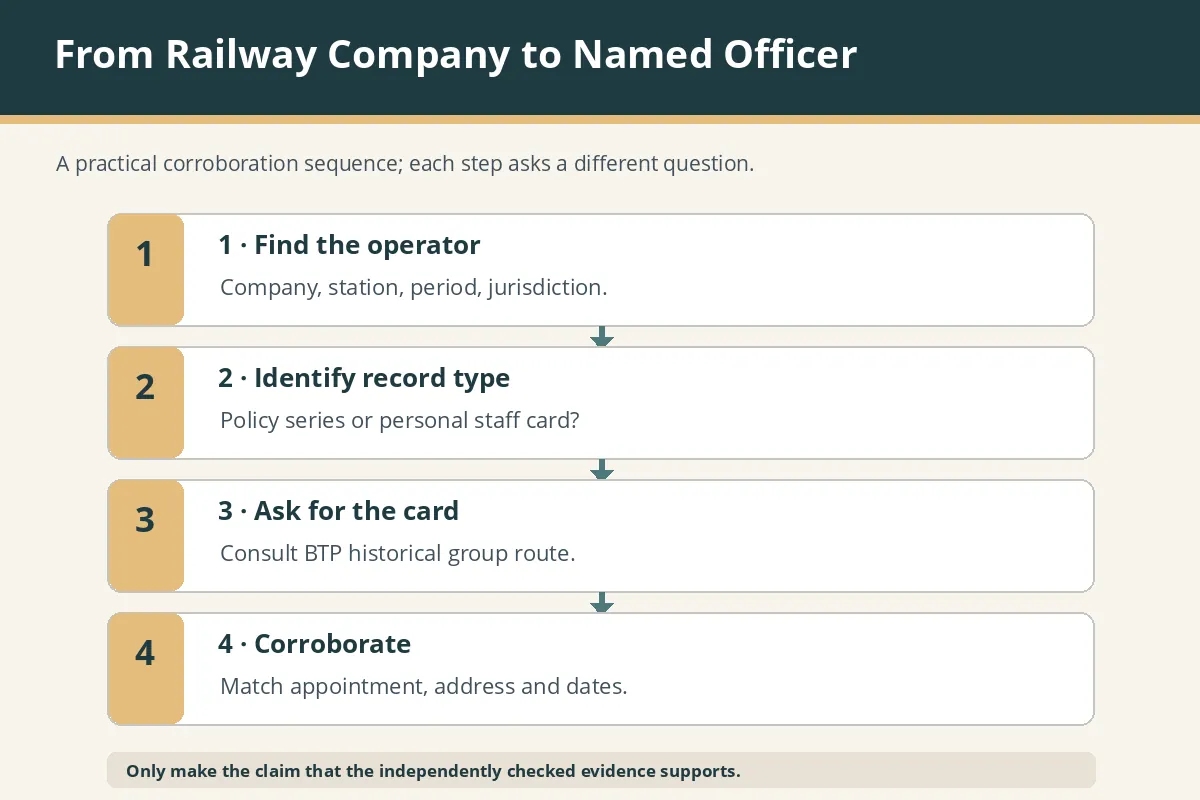
A railway police officer could serve within a company-specific force or a later transport organization. A policy file discussing railway police pay or training is not the same kind of evidence as a named officer’s appointment. Begin with a station, rail line, employer and approximate date. Then establish which company operated the railway at that moment. Without that first step, a plausible surname match in a broad railway collection can lead to the wrong force, district or career.
The National Archives railway research guide explains that more than 120 railway companies merged into four major groups in 1923, before nationalization in 1947. Company identity therefore depends on the target year, not simply the company name remembered by a family. If you only know a town, consult historical railway atlases or company histories and consider several operators before choosing one archival route.
Keep railway employment and policing evidence separate. A station porter, railway clerk, railway police constable and ordinary local police officer could work in the same locality but leave different types of records. Titles, badges and family stories can suggest a role; an identifiable record is required before stating that a person belonged to a particular railway police force. Record the precise company or department in every note.
Distinguish Staff Conferences From Personal Files
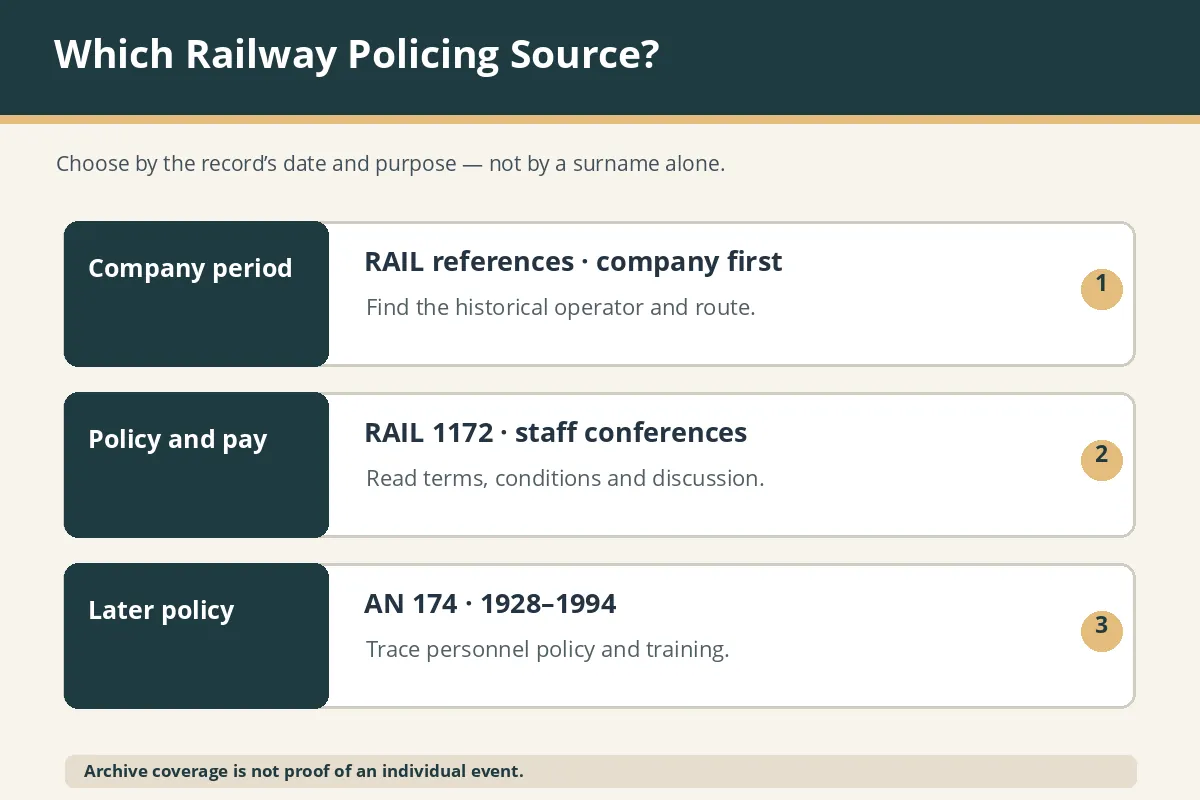
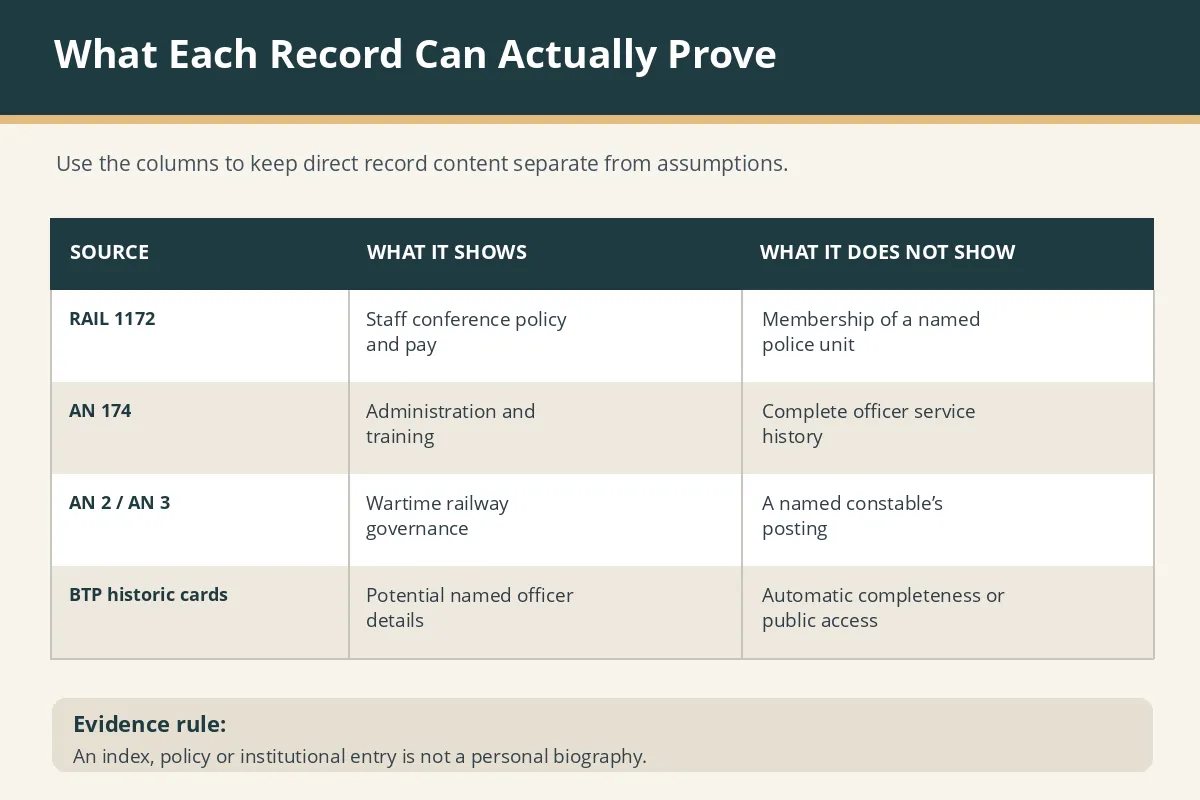
The National Archives police guide identifies RAIL 1172 among records relating to railway staff conferences, including pay and conditions. This can be useful for understanding a job, negotiated terms or institutional changes, but a discussion of salaries does not tell you that a named ancestor received a specific wage. Search by company and terms such as “railway police” or “transport police,” then inspect the exact context of any surviving item.
The same guide identifies AN 174 as personnel-department records of the British Transport Commission and British Railways Board, covering 1928–1994, with material on pay, conditions and training. Despite the word “personnel,” this does not mean every employee has a surviving individual file in that series. Treat AN 174 as a potential administrative source and test the catalogue description before drawing conclusions about an officer’s personal career.
The wartime Railway Executive Committee records in AN 2 and AN 3 provide an additional institutional route for Second World War questions. They do not automatically name every person on duty. A policy change, railway-security directive or administrative reorganization can establish context, but a person-level claim still requires an independent entry. The diagram compares what each source family can actually demonstrate.
Use the Correct Repository for Officer Cards
The official police guide states that the British Transport Police historical group holds several thousand staff record cards dating back to the 1860s. That is a stronger first enquiry for a named officer than presuming a railway staff conference file will contain a biography. Ask what identifying details and time period the historical group needs and what its present access rules allow. Do not promise a searchable public database or an image for every individual.
A card, if found, should be transcribed exactly: official name form, number if present, dates, posts and any changes of role, but only where those items actually appear. It may have been compiled later or condensed from other paperwork. Compare it with a dated census entry, directory, pension record or family document for identity. If two workers have the same surname, the job description alone does not resolve the ambiguity.
Some local or company records may have remained outside The National Archives. The National Archives also points researchers toward company-specific holdings for the railway workforce. Use the catalogue “Held by” field to avoid assuming all material is at Kew. If a historic force changed employers or boundaries, search both sides of the change and cite the exact name in use at the time.
Reconstruct Service as Separate Dated Events
Build an officer-event table with columns for event, date, record creator, original wording, reliability and unresolved alternatives. A claimed appointment needs an appointment or staff entry; a transfer needs evidence showing that movement; a pension payment is evidence of payment rather than the entire prior career. A newspaper report about police attending an accident does not identify every officer present. Do not use operational context to fill a blank service history.
Suppose a family story says an officer served at a junction in 1932. Confirm the station and railway operator first, then search AN material for administrative background and contact the appropriate historical officer-card custodian. Search directories or other dated records for residential corroboration. If an officer card dates a later posting to that district, document the time mismatch rather than altering the family story to make the records appear seamless.
Some railway records will describe conditions across a region rather than a particular individual. Their value is explanatory: they can show what policy applied or what training was discussed, but do not turn a general instruction into proof someone personally completed a course. In the final narrative distinguish “the rule said,” “the institution recorded,” and “this officer demonstrably did.” These categories create a stronger family account than an unqualified employment claim.
Avoid the RAIL Versus AN Shortcut
The police guide broadly points toward RAIL references for earlier company records and AN references for later transport-administration records, but there is no universal year in which every individual record moved from one code to the other. The creator and piece description must win over a convenient date shortcut. Search by the historical company, subject and time window, then verify which body held the responsibilities behind each document.
A negative name search in RAIL 1172 or AN 174 means little if the item describes policy rather than people. Document that you checked the specific file, and pivot to an actual staff source. If no personal card survives or access is restricted, write a bounded conclusion from the evidence you have. A careful account of institutional context can still be useful while leaving unproven service dates unclaimed.
More Research Method Guides
How We Research This Record Series
We begin with the institutional purpose and dated scope of each archival series, then trace the claims to the original record rather than relying on a search-result snippet. This guide was prepared using the linked custodian research guides, and catalogue descriptions should always be rechecked before a research visit. A series date range describes a group of surviving records, not guaranteed person-by-person coverage. We distinguish a named entry, an administrative statement, a corroborated identity and an unresolved inference; none should be silently substituted for another.
For this topic the custodian references are the primary National Archives guide and the complementary research guide. Access and reproduction arrangements may change; check the archive before ordering a copy. Read the affiliate disclosure for the site’s general relationships. No recommendation here requires a paid partner or presumes a commercial endorsement.
No. It includes railway staff-conference correspondence and policy such as pay and conditions.
No. It holds personnel administration and training material, not a documented complete named-officer roster.
The National Archives points to the British Transport Police historical group, which holds thousands of historic staff cards.
No. Operators changed, especially around the 1923 groupings and 1947 nationalization.
Not by itself. A named payment, appointment or service source is needed for a person-level claim.