
The National Archives routes railway charges and rates research to Ministry of Transport records including MT 56, MT 77 and MT 131. These papers may help explain what was proposed, regulated or disputed about a charge. They are not a shipment ledger for a named customer, so a published or discussed rate must not be treated as evidence that freight actually moved.
Identify the Railway and the Question First
Railway rate research begins with a historically correct company and a defined transaction question. The National Archives railway guide notes that a researcher often needs to establish which railway company controlled a line, especially before the 1923 grouping of numerous companies into four main groups and the later change to nationalization. A station or route name alone may refer to a different operator in another period. Record the date, origin, destination, commodity and whether the figure was presented as a charge, quotation, regulation or sum actually paid.
Next ask exactly what you want to prove: an official permissible charge, a dispute about tariffs, the price printed in a rate book, or a particular shipper’s invoice. Those are distinct evidentiary tasks. A freight-rate file may address the first three without naming a customer at all. Where your ancestor was a merchant or station employee, do not infer their individual participation from a regulation applying to their town. Build a company timeline before interpreting the document’s administrative vocabulary.
Choose the Correct MT Series by the Catalogue
The National Archives specifically groups MT 56, MT 77 and MT 131 among Ministry of Transport material concerning charges and rates. It does not present the three series as a mandatory chain with a fixed order of documents. Search their piece descriptions separately, using the historical railway undertaking, a commodity or rate category, dates and the geographical route. Do not manufacture a unique MT 56 piece number from a published fare. The material is organized by official business, not uniformly by individual consignors.
A rate question can be hidden in broader files about railway administration and reorganization. The same guide also includes MT 56 among records associated with the 1921 grouping and 1947 nationalization eras. This means a piece may discuss the rules or policy context rather than provide a tariff table. Read the file title and precise dates in the catalogue, then verify the original before labeling any number as an actual charge. Check the responsible government department and archival custody fields.

Separate Proposal, Regulation, Quote, and Payment
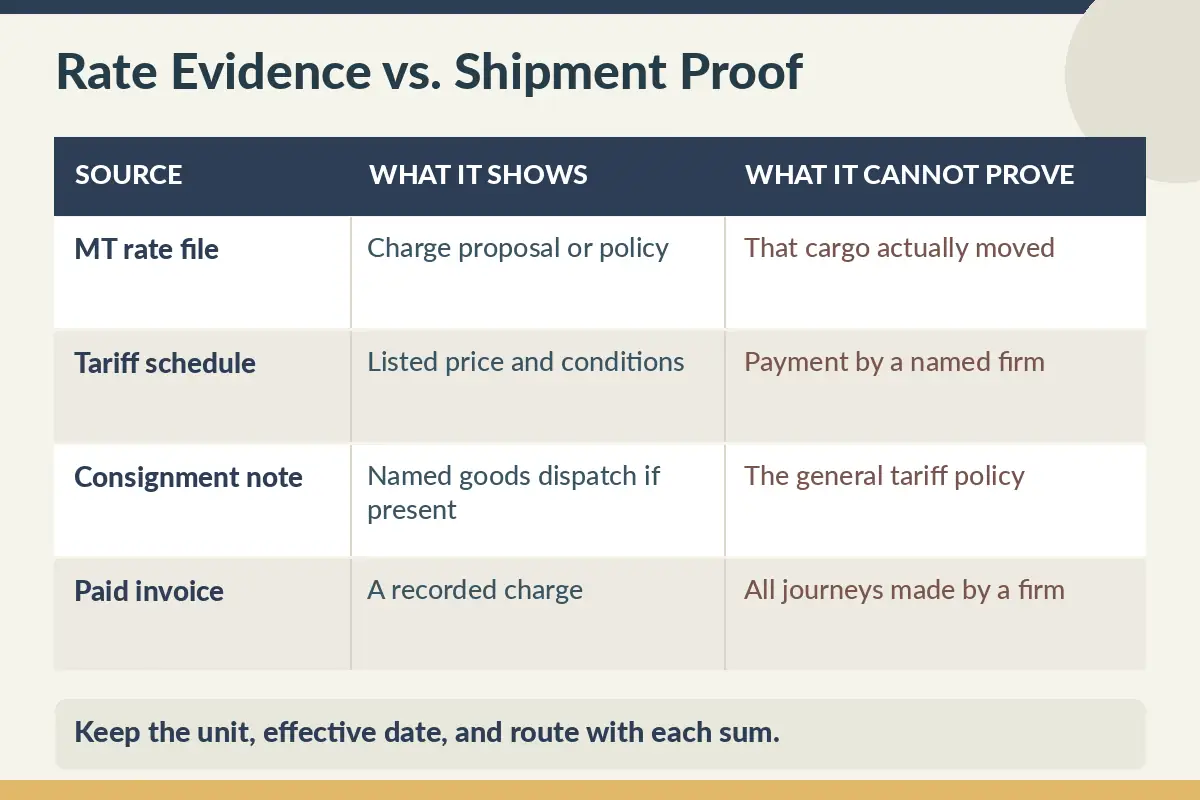
A proposed increase, a tariff authorized by an authority, a quotation offered to a customer and a line on a paid account are four different kinds of evidence. A committee report might describe a rate in argument without showing the rate was ever adopted. A published rate may change by date, route, class of goods or special terms. A family historian should avoid claiming that every shipment used the number appearing in a regulatory file.
Create a matrix with “document states,” “status when written,” “effective date if established” and “independent transaction source.” Never supply an effective date because a file is dated in that year; an administrative minute date could precede implementation. Note whether a price is per ton, per parcel, per distance or described by another unit, exactly as the source gives it. The distinction is important when comparing family business accounts with surviving tariffs or railway rates decisions.
Search by Commodity and Route, Not Just a Family Name
Company and commodity terminology can shift over time. Historical goods classifications may differ from modern categories, and a single station name can cover passenger, goods or branch-line functions. Search both origin and destination, the firm’s old trading name, and likely commodity terms. When a catalogue entry names a general charges committee rather than an individual consignor, that is evidence about record organization, not a negative finding about the merchant. Try wider date windows rather than repeated identical surname searches.
When you find a document, transcribe the actual geographic scope. A national policy paper might not show the rate in force on a specific branch, and a regional rate may not cover the type of load under investigation. If the record mentions an exemption, a negotiated rate or a dispute, keep that special condition attached to the figure. Do not convert an isolated rate in pounds or shillings into a reconstructed invoice without the contemporary units and transaction terms.
Verify a Real Consignment Through Other Records
To establish an actual goods movement, seek a waybill, consignment note, goods invoice, carrier receipt, commercial account or correspondence recording the dispatch or receipt. The National Archives railway guide identifies major private-company collections and notes that other railway records survive in specialist and local archives. Not every firm or consignor has surviving operational paperwork. An invoice might identify the customer and goods while a rate policy file supplies only context for how the price could have been calculated.
Keep supplier, carrier, payer and recipient roles separate. The owner of a business listed in a directory is not automatically the signatory on its consignment note. An accountant’s entry may be posted after travel occurred; a credit adjustment may change the net price. Pair a contemporaneous operational document with the historically applicable tariff before stating that a particular rate was charged. If no movement document survives, report that the transport cost was possible or discussed rather than documented for that named firm.

Document the Rate Finding and Its Limits
A complete research note names the railway company at the relevant date, the exact MT piece and its file title, the number or rule as originally expressed, and the documentary status of that number. Record whether the file is a proposal, administrative policy, approved schedule or post hoc dispute. Cite the original page or folio when available. The difference between a catalogue description and an inspected passage should be visible to another reader.
Finish by specifying one next test: which company held the goods accounts, which branch served the site in that year, or whether a related business invoice survives. A safe conclusion might be “Ministry of Transport papers address charges for this route or category.” Claim that a specific ancestor shipped goods only when a document actually identifies the transaction. A rate is an economic rule or claim, not proof of freight movement.
More Research Method Guides
How We Research, Cite Evidence, and Handle Uncertainty
Research for this article used official archive series guidance and source explanations: The National Archives research guidance; The National Archives research guidance; The National Archives research guidance. The record titles, series categories and retrieval steps are supported by those pages. We have not asserted that an uninspected piece contains a specific named ancestor or that a historical allegation was true. The figures and schematic routes here are explanatory drawings, not facsimile archival originals.
When a claim matters, record the precise series, piece, item and folio where possible; the source creator, record date and historical place; the literal observation; and any independent evidence for your interpretation. A failed catalogue search can be a cataloguing or survival limitation rather than evidence of absence. Our affiliate disclosure explains the site’s policy; these research paths do not require an undisclosed paid referral.
No. The series is among Ministry of Transport materials on charges and rates; customer consignments require operational or business records.
No. They are distinct record groups the Archives identifies for charge and rate research; select the relevant description.
No. Establish the effective rule and then find a transaction-level invoice or receipt.
Use the operator responsible in the event year; railway grouping and nationalization altered company structures.
The precise MT series and piece, document date, relevant railway/commodity/route and the specific item or folio where available.