
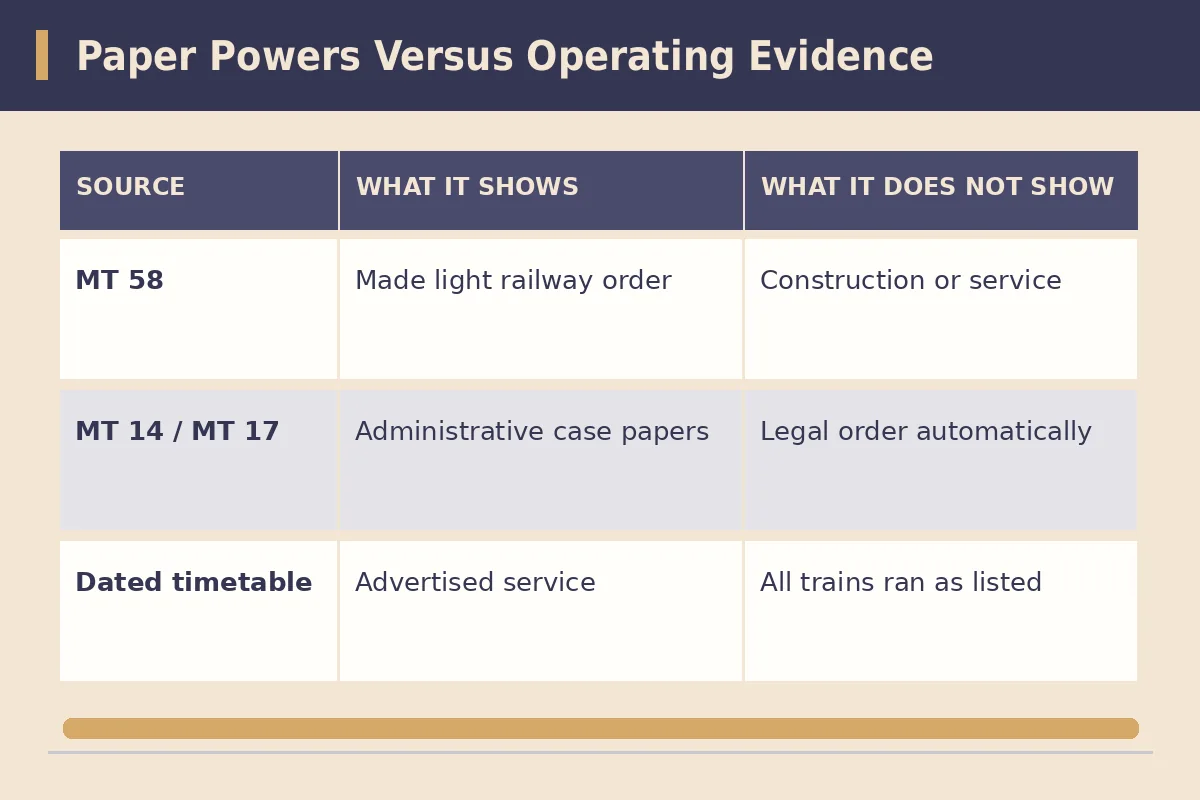
MT 58 is one of the National Archives series for light railway orders made under parliamentary acts. It can establish a legal step in the life of a railway scheme, but the existence of an order does not prove that tracks were laid, stations opened or passengers carried. Investigate the precise order and then seek independent evidence for the later history of the route. This guide gives a precise source route, identifies what the archive can and cannot show, and names the independent documents needed before a personal or geographic conclusion becomes defensible.
Start With the Historical Route and Scheme Name
Historic routes often had similar names and changed promoters, termini or destinations between proposal and authorization. First establish the locality, the approximate date and the organization seeking to construct the light railway. Record the title of the scheme as it appeared in contemporary notices, along with variant spellings and place names. An old map showing a line marked “proposed” tells you something different from a map based on actual surveyed track. Treat these as two separate observations even when their lines overlap on paper.
The National Archives railways guide groups light railway administration under the Ministry of Transport and identifies MT 14, with index MT 16, and MT 17, with index MT 18, for related correspondence and papers. It separately names MT 58 and MT 130 for orders made under parliamentary acts. These distinctions matter: a letter asking for powers, an order granting powers, and an engineer’s drawing of a route occupy different stages. Select the type needed for the claim rather than collecting all railway references indiscriminately.

Locate the Made Order and Read Its Actual Powers
Browse MT 58 in Discovery using the line, local place, promoter and period. Check catalogue-level descriptions against the actual order title and date; a file date span can encompass much more than one legal act. When a specific piece is identified, establish whether it contains a made order, a draft, a later amendment or supporting material. Record the entire reference, the order name, any cited statutory basis and the wording of the provision relevant to your question. Do not silently substitute the date of a search result for the date on the instrument.
Look for language about route limits, authorized works, land acquisition, financial conditions, deviations, deadlines and the parties empowered to act. The existence of such powers does not mean the authorized body exercised every one of them. Read schedules and deposited plans where actually available, and note whether an apparent boundary describes an intended land take rather than a completed purchase. A later amendment may replace or narrow an earlier authorization. Present the conditions and amendments before you label a route approved in a permanent or unqualified sense.
Avoid assuming that every light railway followed the same procedure or survived in a complete file. Different parliamentary acts, amendments and the archive’s uneven descriptions can affect which references are appropriate. Keep alternative series as conditional routes rather than mandatory steps in an imagined official sequence.
Separate the Proposal File From the Legal Outcome
A promoter might submit different alignments, estimates or engineering plans during negotiations. The MT 14 and MT 17 papers may help explain why a proposal changed, yet a drawing in those files is not the final form of the order by itself. Use the approved instrument to test which route and powers were eventually authorized. If an alternative line appears in the application papers but not in the made order, do not show it as a railway that definitely existed. Equally, an approved line could still fail to reach construction.
Keep the administrative phases in a timeline: application, inquiry or consultation if documented, making of the order, amendments, land work, track work and commencement of traffic. Use the exact dates supplied by contemporary sources, leaving blanks where none can be established. The word “order” might refer to an authorization, a variation or a different administrative instrument; inspect the title and operative provisions before making a claim about legal effect. An indexed reference alone is not enough to identify the disposition of every request.
Verify Track, Stations and Service With Other Records
For construction, look for dated engineering reports, maps that distinguish existing from proposed rails, contracts, photographs and local authority papers. For operation, examine dated passenger or goods timetables, period railway guides, contemporary reports and company accounts. These have different evidentiary strengths. A timetable proves an advertised service at the date printed; it may need additional corroboration to show that every scheduled train actually ran. A station name on a route map does not prove the station was open throughout the period portrayed.
For a hypothetical example, suppose a 1904 light railway order authorizes a branch to a mining village. A 1907 map still labels the corridor “projected,” while a 1911 timetable shows only services to the preceding town. It would be unsound to write that the branch was completed in 1904. Instead, present a 1904 authorization and unresolved status of construction, then search later plans, newspapers and company records. A clear chronological account is useful even when the eventual outcome remains uncertain.

Research Workers and Residents as a Different Question
A light railway order can name promoters, landholders or interested parties, but these roles do not prove that an individual drove a locomotive, worked on construction or lived alongside the tracks. The National Archives railway-workers guide recommends establishing the actual company, type of employment and place before consulting surviving staff records. Where a railway was never built, a supposed worker story may involve a different contractor or nearby line. Do not turn the presence of a family surname in an order’s schedule into a payroll record.
Write a findings table with columns for claim, primary source, observed wording, inference and remaining test. If the order granted a route, cite the full MT 58 piece and the relevant clauses. If you find a photo of finished track, date and locate it independently. If you identify a worker, cite a person-level employment or residence record instead of the order. Keep the historic map edition and order date side by side so that a modern reader can tell which railway alignment was merely possible and which is evidenced.
When plotting routes digitally, mark proposals with a different line style from documented running lines and explain the date of every layer. Do not trace a modern right of way backwards across a historical period. A preserved embankment may indicate work without proving that a public passenger service began or that a named relative traveled on it.
More Place and Jurisdiction Guides
How We Research This Archive Series
This guide starts with the official description in The National Archives’ research guidance, not a claim that we have inspected a particular person’s private file or a specific original piece. The archival statements here concern the series or research method. A hypothetical example is labelled as such; it is not a newly discovered historical event. We use the Discovery search guidance to distinguish keyword matches from archive holdings and document contents, because catalogue descriptions do not transcribe every word of an original.
For every real candidate, record its historical place or person’s name, the creator, document type, date, full MT 58 piece or item reference, access restrictions, and the exact claim being tested. The official citation guide explains how to document those references so another researcher can retrace them. An unread document remains a catalogue lead, never proof of imagined details. If a record is missing, preserve the searched terms and dates and examine survival and alternate custodians before interpreting the gap.
Before sharing a conclusion, audit the difference between original source wording and your interpretation. Require independent evidence for any further claim about an individual, property owner, legal effect, or completed action. Respect archival access limits and living people’s privacy. This website also provides an affiliate disclosure; no paid partnership or commercial access is implied by these archival references.
The National Archives identifies MT 58 as a series containing light railway orders made under parliamentary acts.
No. You need separate evidence for construction and the commencement of services.
The official railways guide points to MT 14 and MT 17, with indexes in MT 16 and MT 18.
Compare the exact made order and amendments with each dated proposal before drawing the route.
Not by itself; use independent staff, census or employment evidence for a person.