
Understand What an Enrolled Charitable Deed Records
A charitable trust deed sets out a transfer of assets for charitable purposes, identifying legal roles that must not be merged. The grantor gives property; trustees hold it subject to the terms; beneficiaries or charitable objects are those meant to benefit. An historic school, chapel, meeting hall or recreation ground may appear in such a record without proving who later lived, worked or studied there. The purpose of this research is to locate and read the deed, not to infer a continuous building history.
The National Archives guide to charitable trust deeds distinguishes several legal and record-keeping regimes. For the 1926–1963 Charity Commission enrolments, the relevant series is CHAR 13. It is particularly useful when a place, rather than a grantor’s name, is the best starting clue. The archive guide describes how to decode the place-name index into a volume to consult.
Keep three dates apart: execution of the deed, enrolment of a copy and a later property event. A deed may describe an intended use or condition but cannot by itself establish that a school opened, a chapel was used continuously, or a building remained in the same ownership decades later. Note the exact wording of the property, boundaries and conditions. A trust instrument and a parish’s everyday history are different sources of evidence.
Follow the 1926–1963 Place-Name Index
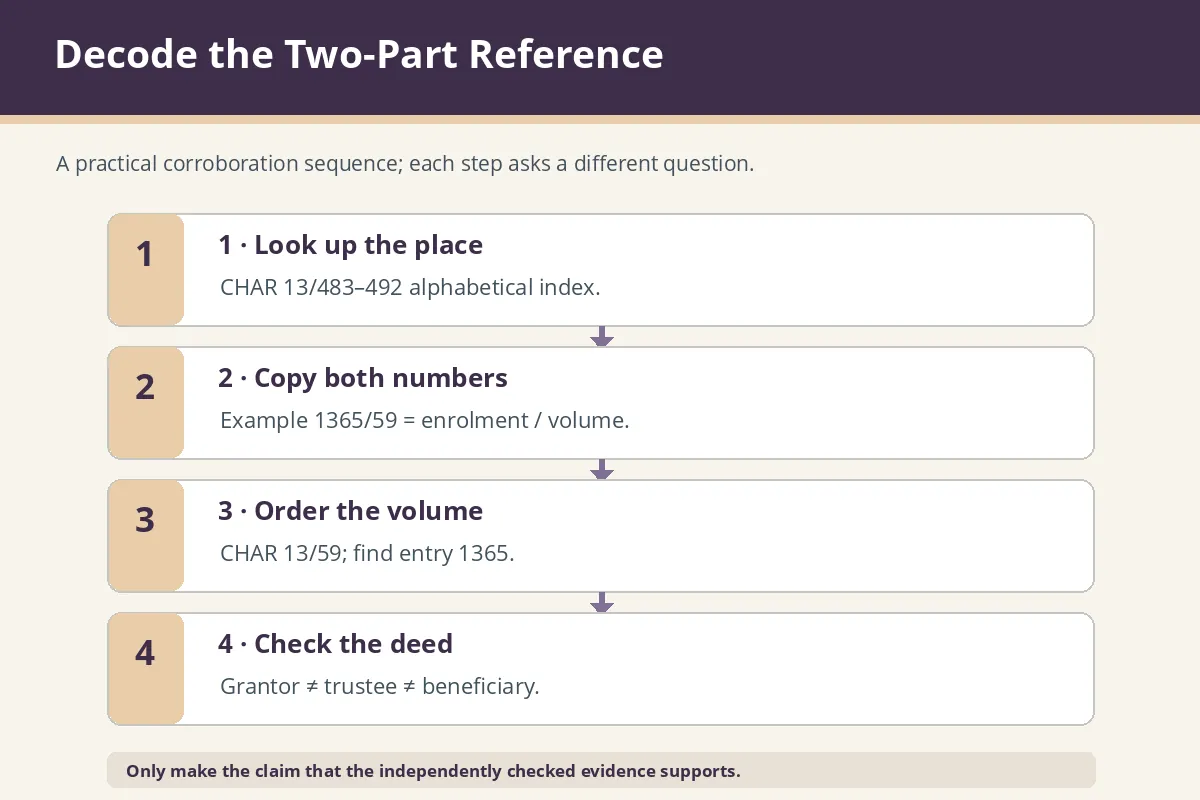
CHAR 13 is a set of 492 bound enrolment volumes and indexes, according to the official guide. The alphabetical place-name index is in CHAR 13/483–492. Start with the historical town or parish spelling and, where possible, a nearby locality or charitable purpose. The index can identify an entry without knowing the person who conveyed the land. However, it is an access tool, not a substitute for the language of the deed itself.
The National Archives gives the instructive example 1365/59. The first number, 1365, is the enrolment number; the second, 59, is the volume number, corresponding to a catalogue piece. To inspect that example, order CHAR 13/59 and find enrolment 1365 within it. Reversing these numbers points you at the wrong material. Record the pair exactly as printed and add the complete reference after finding the deed.
If you know a deed date instead of a place, use the relevant CHAR 13 enrolment volume’s covered dates and inspect the entries. Do not assume index alphabetization exactly matches a modern postal address. Land and buildings can belong to an older parish or have historical spellings. Search nearby place variants systematically and keep a note of which index volumes and years have been inspected.
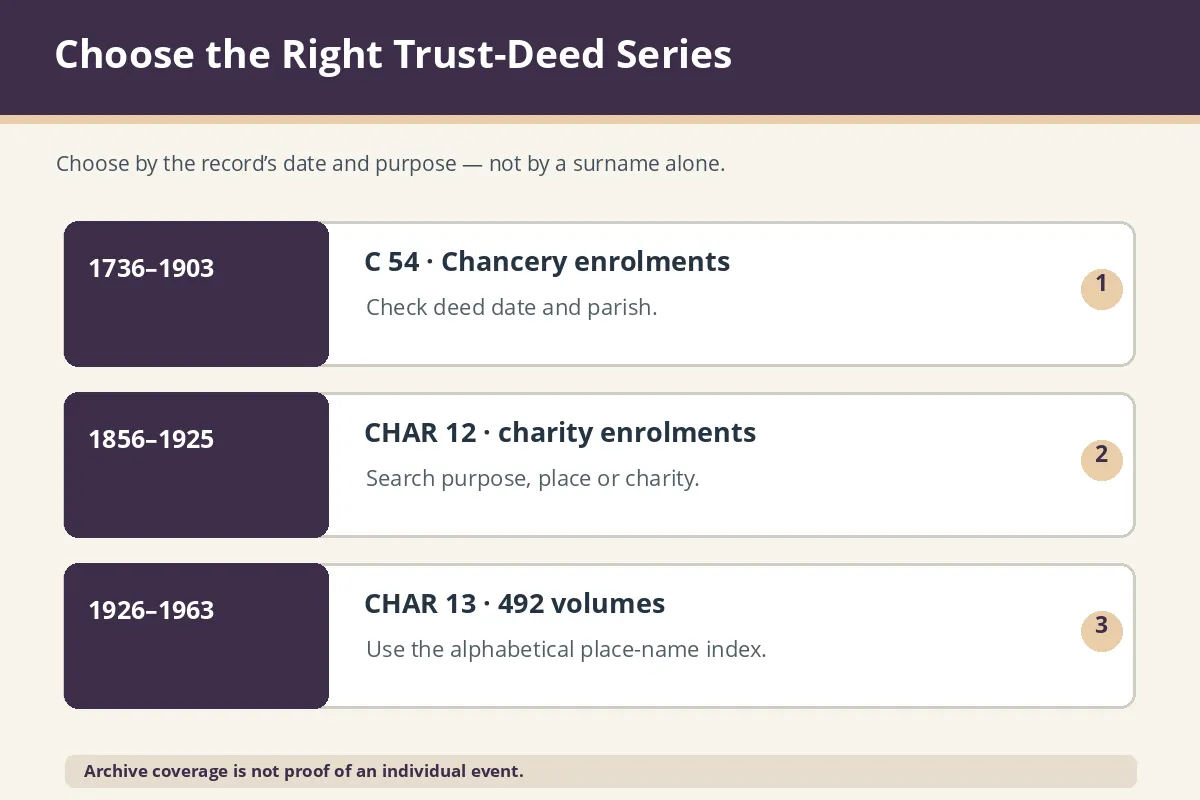
Choose C 54, CHAR 12 or CHAR 13 by Regime
For a deed from 1736–1903, Chancery Close Rolls C 54 may be relevant. For Charity Commission enrolments from 1856–1925, CHAR 12 is another route. The systems overlap because changes in law created different permitted or required forms of enrolment; they should be represented as alternate repositories, not as a chain in which every deed necessarily moves through all of them. Search the period and legal context first.
The 1925 legislation led to CHAR 13 enrolment from 1926. A historic deed in C 54 or CHAR 12 might be followed by later changes, but the absence of a later CHAR 13 hit does not automatically disprove the charity or landholding. Also distinguish an enrolled copy from an original property document retained by trustees or another institution. The legal relevance of any deed should be evaluated from its date, wording and surrounding record trail.
For school foundations, additional deeds may be found among education records, including ED 191 and school files. The National Archives elementary and primary schools guide confirms the cross-repository nature of these records. Do not transfer a school trustee’s surname directly into a student or staff list. Trustees, donors, managers, teachers and pupils are roles that require separately documented identities.
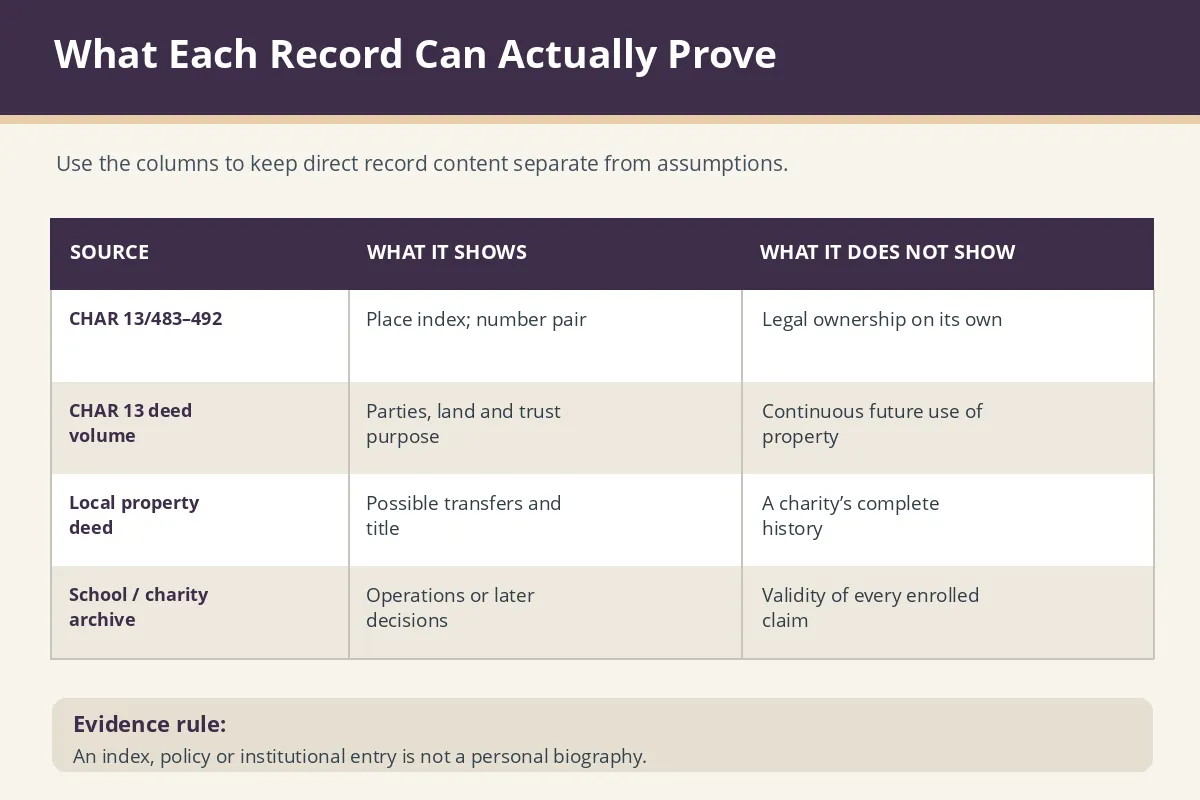
Transcribe Property, Parties and Restrictive Conditions
Create separate worksheet fields for grantor, trustees, any named replacement trustees, beneficiaries or charitable purpose, property description, date of execution and enrolment reference. An endowment may contain land, money or another asset; a map or lot description can be useful even if the building no longer stands. Do not treat an approximate historic location as a modern cadastral boundary until compared with other dated land evidence.
A trustee may hold legal title without occupying the premises, and a named donor need not have been a local resident. A deed naming an institution may not give a list of staff, students or beneficiaries. Pay particular attention to conditions on how the property could be used. If later records appear to contradict an original purpose, separate what was required by the trust document from what independent evidence shows actually happened.
Search local archives for subsequent conveyances, plans, meeting minutes, tax assessments or photographs. Those can document use, repair, transfer or demolition at distinct dates. Do not assume that an image of a later building depicts the exact structure described in an earlier deed. A property timeline should preserve name changes and uncertainty about the site, including a link to the evidence supporting each claimed stage.
Manage an Absence From the Index Honestly
A missing name in CHAR 13 can reflect the wrong period, an alternate parish spelling, a different enrolment route or incomplete identification of the charitable body. Write down the specific alphabetical index range, place variants and approximate years searched. An index-only search is not a legal conclusion that no trust existed. The trust deed may survive in the charity’s own papers or in a county record office instead.
Check the charity’s later records when reconstructing events after the deed date. The official guide notes that the Charity Commission’s files mostly concern its interactions with charities, not necessarily the charities’ complete internal archives. The archive trail can therefore be fragmented across legal enrolments and local institutional papers. Present the resulting history as a sequence of separately proven events rather than one assumed uninterrupted ownership story.
More House and Local History Guides
How We Research This Record Series
We begin with the institutional purpose and dated scope of each archival series, then trace the claims to the original record rather than relying on a search-result snippet. This guide was prepared using the linked custodian research guides, and catalogue descriptions should always be rechecked before a research visit. A series date range describes a group of surviving records, not guaranteed person-by-person coverage. We distinguish a named entry, an administrative statement, a corroborated identity and an unresolved inference; none should be silently substituted for another.
For this topic the custodian references are the primary National Archives guide and the complementary research guide. Access and reproduction arrangements may change; check the archive before ordering a copy. Read the affiliate disclosure for the site’s general relationships. No recommendation here requires a paid partner or presumes a commercial endorsement.
The National Archives identifies it in CHAR 13/483–492, arranged alphabetically by place.
1365 is the enrolment number and 59 is the volume; the volume is ordered as CHAR 13/59.
No. They record an enrolled deed; later title and use need later evidence.
CHAR 13 is the principal route for 1926–1963; CHAR 12 concerns earlier Charity Commission enrolments.
No. A trustee’s legal role is separate from residence or use of the property.