
Charity Commission record series CHAR 12 contains enrolled charitable trust deeds from 1856 to 1925. A deed can identify a donor, trustees, property and intended charitable purpose; it generally does not provide a roll of people who received aid or an unbroken list of later owners. Locate the right enrolment before making any family or property claim. This guide gives a precise source route, identifies what the archive can and cannot show, and names the independent documents needed before a personal or geographic conclusion becomes defensible.
Recognize a Charitable Gift, Not a List of Recipients
A charitable trust deed records a legal arrangement, not the day-to-day distribution of help. It usually names the grantor transferring property and trustees receiving responsibility for its charitable purpose. The land may have been intended for a school, place of worship, public recreation, housing or relief of poverty. The people helped may be described collectively, such as the poor of a parish, rather than named as individuals. When a surname appears in a deed, identify the capacity in which it appears before calling that person a relative of anyone else.
Copy the original property description in full: acreage, abuttals, street or field name, parish, county and any stated buildings. Historical deeds can describe land by neighbors or old plot names that changed later. A modern house number may be absent. The trust purpose is a separate claim from the identity of those who lived on or used the premises. A school trust could have existed before a school building was completed, and an intended beneficiary was not necessarily a documented pupil.
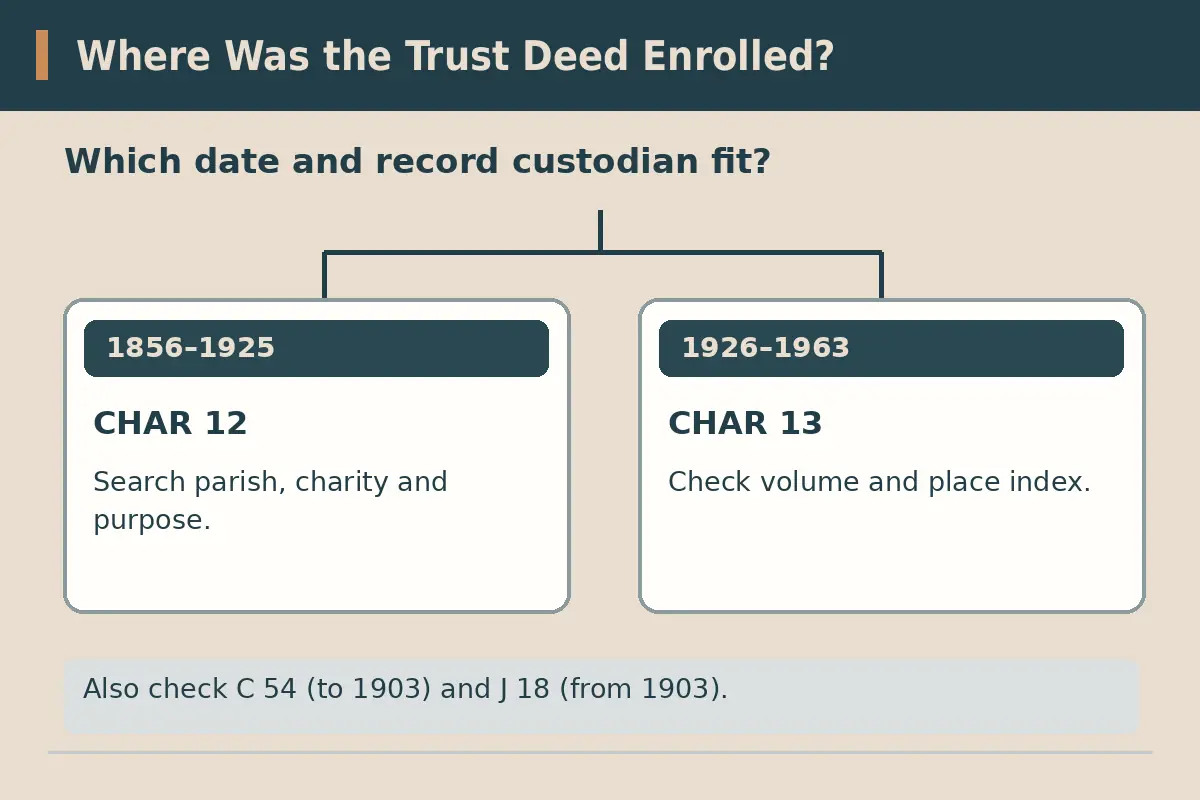
Use the 1856–1925 Enrolment Window Correctly
The National Archives explains that CHAR 12 records enrolments of deeds in the Charity Commission books for 1856–1925. A deed execution date and the date of enrolment are different events; the archive suggests enrolment often occurred within roughly six months of execution. Do not substitute the entry date for the exact date when the donor signed. Search an interval covering both possibilities. The official advanced-search method combines place, date, charitable object and purpose: a parish plus “school” or “recreation ground” may retrieve a different set of candidates from a charity name alone.
The legal routes overlap rather than forming a single replacement sequence. C 54 includes Chancery Close Roll charity conveyances for 1736–1903, while J 18 covers subsequent court enrolments, and CHAR 13 holds Charity Commission enrolments for 1926–1963. Deeds for certain schools may be located instead within Education Department records. The absence of one surname or school name from CHAR 12 therefore does not prove there was no trust. Record the precise scope searched before trying each other custodian.
Worked search example (hypothetical): you know that a recreation ground was said to have been given in an English parish around 1890. Search CHAR 12 for parish and county, then add “recreation” and a range from the late 1880s into the early 1890s. Note potential deeds before opening any item. Once the original is read, record the grantor and trustee names, any boundary descriptions and separately whether the ground was actually used as intended. The example illustrates search logic, not a discovered transaction.

Build a Claim-Level Deed Transcription
Create columns for original wording, document role, exact date, place and what the entry can establish. Write “grantor,” “trustee,” “witness” or “charitable beneficiary group” where supported, not the interchangeable term “owner.” Trustees hold legal responsibilities on behalf of the trust; that does not mean they privately enjoyed the charitable property. Witnesses may have known the parties, but signing near another person is not proof of kinship. If a deed names a previous conveyance, quote the source of that recital and seek the earlier instrument.
Make a separate property schedule for plots and boundaries. Record every neighboring occupier exactly as described, with no assumption that a boundary neighbor was an owner or family member. Compare the deed with successive large-scale maps, local rating books, land tax returns and later conveyances. A map might show a school where the trust deed describes only a plot; conversely a deed can describe a building that was later removed. Build a dated chronology rather than treating all records as if produced at the same moment.
Check Schools and Local Charities in Other Archives
For a historical school charity, the National Archives directs researchers to ED 21 for elementary school files, ED 29 for some building grants, ED 43 for estate-management material and ED 191 for enrolled deeds in the early twentieth century. Those records can show a school’s administrative development but should not be treated as full pupil registers. A local education archive, surviving school log, parish archive or trust minutes may answer a named-person question more directly. Search by historic institution name and keep changes of management in view.
For other charities, check whether the organization still exists and where it deposits historical records. The Charity Commission’s own files largely concern its interactions with charities rather than the entire local archive of each body. A trustees’ minute book or charitable account may contain recipients or payments not found in the foundational deed, although access may be restricted. Ask the repository for the document type and covering years instead of assuming every enrolled institution maintained identical volumes.

Record What an Unsuccessful Enrolment Search Means
A useful negative-search entry names the parish and neighboring spelling variants, the date interval, record series and query terms. Also record whether the online result was a catalogue description or a deed actually read. Some records may be accessible only by ordering copies or consulting the original in a reading room. A search of indexed names alone is not enough to claim that no relevant document survives. Catalogue item descriptions and indexes are aids to access, not full transcriptions of every person mentioned.
Finish with a narrow conclusion: “A deed enrolled in CHAR 12 records a gift of specified land to named trustees for a named charitable object” is a defensible finding when the deed has been read. “The donor’s descendants attended the school” is a different question requiring admissions, censuses or other person-level sources. Keep unresolved identities explicitly unresolved. This separation lets a local historian use a deed without silently converting a land transaction into a family tree.
A sound citation should identify the archive custodian, CHAR 12 volume or piece number, deed or folio details where given, parties, execution and enrolment dates, and whether you consulted an original, copy or catalogue description. This allows later historians to test the property description against changed streets and institutional names.
More House and Local History Guides
How We Research This Archive Series
This guide starts with the documented evidence in an authoritative source, not a claim that we have inspected a particular person’s private file or a specific original piece. The archival statements here concern the series or research method. A hypothetical example is labelled as such; it is not a newly discovered historical event. We use the Discovery search guidance to distinguish keyword matches from archive holdings and document contents, because catalogue descriptions do not transcribe every word of an original.
For every real candidate, record its historical place or person’s name, the creator, document type, date, full CHAR 12 piece or item reference, access restrictions, and the exact claim being tested. The official citation guide explains how to document those references so another researcher can retrace them. An unread document remains a catalogue lead, never proof of imagined details. If a record is missing, preserve the searched terms and dates and examine survival and alternate custodians before interpreting the gap.
Before sharing a conclusion, audit the difference between original source wording and your interpretation. Require independent evidence for any further claim about an individual, property owner, legal effect, or completed action. Respect archival access limits and living people’s privacy. This website also provides an affiliate disclosure; no paid partnership or commercial access is implied by these archival references.
It contains Charity Commission enrolments of charitable trust deeds dating from 1856 to 1925.
Not ordinarily. It chiefly records donor, trustees, property and charitable objects; beneficiary groups can be generic.
Yes. The National Archives recommends place, date, charitable purpose and object as alternative search terms.
CHAR 13 covers Charity Commission enrolments for 1926–1963; other court or local routes may also matter.
No. Compare actual construction or school-opening evidence with the conditions expressed in the deed.